Europe is updating the standards used to assess wood-burning sauna heaters. Under Commission Implementing Decision (EU) 2026/284[^1], the new EN 16510-2-10:2025 standard replaces EN 15821:2010[^2], with the transition period ending on February 9, 2027[^3].
For sauna equipment importers, hotel developers, and commercial buyers, this is an important change to understand before purchasing wood-fired sauna heaters for the European market.
But beyond compliance, how do you actually choose the right wood-burning sauna heater for your project? Let's look at both.
What's Changing in Europe's Wood-Burning Sauna Heater Standard?
The European Union has introduced a new harmonised standard, EN 16510-2-10:2025, covering certain manually operated, multi-firing sauna stoves that burn natural wood logs[^4].
The new standard updates how these appliances are assessed for safety, performance, and emissions[^5].
The Key Changes
| Area | Previous Standard | New Standard |
|---|---|---|
| Standard | EN 15821:2010 | EN 16510-2-10:2025 |
| Safety & performance | Existing assessment requirements | Revised requirements and assessment methods |
| Emissions | Previous testing framework | Updated methods covering particulate matter, NOx and hydrocarbons |
| Product assessment | Previous conformity framework | Updated classification and assessment provisions |
| Transition | Old standard remains applicable during coexistence | Coexistence ends February 9, 2027 |
One important development is the updated approach to emissions testing.
Wood-burning heaters produce combustion gases and particles. The new standard introduces or updates methods for measuring pollutants such as nitrogen oxides (NOx), hydrocarbons, and particulate matter.
This gives manufacturers a revised technical framework for evaluating wood-burning sauna stoves.
The change does not mean that wood-burning saunas are being banned in Europe[^6]. Nor does it mean that every previously installed stove must be replaced[^7].
It means manufacturers and suppliers need to review the conformity documentation and performance assessment of products being placed on the EU market.
When Does the New Standard Apply?
The EU has established a one-year coexistence period.
- February 9, 2026: The coexistence period begins.
- February 9, 2027: The coexistence period ends.
During the transition, the old and new standards coexist within the relevant EU harmonised standards framework.
After the coexistence period, the superseded standard no longer provides the same basis for presumption of conformity under that framework.
For buyers ordering products around this period, it is important to confirm which standard and supporting documentation apply to the exact model being supplied.
The standard specifically covers certain multi-firing sauna stoves burning natural wood logs. It does not automatically apply to electric sauna heaters, infrared heaters, or steam generators.[^8]
What Should EU Buyers Check?
Before placing an order, ask the supplier for:
- The exact heater model and product code.
- The applicable EN standard and product documentation.
- The relevant performance declaration and CE marking information.
- The manufacturer's installation and operating instructions.
- Confirmation of the product version intended for the destination market.
Remember that compliance with a product standard and compliance with local installation requirements are not necessarily the same thing. Chimney, fire-safety, and building requirements must also be checked in the destination country.
How to Choose the Right Wood-Burning Sauna Heater
Regulations are one consideration. The other is choosing a stove that actually fits the sauna room, installation conditions, and intended use.
Unlike electric heaters, wood-burning sauna stoves require a suitable chimney, combustion air supply, fuel handling, and space for safe operation.
Here are the main factors to compare.
1. Match the Heater to Sauna Room Volume
Start with the sauna's internal volume:
Length × Width × Height = Room Volume (m³)
Then check the manufacturer's recommended room-volume range.
For example, a sauna measuring 2 × 3 × 2.2 metres has an internal volume of 13.2 m³ before any adjustments.
Large glass surfaces, uninsulated walls, and other heat-loss factors can increase the effective heating requirement.
Do not select a stove simply because it appears powerful. Match the model to the manufacturer's specified room-volume range and the room construction.
2. Check Chimney Connections and Safety Distances
Wood-burning stoves need more installation planning than electric heaters.
Important specifications include:
- Flue outlet: Diameter and connection position.
- Safety clearances: Required distances from combustible walls, benches, and the ceiling.
- Floor protection: Requirements for combustible or heat-sensitive flooring.
- Combustion air: Adequate air supply for proper burning.
- Maintenance access: Space for loading firewood, removing ash, and cleaning.
The chimney system must be compatible with the chosen stove and installed according to local requirements.
3. Compare Stone Capacity and Firewood Requirements
Two wood-burning sauna heaters designed for similar room sizes may offer different heating experiences and operating requirements.
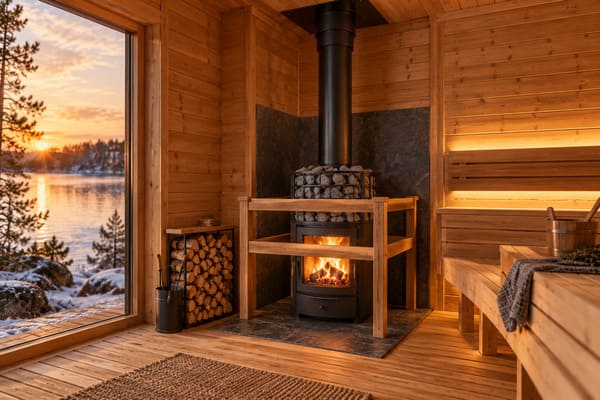
Stone capacity affects heat storage and how the stove responds when water is poured over the stones.
Maximum firewood length affects how easily staff can prepare and load fuel.
Firebox design and ash removal influence everyday operation and cleaning.
For a commercial sauna, these details matter just as much as the stove's appearance.
4. Compare the Complete Purchase Cost
A wood-burning sauna stove quotation may not include everything needed for installation.
| Item | What Buyers Should Confirm |
|---|---|
| Wood-burning stove | Exact model, dimensions and rated room volume |
| Sauna stones | Required size, weight and whether included |
| Chimney components | Compatible flue pipes and connection accessories |
| Floor and wall protection | Required protective components |
| Installation | Local chimney and fire-safety work |
| Documentation | Market-specific product and installation documents |
For hotels and outdoor resorts, fuel storage, ash removal, and regular chimney maintenance should also be included in the operating budget.
The lowest stove price is not necessarily the lowest total project cost.
Conclusion
Europe's updated wood-burning sauna stove standard introduces a new technical assessment framework, with the old standard's coexistence period ending on February 9, 2027.
For buyers, the practical approach is straightforward: confirm the product's applicable documentation, then choose a stove based on room volume, chimney requirements, safety clearances, stone capacity, and total installation cost.
A suitable wood-burning sauna heater should meet both the project's operating needs and the requirements of its destination market.
Planning a wood-burning sauna project or sourcing heaters in bulk?
ROC Sauna Solution works with international B2B buyers on sauna equipment sourcing and project specifications. Share your destination market, room dimensions, required models, and order quantity with our team to discuss available options and documentation.
Frequently Asked Questions
1. Will wood-burning sauna heaters be banned in the EU in 2027?
No. The February 2027 date concerns the end of the coexistence period between the old and new harmonised standards. It is not a general ban on wood-burning sauna heaters.
2. How do I choose the right size wood-burning sauna stove?
Calculate the room volume and compare it with the manufacturer's recommended heating range. Glass surfaces, insulation, ceiling height, and other heat-loss factors should also be considered.
3. What should I check before importing wood-burning sauna heaters into the EU?
Confirm the exact model, applicable standard, performance and conformity documentation, installation instructions, and destination-market requirements. Buyers should also confirm chimney compatibility and safety clearances before finalising the order.
[^1]: "COMMISSION IMPLEMENTING DECISION (EU) 2026/284 - EUR-Lex", https://eur-lex.europa.eu/legal-content/EN/TXT/HTML/?uri=OJ:L_202600284. Commission Implementing Decision (EU) 2026/284 is the legal act cited for the updated harmonised-standard listing for wood-burning sauna stoves, including the replacement relationship between EN 15821:2010 and EN 16510-2-10:2025. Evidence role: case_reference; source type: government. Supports: The EU update is made under Commission Implementing Decision (EU) 2026/284.. Scope note: The source establishes the EU harmonised-standards listing and dates, not commercial suitability of any individual heater model. [^2]: "Sauna heater manufacturers, please note: a new harmonised ...", https://www.szutest.cz/en/news/sauna-heater-manufacturers-please-note-a-new-harmonised-standard-is-now-in-force. The EU harmonised-standards notice identifies EN 16510-2-10:2025 as the successor entry for manually fired sauna stoves and gives EN 15821:2010 as the withdrawn superseded standard. Evidence role: historical_context; source type: government. Supports: EN 16510-2-10:2025 replaces EN 15821:2010 in the relevant EU harmonised-standards framework.. Scope note: The notice supports the harmonised-standard transition; the full technical comparison requires access to the standards themselves. [^3]: "EU Wood-Fired Sauna Heater Standard Changes on February 9, 2027", https://www.saunanews.com/article/eu-wood-fired-sauna-heater-standard-february-2027. The official EU listing gives 9 February 2027 as the date on which the superseded EN 15821:2010 entry ceases to provide the relevant harmonised-standard status. Evidence role: historical_context; source type: government. Supports: The transition period for the relevant wood-burning sauna heater standard ends on February 9, 2027.. Scope note: The date concerns the harmonised-standard coexistence period and should not be read as a market-wide prohibition date. [^4]: "https://cfpub.epa.gov/oarweb/woodstove/index.cfm?f...", https://cfpub.epa.gov/oarweb/woodstove/index.cfm?fuseaction=app.searchresults&manufacturersid=0&bturange=0%20BTUs%20%2D%20100000%20BTUs&efficiencytested=0%20%2D%20100&emissionrate=0%20grams%2Fhr%20%20%20%20%20%20%20%20%20%20%20%20%20%20%20%20%20%2D%2010%20grams%2Fhr%20%20%20%20%20%20%20%20%20%20%20%20%20%20%20%20&fireboxvolume=0%20Cubic%20Feet%20%2D%2010%20Cubic%20Feet&fireboxVolumeLower=0&fireboxVolumeUpper=10&heatoutputlower=0&heatoutputupper=100000&lu_appliancetypesid=5&lu_appliancesubtypesid=0&lu_fueltypesid=0&lu_testmethodsid=0&nspscompliance2020Only=off&recs2display=100&searchterms=&searchtype=advanced&z_outofproduction=0&sortby=COSort. The published scope information for EN 16510-2-10:2025 describes the standard as applying to manually fired sauna stoves using natural wood logs, supporting the article’s description of the covered appliance category. Evidence role: definition; source type: institution. Supports: EN 16510-2-10:2025 covers certain manually operated, multi-firing sauna stoves that burn natural wood logs.. Scope note: Scope summaries do not substitute for the complete standard text, which may contain exclusions and technical definitions. [^5]: "BS EN 16510-2-10:2025 - Multi-firing sauna stoves fired by ...", https://webstore.ansi.org/standards/bsi/BSEN16510102025. EN 16510 series documentation and the related EU harmonised-standard listing describe assessment provisions for residential solid-fuel appliances, including safety, performance, and emission characteristics relevant to sauna stoves. Evidence role: general_support; source type: institution. Supports: The new standard updates how wood-burning sauna stoves are assessed for safety, performance, and emissions.. Scope note: Public summaries support the categories of assessment, while the detailed test procedures are contained in the paid standard text. [^6]: "STN EN 16510-2-10 Multispaľovacie saunové pece na ...", https://normy.normoff.gov.sk/norma/140886/nahlad/. The EU notice concerns harmonised standards and withdrawal of a superseded standard entry, not a legal prohibition on wood-burning sauna appliances, so it supports the distinction between a standards transition and a ban. Evidence role: general_support; source type: government. Supports: The standards change does not mean wood-burning saunas are being banned in Europe.. Scope note: This is contextual support; separate EU, national, or local air-quality rules could still restrict use in specific places. [^7]: "The New Blue: EU Updates Key “Blue Guide” to Products Laws", https://products.cooley.com/2022/07/08/the-new-blue-eu-updates-key-blue-guide-to-products-laws/. EU product-compliance guidance distinguishes requirements for products placed on the market from rules for products already in service, supporting the point that a harmonised-standard update does not automatically require replacement of installed appliances. Evidence role: expert_consensus; source type: government. Supports: The standards transition does not automatically require every previously installed stove to be replaced.. Scope note: National safety inspections, insurance conditions, or local fire regulations may impose separate obligations for existing installations. [^8]: "EN 16510-2-10:2025 - Multi-Firing Sauna Stoves Standard ...", https://standards.iteh.ai/catalog/standards/cen/e8b411b4-6537-4bd3-808e-a2e0197ca450/en-16510-2-10-2025?srsltid=AU7gw4WJqX15w-rmUIWvc9ePRCR9T1GlmwMQ-puttucBovik6GGcKO31. The scope description for EN 16510-2-10:2025 identifies manually fired solid-fuel sauna stoves using wood logs, which supports the exclusion of electric, infrared, and steam sauna equipment from that standard’s direct scope. Evidence role: definition; source type: institution. Supports: EN 16510-2-10:2025 does not automatically apply to electric sauna heaters, infrared heaters, or steam generators.. Scope note: Those other product types may be covered by different EU directives, regulations, or standards.