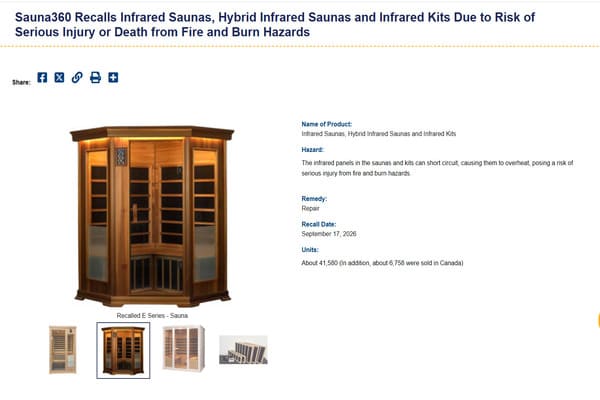
On 17 September 2026, the U.S. Consumer Product Safety Commission and Health Canada announced a recall of infrared saunas, hybrid infrared saunas and infrared kits made by Sauna360, affecting about 41,580 units in the United States and roughly 6,758 more sold in Canada. The recall covers products sold under the Finnleo, Tylo, Polar, Radiant Health and Helo brand names, and the reason is specific: the infrared panels can short circuit and overheat, creating a risk of fire and burns.
For hotels, spas, gyms and other commercial projects that are buying or already operating sauna equipment, a recall like this raises a fair question that goes beyond any single brand: beyond name, appearance and price, what should we actually be checking about the products and the supplier behind them? This article walks through what happened, why the panels were recalled, what a well-built infrared sauna actually looks like, and — most usefully for a commercial buyer — what to verify before you place your next order for a commercial infrared sauna.
Sauna360 Recall: What Happened and Which Products Are Affected
The essentials, drawn directly from the official notices, are worth stating plainly.
The Sauna360 recall was announced on 17 September 2026 by the U.S. CPSC and Health Canada. It covers infrared saunas, hybrid infrared saunas and infrared kits sold under five brands — Finnleo, Tylo, Polar, Radiant Health and Helo — with about 41,580 units affected in the United States and around 6,758 in Canada. The hazard is that the infrared panels can short circuit and overheat, posing fire and burn risks. The official remedy is repair: consumers are told to immediately stop using the recalled product and contact Sauna360 to arrange a free in-home repair by a professional installer.
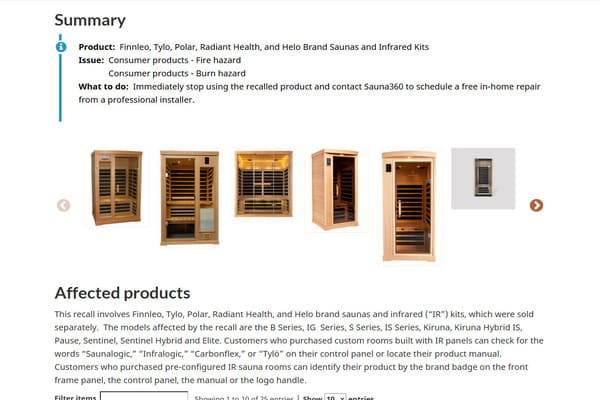
If you operate or are buying any infrared sauna, the first step is to check whether your unit is in scope. According to the notices, affected models include the B Series, IG Series, S Series, IS Series, Kiruna, Kiruna Hybrid IS, Pause, Sentinel, Sentinel Hybrid and Elite. Buyers of custom rooms built with IR panels can look for the words "Saunalogic," "Infralogic," "Carbonflex" or "Tylö" on the control panel or in the product manual, while pre-configured rooms can be identified by the brand badge, control panel, manual or logo handle. The full model list is published on the official CPSC recall page and the corresponding Health Canada recall notice.
If you own an affected product, the recommended action is clear and comes first: stop using it and contact Sauna360 to arrange the free repair. Nothing in this article replaces that official instruction — the manufacturer's recall process is the correct route for anyone with a recalled unit. What follows is guidance for buyers thinking about their next purchase, not a substitute for the recall remedy.
Why Were the Infrared Panels Recalled?
Understanding the cause helps a buyer ask better questions — without over-reading it.
The recall was issued because the infrared panels in the affected saunas and kits can short circuit, causing them to overheat and creating a risk of fire and burns. This is the specific, officially confirmed fault. It relates to the infrared heating panels themselves — the components that warm the body directly — rather than to sauna heating as a whole.
It's worth separating two things here:
- What the recall officially confirms — the notices state that the infrared panels can short circuit and overheat. That is the documented issue, and it's sensible to take it at face value rather than speculating about root causes such as materials, wiring age or manufacturing process, which the official notices do not assign.
- What it prompts a buyer to check — a fault involving electrical short circuits and overheating naturally draws attention to electrical safety, thermal protection, component matching and installation. These are useful areas to review with any supplier, but reviewing them is not the same as concluding they were the confirmed cause of this event.
One more point of scope: the recall targets specified products and their infrared panels. It is not a verdict on all infrared saunas, all infrared sauna heater designs, or on traditional sauna heaters generally. Infrared saunas remain a widely used category; the question for a commercial buyer isn't "is infrared sauna technology unsafe?" but "how do I verify that the specific product and supplier I'm considering are built and backed properly?"
What Does a Good Infrared Sauna Actually Look Like?
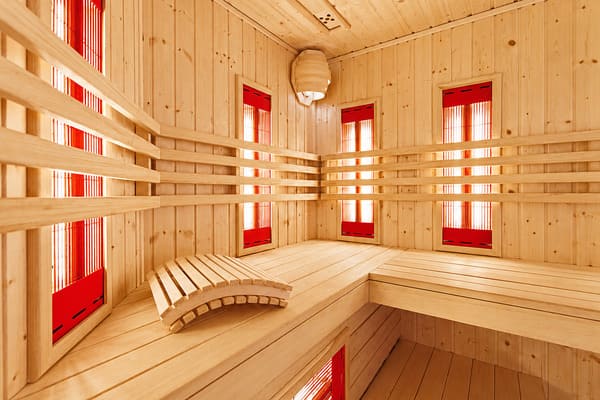
If the recall tells us what can go wrong, it's worth turning the question around: what does a well-built infrared sauna look like? For a commercial buyer, "good" isn't about looks — it's about the panels, the electrical build, the controls and the safety features working reliably under daily use.
A good commercial infrared sauna has well-made infrared panels with sound electrical construction and proper thermal protection, so they heat reliably without short circuits or overheating. It uses quality carbon or ceramic infrared heating elements matched to the room size, a reliable controller with accurate temperature regulation and cut-off protection, adequate ventilation, and certified components suitable for the installation country. Just as important, it comes with clear documentation — certification, test results and specifications — and dependable spare-parts and after-sales support, because a commercial sauna runs for hours every day and every part must withstand that duty cycle.
Concretely, when you're judging whether an infrared sauna is well built, these are the marks of quality worth looking for:
- Sound infrared panels — quality infrared heating elements (carbon or ceramic) with proper wiring and thermal protection, so the infrared sauna panels heat evenly and safely rather than being a weak point.
- Reliable control and cut-off — an accurate controller with temperature regulation and over-temperature protection, so the sauna can't run away with itself.
- Right power for the room — an infrared sauna heater output matched to the room volume, not over- or under-specified, on the correct voltage and phase.
- Certification and documentation — components and the finished product certified and documented for the country of installation, with test results you can review.
- Ventilation and materials — adequate airflow and sauna-grade materials that tolerate repeated heating cycles.
- Serviceability — accessible components, available spare parts, and a clear warranty, so the sauna stays safe and operational over years of commercial use.
In short, a good infrared sauna is one whose safety and performance you can verify — in the panels, the electrics, the controls and the paperwork — rather than assume from the brand name. That principle leads directly into the checklist below.
What Should Commercial Buyers Check Before Ordering?
This is where a recall becomes genuinely useful — as a checklist for your next purchase. For a commercial infrared sauna that will run for hours every day, four areas matter most.
Before ordering a commercial infrared sauna, buyers should check four things. First, product documentation and market fit: does the specific model come with technical files, test results or certification, and is it suitable for your country's requirements? Second, equipment and power matching: do the room volume, power rating, voltage, phase and controller configuration all correspond correctly? Third, installation and safety protection: what are the requirements for safety clearances, sensor placement, ventilation and protective features? Fourth, maintenance and after-sales: how are spare parts sourced, what does the warranty cover, and who is responsible for installation, inspection and technical support?
| Check area | What to confirm |
|---|---|
| Documentation & market fit | Which technical files, test results or certifications does the model carry? Is it suitable for the country where it will be installed? |
| Equipment & power matching | Do room volume, power, voltage, phase and controller configuration all correspond? |
| Installation & safety | What clearances, sensor positions, ventilation and protective features are required? |
| Maintenance & after-sales | How are spare parts obtained? What does the warranty cover? Who handles installation, inspection and support? |
These aren't reactions to one recall — they're the questions that separate a well-specified commercial installation from a problem waiting to happen, whatever the brand. Getting satisfactory answers on infrared sauna safety, certification and after-sales support before you commit is simply good procurement.
Once you've clarified the project's actual requirements, comparing brands, models and quotes becomes meaningful — because the choice rests on verifiable information rather than brand impression or price alone.
Harvia and ROC: Equipment Options for Different Project Needs
With the project requirements clear, here's how two ranges we work with fit different commercial needs.
Harvia: Finnish Sauna Expertise Since 1950
Harvia is a leading Finnish sauna manufacturer founded in 1950, bringing more than 75 years of accumulated sauna experience to its equipment. For a commercial buyer, that heritage is useful background — but the practical value is in the specifics: the models we can supply, the matching control options, and the product documentation available for each. Brand history sets the context; it doesn't, on its own, remove the need to confirm that a given model suits your room size, power supply and installation conditions. We can help you review those details model by model.
ROC: Equipment Selection Around Your Project
Alongside Harvia, ROC Sauna-Solution manufactures its own-brand ROC range, including the ROC infrared series built for spectrum rooms and infrared cabins. Rather than positioning ROC as a low-cost alternative, we present it as a set of equipment options with defined parameters and supply conditions you can verify: the structure and materials of a given model, its power configuration, control method, maintenance access and warranty terms. Where useful, we also help clients compare equipment configuration, project budget and ongoing maintenance needs, so ROC can serve as one clearly specified option matched point-by-point to your project's actual requirements.
How We Support Your Commercial Sauna Project
Beyond having products, here's the work we help commercial buyers actually get done.
For a commercial infrared sauna project, our role is to help you move from requirements to a specified, supportable installation. Based on your project conditions, we help compile a list of suitable models, compare configurations and budgets, provide the corresponding technical documentation and quotes, and set out the scope of delivery and after-sales support. Because we both manufacture the ROC range and act as a HARVIA-authorised agent, we can match equipment to your project rather than fit your project to whatever's on hand — and pair your chosen equipment with the right control system.
To get the most useful response, it helps to tell us: the country where the sauna will be installed, the sauna room dimensions, the intended use and duty cycle, the available voltage and phase, and your purchase quantity and budget. With those details, we can specify appropriate options and provide the documentation to support them.
Conclusion
A recall is unsettling, but for a commercial buyer it's also clarifying. The 2026 Sauna360 recall — covering Finnleo, Tylo, Polar, Radiant Health and Helo infrared products because their panels can short circuit and overheat — is a reminder that brand, appearance and price are only part of the picture. Anyone with an affected unit should follow the official remedy first: stop using it and contact Sauna360 for the free repair. And anyone planning a new purchase can turn the moment into better procurement by knowing what a good infrared sauna looks like and checking documentation and market fit, power matching, installation and safety, and after-sales support before ordering. Specify a commercial infrared sauna on that basis, from a supplier who can show you the details, and you build your decision on information you can verify.
Planning a commercial infrared sauna and want equipment matched to your project — with the technical documentation, certification and after-sales support to back it up? Talk to ROC Sauna-Solution about your project, and we'll help you specify suitable options from our own ROC range and HARVIA. Start your enquiry here. You can also ask our AI assistant your infrared sauna questions.
Frequently Asked Questions
What is the 2026 Sauna360 recall about? On 17 September 2026, the U.S. CPSC and Health Canada announced a recall of infrared saunas, hybrid infrared saunas and infrared kits made by Sauna360, sold under the Finnleo, Tylo, Polar, Radiant Health and Helo brands. About 41,580 units were affected in the United States and around 6,758 in Canada. The reason is that the infrared panels can short circuit and overheat, creating a risk of fire and burns. The official remedy is a free repair: consumers are advised to immediately stop using the recalled product and contact Sauna360 to arrange an in-home repair by a professional installer. For the full list of affected models, refer to the official CPSC and Health Canada notices.
How do I know if my infrared sauna is affected? Check whether your product matches the affected models listed in the official notices, which include the B Series, IG Series, S Series, IS Series, Kiruna, Kiruna Hybrid IS, Pause, Sentinel, Sentinel Hybrid and Elite. Buyers of custom rooms built with infrared panels can look for the words Saunalogic, Infralogic, Carbonflex or Tylö on the control panel or in the product manual. Buyers of pre-configured infrared sauna rooms can identify their product by the brand badge on the front frame panel, the control panel, the manual or the logo handle. If your unit is affected, stop using it and contact Sauna360 for the free repair. Always confirm against the official CPSC and Health Canada recall pages.
Are infrared saunas safe after this recall? This recall applies to specified Sauna360 products whose infrared panels can short circuit and overheat — it is not a judgment on all infrared saunas or all infrared heating technology. Infrared saunas remain a widely used category. That said, the recall is a useful reminder to check infrared sauna safety properly before buying: confirm the product's certification and test documentation, that it suits your country's requirements, that power and controls are correctly matched, that installation clearances and protective features are specified, and that warranty and after-sales support are clear. Safety comes from verifying the specific product and supplier, not from brand name or price alone — and any recalled unit should always follow the official remedy first.
What makes a good commercial infrared sauna? A good commercial infrared sauna has well-made infrared panels with sound electrical construction and thermal protection, so they heat reliably without short circuits or overheating. It uses quality carbon or ceramic infrared heating elements matched to the room size, a reliable controller with accurate temperature regulation and over-temperature cut-off, adequate ventilation, and certified components suitable for the installation country. It should also come with clear documentation — certification, test results and specifications — plus dependable spare-parts availability and after-sales support. Because a commercial sauna runs for hours every day, every component must withstand that duty cycle. In short, a good infrared sauna is one whose safety and performance you can verify in the panels, electrics, controls and paperwork, rather than assume from the brand name.
What should I check before buying a commercial infrared sauna? Focus on four areas. First, documentation and market fit: what technical files, test results or certifications does the specific model carry, and is it suitable for your country? Second, power matching: do room volume, power rating, voltage, phase and controller configuration all correspond? Third, installation and safety: what clearances, sensor positions, ventilation and protective features are required? Fourth, maintenance and after-sales: how are spare parts sourced, what does the warranty cover, and who is responsible for installation, inspection and technical support? A commercial infrared sauna runs for hours daily, so confirming these points before ordering — rather than relying on brand or price — is what protects both safety and your investment.
References
- U.S. Consumer Product Safety Commission (CPSC) — Sauna360 recall notice. https://www.cpsc.gov/Recalls/2026/Sauna360-Recalls-Infrared-Saunas-Hybrid-Infrared-Saunas-and-Infrared-Kits-Due-to-Risk-of-Serious-Injury-or-Death-from-Fire-and-Burn-Hazards
- Health Canada — Finnleo, Tylo, Polar, Radiant Health and Helo brand saunas and infrared kits recall. https://recalls-rappels.canada.ca/en/alert-recall/finnleo-tylo-polar-radiant-health-and-helo-brand-saunas-and-infrared-kits-recalled-due
- Wikipedia — Infrared sauna. https://en.wikipedia.org/wiki/Infrared_sauna
- Wikipedia — Product recall. https://en.wikipedia.org/wiki/Product_recall
- Wikipedia — Short circuit. https://en.wikipedia.org/wiki/Short_circuit
- Wikipedia — Infrared heater. https://en.wikipedia.org/wiki/Infrared_heater
- Wikipedia — Electrical safety. https://en.wikipedia.org/wiki/Electrical_safety
- Wikipedia — Sauna. https://en.wikipedia.org/wiki/Sauna