Choosing a sauna heater isn't just about power output — the type and mounting style you pick shapes your floor space, your safety clearances, your maintenance workload, and even whether the heater becomes a design feature or disappears into the wall. Most guides sort heaters only by kilowatts; this one sorts them the way a commercial buyer actually decides: by energy source and by how they're mounted. This guide walks you through the main sauna heater types, what each one costs you in space and upkeep, and which fits a hotel, spa, gym, or compact room — so you specify the right heater the first time instead of discovering the wrong fit after installation.
Sauna heater types divide two ways: by energy source and by mounting style. By energy source, the main types are electric heaters (the most common for commercial use, easy to control and install), wood-burning heaters (traditional, needing a flue), combi heaters (electric heaters that also produce steam), and infrared panels (which heat the body directly rather than the air). By mounting style, heaters are wall-mounted (space-saving, ideal for smaller rooms), floor-standing (higher-powered, for larger commercial saunas), and designer or pillar heaters (floor-standing units built to be a visual centrepiece). For a commercial project, electric heaters dominate, and the choice between wall-mounted and floor-standing usually comes down to room size, power needs, and whether the heater should be a design feature. Match the type to your room size, duty cycle, and aesthetic, and you protect both performance and budget.

Sorting by Energy Source: Electric, Wood, Combi, Infrared
Start with the energy source, because it determines your infrastructure — power supply, flue, or water — before you even think about mounting.
The four main sauna heater types by energy source are electric, wood-burning, combi, and infrared. Electric heaters are the standard for commercial saunas because they're easy to control, quick to heat, require no flue, and suit frequent use — most hotels, spas, and gyms use them. Wood-burning heaters deliver a traditional experience but need a flue, fuel handling, and more maintenance, which limits their commercial use to specific settings like rustic resorts. Combi heaters are electric units that can also pour water over separately heated stones or a water reservoir to add steam and humidity, giving guests a choice of dry or moist heat. Infrared panels heat the body directly rather than warming the air, operating at lower temperatures for a different kind of session. For most commercial projects, electric or combi heaters are the practical choice.
For a commercial buyer, the energy-source decision is really an infrastructure decision:
- Electric — the commercial default. No flue, precise control, fast heat-up, built for frequent duty cycles. This is what most projects specify.
- Wood-burning — authentic and atmospheric, but needs a flue, fuel storage, and hands-on maintenance. Right for a rustic destination resort, impractical for a busy urban spa.
- Combi — an electric heater with a steam function, letting one installation offer both dry sauna and humid löyly. Popular where you want to give guests variety from a single unit.
- Infrared — a fundamentally different experience, heating the body at lower air temperatures. Suits wellness and spectrum-room concepts rather than traditional hot saunas. Our ROC infrared series covers this category for spectrum rooms.
The overwhelming majority of commercial saunas run on electric sauna heaters for one reason: they're reliable and controllable under heavy, repeated use. Combi extends that with a steam option. Wood and infrared serve specific concepts. Settle the energy source first, then move to the decision that actually shapes your room — the mounting style.
Sorting by Mounting Style: Where the Real Decision Lives
This is the comparison most guides skip, and it's the one that determines your floor space, safety clearances, and whether the heater is seen or hidden.
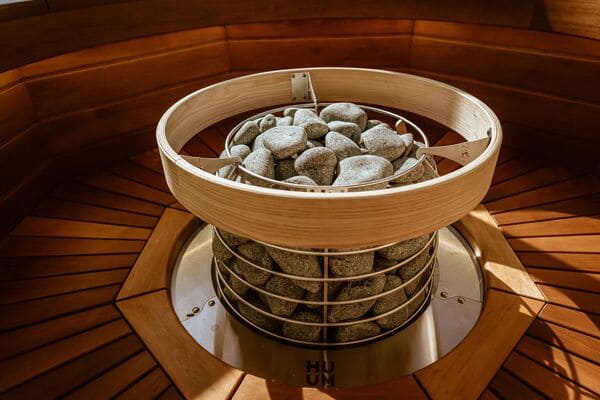
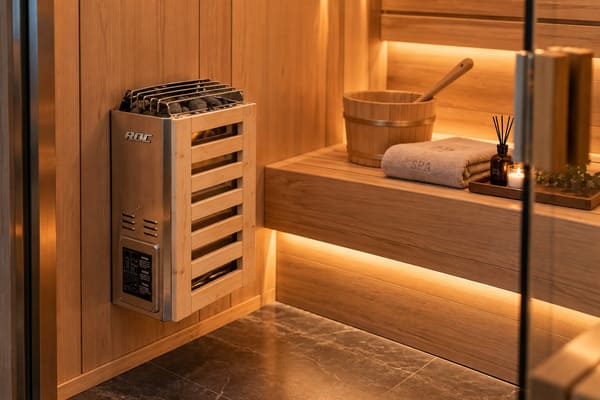
Sauna heaters mount in three main ways, each suiting different projects. Wall-mounted heaters attach to the sauna wall, keeping the floor clear — the space-saving choice for small and medium rooms and the most common commercial format. Floor-standing heaters sit on the floor, handle higher power outputs, and suit larger commercial saunas that need more heat and stone capacity. Designer or pillar heaters are floor-standing units styled to be a visual centrepiece, often with stones visible on all sides, chosen when the heater is part of the sauna's interior design. The right mounting style depends on your room size, the power you need, the floor space you can spare, and whether you want the heater to be a feature or stay discreet.
Here's how the mounting styles compare on the factors a buyer actually weighs:
| Factor | Wall-mounted | Floor-standing | Designer / Pillar |
|---|---|---|---|
| Floor space | Minimal (off the floor) | Needs floor footprint | Needs floor footprint |
| Power range | Lower–mid (small/medium rooms) | Higher (large rooms) | Mid–high |
| Stone capacity | Smaller | Larger (better löyly) | Larger, often visible |
| Best room size | Compact to medium | Large / commercial | Medium to large |
| Visual role | Discreet | Functional | Centrepiece feature |
| Guard rail | Recommended | Recommended | Often integral to design |
| Typical use | Hotels, gyms, compact spa | Large spa, commercial | Design-led premium spaces |
Wall-mounted heaters are the commercial workhorse: they keep the floor clear, suit compact and medium rooms, and are the easiest to fit around bench layouts. Our own ROC SCA (3–9 kW) and curved HX (4.5–16.5 kW) ranges cover this format, as does the popular Harvia The Wall with its minimal-space design. For very small VIP or apartment cabins, the compact ROC JM (3–3.6 kW) is sized to little rooms where a standard unit would overwhelm the space.
Floor-standing heaters step up the power and stone capacity for larger saunas that need serious, sustained heat — the choice for big commercial rooms. Our heavy-duty ROC SAV (10.5–36 kW) and the Harvia Virta floor-mounted range are built for exactly this kind of medium-to-large commercial duty.
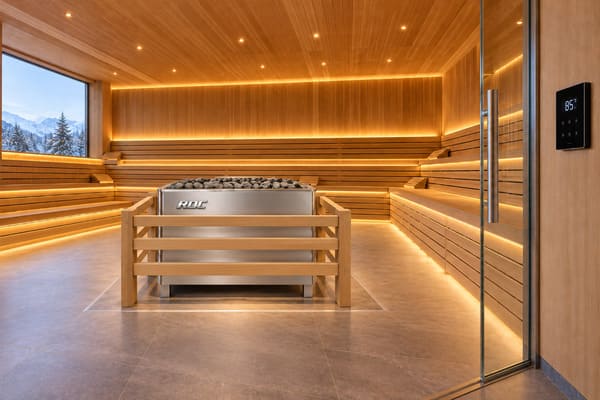
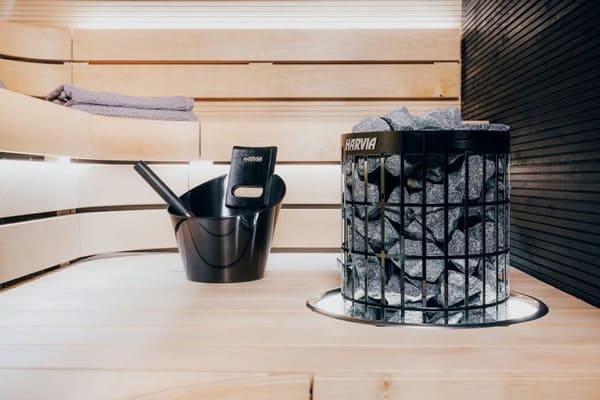
Designer/pillar heaters take a floor-standing core and dress it as a centrepiece, with stones often visible on every side, for projects where the sauna itself is part of the interior statement. Our ROC designer SA/YP series (10.5–18 kW) offers decorative casings for design-led rooms, while the cylindrical steel-mesh Harvia Cilindro exposes a large stone surface on all sides. Most buyers land on wall-mounted for standard rooms and floor-standing or designer for large or premium spaces.
The Decision Factors Behind Every Choice
Beyond space and power, several practical factors decide which heater actually works in your project — and they're where poor specification comes back to bite.
When choosing a sauna heater type, weigh floor space (wall-mounted saves it, floor-standing needs it), safety clearances (every heater needs minimum distances to walls, benches, and the guard rail — floor-standing units often need more room around them), stone capacity (more stones hold and release more heat for better steam, favouring floor-standing units), bench layout (the heater must fit the seating plan without compromising clearances), maintenance access (heaters and stones need periodic cleaning and inspection, so plan access), and duty cycle (commercial saunas run for hours daily, demanding commercial-grade heaters built for sustained use). Balancing these against your room size and budget is what determines the right heater — not power output alone.
For a commercial buyer, these are the factors that separate a heater that works from one that causes problems:
- Floor space & footprint — wall-mounted frees the floor; floor-standing and designer units claim it. In a tight room, this alone can decide the type.
- Safety clearances — every heater needs minimum distances to walls, benches, and a guard rail. Floor-standing units generally need more surrounding space; design this in early.
- Stone capacity — more stones mean better heat retention and steam quality. Floor-standing and designer heaters carry more, which is part of why large saunas favour them.
- Bench layout — the heater and its clearances must coexist with your seating plan. Getting this wrong wastes capacity or compromises safety.
- Maintenance access — stones and elements need periodic inspection and cleaning; a heater you can't easily reach becomes an operational headache.
- Duty cycle — this is the big one for commercial buyers. A sauna running many hours a day needs a commercial sauna heater built for sustained, repeated use, paired with a reliable control system. Home-grade units fail fast under that load.
Notice that power output — the thing most spec sheets lead with — is only one input. The real decision balances all of the above against your room and budget. That's why the same buyer might choose a compact wall-mounted heater for a hotel room sauna and a heavy floor-standing unit for the main spa.
Which Heater Fits Which Project
Pulling it together, here's how the types map to the commercial settings you're most likely planning.
Matching heater type to project: hotels typically use wall-mounted electric heaters in guest and amenity saunas, saving space and running reliably. Spas often combine floor-standing or designer heaters in larger feature saunas with combi heaters where steam variety is wanted. Gyms and fitness clubs favour robust wall-mounted or floor-standing electric heaters built for heavy daily use. Compact spaces — small apartment, VIP, or boutique saunas — suit small wall-mounted heaters sized to little rooms. Large commercial saunas need high-power floor-standing heaters with the stone capacity for sustained heat. In every case, the heater must be commercial-grade to withstand the duty cycle, with the type chosen to fit the room's size, use, and design intent.
The practical mapping, by setting:
- Hotels — compact-to-medium wall-mounted electric heaters for guest and amenity saunas: space-saving, reliable, discreet.
- Spas — often floor-standing or designer heaters as feature units in the main sauna, with combi heaters where guests want a steam option.
- Gyms & fitness clubs — robust wall-mounted or floor-standing electric heaters built for heavy, all-day traffic.
- Compact / VIP / apartment saunas — small wall-mounted heaters matched to little rooms, where a standard unit would overwhelm the space.
- Large commercial saunas — high-power floor-standing heaters with large stone capacity for sustained, powerful heat.
Across all of them, the constant is the duty cycle: commercial saunas run hard, every day, so whatever the type, the heater must be commercial-grade. Within that constraint, you match the type to the room's size, traffic, and design intent — and that's the whole decision in one line.
How ROC Sauna-Solution Equips Every Project
For a commercial buyer, having both an own-brand heater range and access to a top global brand means you can match any project without compromise.
ROC Sauna-Solution is both an OEM/ODM manufacturer of our own-brand ROC sauna heaters and a HARVIA-authorised agent, giving commercial buyers a complete range across every heater type and mounting style. Our own ROC range covers wall-mounted electric heaters — the SCA workhorse (3–9 kW), the curved HX (4.5–16.5 kW), the flocked-panel SE/SK/SD (2.2–20 kW), and the compact JM (3–3.6 kW) for small VIP and apartment saunas — plus floor-standing units in the heavy-duty SAV (10.5–36 kW) for large commercial rooms, the designer SA/YP series (10.5–18 kW) when the heater is a centrepiece, and ROC infrared panels for spectrum rooms. Alongside these we supply HARVIA heaters, all CE-certified and built for commercial duty cycles. Whatever your room size, power need, and design intent, we can specify the right type from a single source.
Because we manufacture our own heaters and represent HARVIA, we can genuinely match the heater to your project rather than fit your project to whatever's in stock. Browse the full ROC sauna heater range to see every series, from the flocked-panel SE/SK/SD to our designer and floor-standing units, and pair your chosen heater with the matching control system for your project. Tell us your room size, expected traffic, and design intent, and we'll specify the right type — wall-mounted, floor-standing, designer, or infrared — from our own ROC range and HARVIA.
Conclusion
The right sauna heater is rarely just the most powerful one — it's the type and mounting style that fits your room, your traffic, and your design. Settle the energy source first: electric for most commercial projects, combi where you want steam, wood or infrared for specific concepts. Then make the decision that actually shapes your space — wall-mounted to save floor area in compact and medium rooms, floor-standing for the power and stone capacity a large sauna needs, or a designer heater when it should be a centrepiece. Weigh clearances, stone capacity, bench layout, maintenance access, and above all the commercial duty cycle, and match the type to the setting — hotel, spa, gym, or compact room. Specify it this way, from a supplier who can offer the full range of types, and you get a heater that performs, lasts, and fits the first time.
Choosing sauna heaters for a commercial project and want the right type matched to each room — wall-mounted, floor-standing, designer, or infrared, in commercial-grade quality? Talk to ROC Sauna-Solution about your project, and we'll help you specify the right heater from our own ROC range and HARVIA. Start your enquiry here. You can also ask our AI assistant your sauna heater questions.
Frequently Asked Questions
What are the main types of sauna heaters? Sauna heaters divide two ways. By energy source, the main types are electric (the commercial standard — easy to control, no flue, quick to heat), wood-burning (traditional but needing a flue and more maintenance), combi (electric heaters that also produce steam for dry-or-moist flexibility), and infrared panels (which heat the body directly at lower air temperatures). By mounting style, heaters are wall-mounted (space-saving, for small and medium rooms), floor-standing (higher-powered, for larger saunas), and designer or pillar heaters (floor-standing units built as a visual centrepiece). Most commercial projects use electric heaters, choosing between wall-mounted and floor-standing based on room size, power needs, and design intent.
Wall-mounted or floor-standing sauna heater — which is better? Neither is universally better; it depends on your room and needs. Wall-mounted heaters attach to the wall and keep the floor clear, making them the space-saving choice for small and medium rooms and the most common commercial format — ideal for hotels, gyms, and compact saunas. Floor-standing heaters sit on the floor, handle higher power outputs, and carry more stones for better sustained heat, suiting large commercial saunas. They need more surrounding floor space and clearance. As a rule, choose wall-mounted for compact and medium rooms where space is tight, and floor-standing for large rooms that need more power and stone capacity. Room size and power requirements usually decide it.
Do commercial saunas need a special type of heater? Yes — commercial saunas need commercial-grade heaters regardless of type or mounting style. A commercial sauna runs for many hours daily under heavy, repeated use, which demands heaters with the durability, heating elements, and build quality to withstand that duty cycle. Specifying home-grade equipment for commercial use is a false economy: it wears out faster and generates complaints and replacement costs. Both wall-mounted and floor-standing electric heaters are available in commercial-grade versions, so you can choose the mounting style that fits your room while ensuring the heater is built for the load. Matching commercial-grade construction to the actual duty cycle protects both performance and your investment.
What is a designer or pillar sauna heater? A designer or pillar sauna heater is a floor-standing heater built to be a visual centrepiece of the sauna, rather than a purely functional unit. These heaters often display their stones on all sides or feature decorative casings — polished, ribbed, or perforated stainless steel — so the heater becomes part of the room's interior design. They typically deliver mid-to-high power for medium and large saunas and use a separate control unit. Designer heaters are chosen for premium, design-led projects where the sauna itself is a feature of the space, such as high-end spas and signature wellness areas, rather than for utilitarian installations where a discreet wall-mounted heater would do.
Which sauna heater type is best for a hotel or spa? It depends on the specific sauna. Hotels typically use compact-to-medium wall-mounted electric heaters in guest and amenity saunas, because they save floor space, run reliably, and stay discreet. Spas often use floor-standing or designer heaters as feature units in a larger main sauna, and may add combi heaters where guests want the option of steam. In both cases the heater must be commercial-grade to handle daily use. The best choice is the type that fits the room's size, expected traffic, and design intent — a space-saving wall-mounted unit for standard rooms, and a higher-powered floor-standing or designer heater for large or premium feature saunas.
References
[^1]: Wikipedia — Sauna. https://en.wikipedia.org/wiki/Sauna [^2]: Wikipedia — Kiuas (sauna stove). https://en.wikipedia.org/wiki/Kiuas [^3]: Wikipedia — Electric heating. https://en.wikipedia.org/wiki/Electric_heating [^4]: Wikipedia — Infrared heater. https://en.wikipedia.org/wiki/Infrared_heater [^5]: Wikipedia — Löyly. https://en.wikipedia.org/wiki/L%C3%B6yly [^6]: Wikipedia — Wood-burning stove. https://en.wikipedia.org/wiki/Wood-burning_stove [^7]: Wikipedia — Thermostat. https://en.wikipedia.org/wiki/Thermostat [^8]: Wikipedia — Stainless steel. https://en.wikipedia.org/wiki/Stainless_steel