In most commercial sauna projects the heater gets all the attention — and the control unit is treated as an afterthought. Then problems appear: the controller can't handle the heater's power, the voltage doesn't match, or the hotel wants central management but the system has no Wi-Fi. A sauna heater and its control unit should be specified together, as one system, at the buying stage.
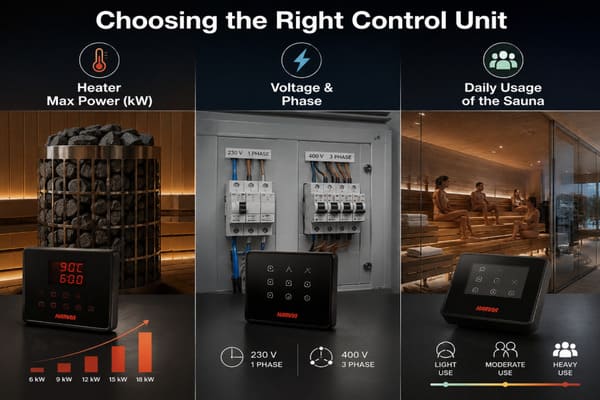
The choice of a commercial sauna control unit is driven by three things: the heater's maximum power in kilowatts, the voltage and phase of the supply, and how the sauna is used day to day. The controller must support the heater's kW rating; heaters above that limit need a separate power unit; three-phase supplies need a matching controller; and continuous commercial operation, scheduling, and remote or Wi-Fi management all shape which control unit is right. This guide helps hotels, spas, gyms, and commercial buyers match the control system to heater power, electrical supply, and operating requirements.
What Does a Sauna Control Unit Actually Control?
Before choosing one, it helps to know what the unit does — and why sometimes you can't avoid buying a separate one.
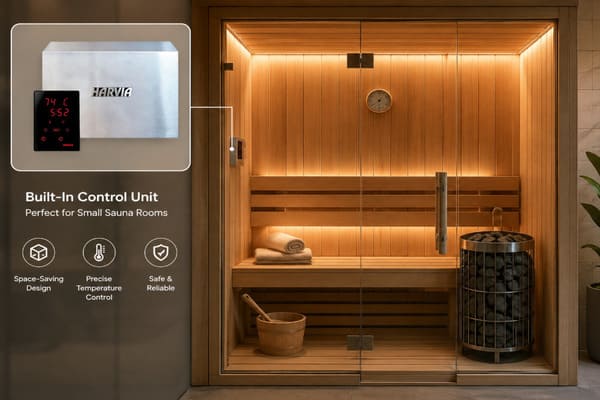
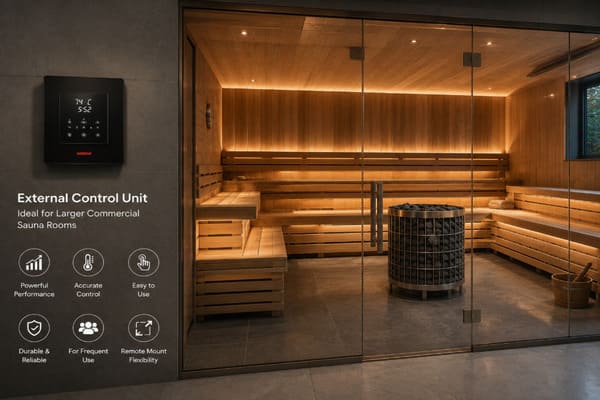
A sauna control unit manages temperature, operating time, and safety cut-offs, and on many models also controls lighting, ventilation fans, scheduling, and — on combi systems — steam and humidity. Some heaters have controls built in; larger commercial heaters require an external control unit mounted outside the hot room.
The temperature and time limits a control unit enforces are not arbitrary — they follow the dedicated safety standard for sauna heating appliances, IEC 60335-2-53.[^1] The other key decision is built-in versus external control. Small heaters often integrate the controls into the heater body, which is simpler but limited. Commercial heaters, especially higher-output units, almost always require an external control unit plus, in many cases, a separate power unit — because the current involved is too high to switch through a compact built-in control. According to Harvia, most of its commercial heaters are paired with a dedicated control unit for exactly this reason.
Built-In vs External Controls: Which Is Better for Commercial Use?
This is the first fork in the road, so it's worth seeing the trade-offs side by side.
Built-in controls suit small, simple saunas, while external controls are the standard for commercial use because they support higher power, scheduling, remote management, and easier servicing. For hotels, spas, and gyms, an external control unit is almost always the right choice.
| Built-in Control | External Control | |
|---|---|---|
| Installation | Simpler | More components |
| User interface | On the heater | Separate panel |
| Commercial management | Limited | Usually better |
| Scheduling | Depends on model | More options |
| Remote functions | Limited / model-dependent | More options |
| Best for | Smaller / simple projects | Hotels, spas, gyms |
Match the Controller to Heater Power (kW)
This is the core technical rule, and getting it wrong is a common and costly mistake.
Every sauna control unit has a maximum heater power it can support. The heater's kW rating must not exceed the controller's limit. If the heater's power is higher than the control unit can switch directly, the system needs a separate power unit (contactor box) between the controller and the heater.
So the load path becomes: Control Panel → Power Unit → Sauna Heater. Skipping the power unit on a high-power heater is a frequent specification error. This guide is about the controller side of the decision — for how to calculate the right kW for your room in the first place, see our sauna heater size guide and our rock and heater capacity guide.
Do not select a controller based only on panel appearance or Wi-Fi features — its power rating and power-unit requirement come first.
Match Voltage and Phase: Single vs Three Phase
Power in one country is not the same as power in another, and the controller has to fit the supply.
The control unit, power unit, and heater must all match the site's voltage and phase. Small heaters may run on single-phase supply, while larger commercial heaters typically require three-phase power and a control system rated for it. A mismatch here can make an otherwise correct heater unusable.
A hotel buyer may order a heater based only on kW, then discover the site's available electrical supply doesn't match the selected configuration — a delay that is entirely avoidable. Three-phase power and its voltage conventions vary by region, as the IEC[^2] international electrical standards reflect, so always confirm the local supply. This guide covers only how the controller must match the supply; for wiring, dedicated circuits, and site electrical work, see our commercial sauna electrical requirements guide.
Certification is equally important: control units and heaters should carry the marks required by your market, such as CE marking[^3] for the EU or UL[^4] / ETL for North America, and — for electronic components — compliance with the EU RoHS directive[^5] restricting hazardous substances.
What Information Do You Need Before Choosing a Commercial Sauna Controller?
Here is the part most buyers skip — and it's the one that saves the most time. You can't simply tell a supplier "I need a sauna controller." Gather these details first, and the specification becomes straightforward.
Before choosing a commercial sauna control unit, prepare this checklist: heater brand and model, heater power (kW), supply voltage, single- or three-phase, number of heaters and sauna rooms, expected daily operating hours, built-in or external control, need for scheduling, need for remote or Wi-Fi management, steam or combi function, installation country/market, and whether a separate power unit is required.
- Heater brand and model
- Heater power (kW)
- Supply voltage
- Single-phase or three-phase
- Number of heaters / sauna rooms
- Expected daily operating hours
- Built-in or external control
- Need for scheduling
- Need for remote / Wi-Fi management
- Steam or combi function
- Installation country / market
- Whether an additional power unit is required
Sending these details to your supplier before ordering significantly reduces compatibility mistakes — and moves your project straight to an accurate quote.
Daily Operation: Continuous Use, Scheduling and Remote Management
How you run the sauna every day should shape the controller as much as the heater does — and the priorities differ by venue.
Commercial saunas run for long hours daily, so the control unit must support continuous operation, reliable scheduling, and often remote or centralized management. The right feature set depends on whether the venue is a hotel, gym, or spa.
- Hotel / Resort — scheduling, remote monitoring, and centralized management across multiple saunas matter most; Wi-Fi or networked control is often required. Connected control units such as those managed through the MyHarvia app allow scheduling and remote operation.
- Gym / Fitness Club — long daily operating hours, simple staff operation, and a timer/scheduling function are the priorities.
- Spa / Wellness Center — multiple daily sessions, lighting/atmosphere control, and steam or combi integration are usually key.
Identifying your venue type early tells you which controller features are essential and which you can skip.
Choosing the Right Harvia Controller for Your Project
The principles above are universal, but at some point you match them to a specific controller family.
Harvia offers a range of control units — such as the Xenio series — suited to different project sizes and management needs, from basic external control to networked units for multi-room commercial installations. The right model depends on heater power, whether a power unit is needed, and your remote-management requirements.
| Project requirement | Controller configuration to consider |
|---|---|
| Basic external control | Standalone control unit |
| Higher heater output | Control unit + power unit |
| Remote management | Compatible connected / Wi-Fi controller |
| Combi sauna | Controller supporting humidity / steam |
| Commercial multi-room project | Project-specific configuration |
You can review the technical specifications of models like the Harvia Xenio control units directly, but rather than choosing on features alone, match the controller to the heater and the way the room will be run. If you're unsure which model fits, our team can specify it against your heater and site.
Steam and Combi Systems Need Different Control Requirements
A dry sauna and a combi or steam system do not share the same control logic.
Standard saunas, combi saunas, and steam systems use different control logic. A combi or steam installation needs a control unit that also manages humidity and the steam generator, not just temperature.
If your project includes steam, specify the controller accordingly — our commercial steam generator guide covers how the steam side is selected and controlled.
Common Control Unit Mistakes in Commercial Sauna Projects
Most control-unit problems trace back to the same handful of oversights.
The most common commercial sauna control unit mistakes are: choosing the heater first and the controller later, ignoring the controller's maximum supported kW, forgetting the required power unit, ordering without confirming voltage and phase, choosing Wi-Fi features before checking compatibility, ignoring commercial daily operating hours, and assuming one controller works with every heater.
| # | Mistake |
|---|---|
| 1 | Choosing the heater first, the controller later |
| 2 | Ignoring the maximum supported kW |
| 3 | Forgetting the required power unit |
| 4 | Ordering without confirming voltage and phase |
| 5 | Choosing Wi-Fi features before checking compatibility |
| 6 | Ignoring commercial daily operating hours |
| 7 | Assuming one controller works with every heater |
Avoid these, and the control system becomes one of the easiest parts of the project rather than a source of delays.
How to Source a Complete Sauna Control System
For commercial projects, the controller should ideally be sourced together with the heater, a compatible power unit, and the required accessories — as one matched system.
ROC Sauna-Solution helps hotels, spas, gyms, and contractors source complete, compatible control systems — verifying heater power, voltage, phase, controller compatibility, and any required power units before ordering, so nothing arrives mismatched. We supply genuine certified Harvia heaters, control units, power units, and accessories as one specified package.
Send us your project parameters — heater model and kW, supply voltage and phase, number of rooms, daily operating hours, and whether you need scheduling, remote management, or steam — and we'll specify the matching control system, whether it pairs with a compact heater like the Harvia The Wall or Glow Corner, or a robust unit like the Harvia Vega Pro. Genuine control units and spare parts and accessories keep the system serviceable, and you can factor it all into your commercial sauna cost planning.
Conclusion
A commercial sauna control unit is not an accessory you add at the end — it is part of the heating system and should be specified alongside the heater. Match it to the heater's kW, the site's voltage and phase, and the way the sauna will be run each day; add a power unit where the load demands it; and choose features based on your venue, not on marketing. Prepare the checklist, source the controller as part of a complete system, and the control side becomes reliable and predictable for the life of the sauna.
Ready to specify the right control system for your project? Send ROC Sauna-Solution your project parameters — heater model and kW, voltage and phase, number of rooms, operating hours, and management needs — for a matched, compatible control-system recommendation. Submit your project details here. You can also ask our AI product assistant which controller fits your heater and site.
Frequently Asked Questions
Does a commercial sauna heater have a built-in controller or need an external one? It depends on the heater. Small heaters often have built-in controls, but larger commercial heaters almost always require an external control unit mounted outside the hot room, and frequently a separate power unit as well. For hotels, spas, and gyms, external control is the standard choice because it supports higher power, scheduling, and remote management.
What is the maximum kW a sauna control unit can support? Every control unit has a maximum heater power it can switch directly, and this varies by model. The heater's kW rating must not exceed the controller's limit. If the heater's power is higher than the control unit can handle directly, a separate power unit (contactor box) is installed between the controller and the heater.
Do I need a separate power unit for my sauna heater? You need a power unit when the heater's power exceeds what the control unit can switch on its own — common with higher-output commercial heaters. The load path then runs from the control panel through the power unit to the heater. Confirm the requirement against the specific controller and heater before ordering.
How do I match a controller to single-phase or three-phase power? The control unit, power unit, and heater must all match the site's voltage and phase. Small heaters may run on single-phase supply, while larger commercial heaters typically need three-phase power and a control system rated for it. Confirm your site's available supply before selecting the configuration to avoid a mismatch.
Can I control multiple hotel saunas remotely or over Wi-Fi? Yes, with a suitable networked or Wi-Fi-capable control unit. Hotels and resorts often need scheduling, remote monitoring, and centralized management across several saunas, so choose a controller that supports these functions — and confirm compatibility with your heaters before ordering rather than choosing on features alone.
How do I choose between different Harvia controller models? Match the controller to your heater power, whether a power unit is required, your voltage and phase, and your management needs — basic external control, scheduling, remote/Wi-Fi management, or steam/combi control. The right Harvia model, such as within the Xenio range, depends on those project parameters rather than on features in isolation.
About ROC Sauna-Solution
ROC Sauna-Solution is an official authorized Harvia distributor and commercial sauna sourcing partner based in China, with over 12 years of experience supplying and integrating sauna projects worldwide. We help hotels, spas, resorts, gyms, and project contractors across 50+ countries specify complete, compatible sauna systems — supplying genuine certified Harvia heaters, control units, power units, steam generators, stones, and accessories, with full technical documentation, CE/ETL/RoHS certification, OEM options, and technical and after-sales support.
[^1]: IEC 60335-2-53: Household and similar electrical appliances – Safety – Particular requirements for electric sauna heating appliances. International Electrotechnical Commission (IEC). https://webstore.iec.ch/publication/1627 [^2]: World plugs and international standards. International Electrotechnical Commission (IEC). https://www.iec.ch/ [^3]: CE marking. Your Europe – European Union. https://europa.eu/youreurope/business/product-requirements/labels-markings/ce-marking/index_en.htm [^4]: Product certification and listing. UL Solutions. https://www.ul.com/ [^5]: Restriction of Hazardous Substances (RoHS) Directive. European Commission. https://environment.ec.europa.eu/topics/waste-and-recycling/rohs-directive_en