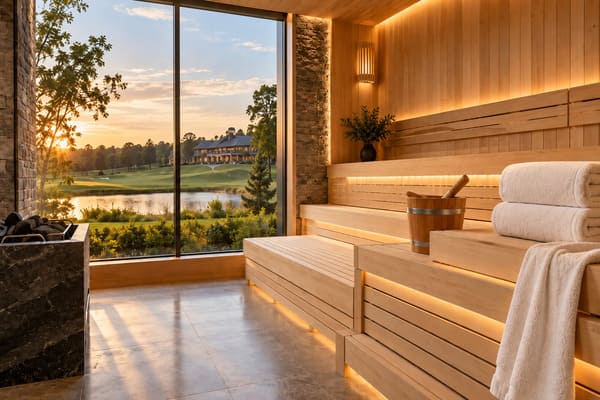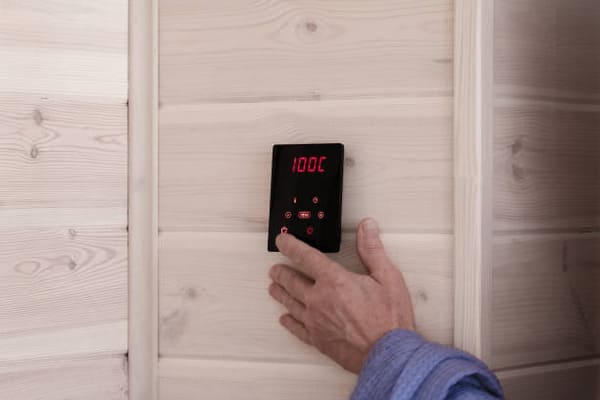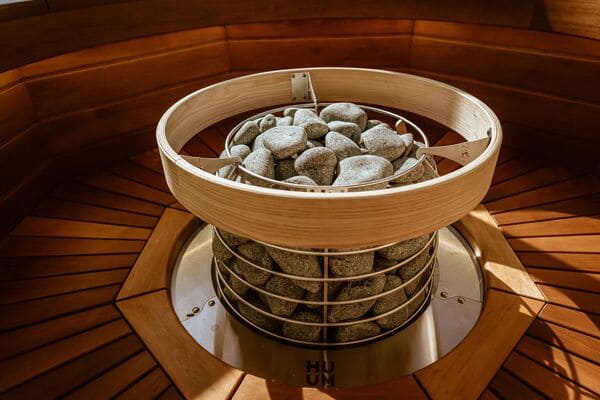
A hotel sauna is not just a piece of equipment you install — it's an amenity that runs for hours every day, serves many guests at once, and shapes how your spa and wellness area operate. Guests increasingly expect it: a sauna is now a standard feature travellers search for when choosing where to stay[^1]. But planning one for a hotel is a completely different exercise from a home sauna. It's about capacity, peak guest flow, operating hours, and how the sauna fits into your wider spa. This guide walks hotel owners, project teams, and wellness renovation contractors through the planning decisions that matter — before you ever specify a heater.
Planning a hotel sauna means sizing it to your property's guest flow, not just its floor area. Base capacity on peak simultaneous use rather than total room count, plan gender zoning and layout around your market, set operating hours that match a commercial duty cycle, integrate the sauna into the spa circulation, and schedule cleaning and backup so it never goes offline during business hours. Equipment selection follows these operational decisions, not the other way around.
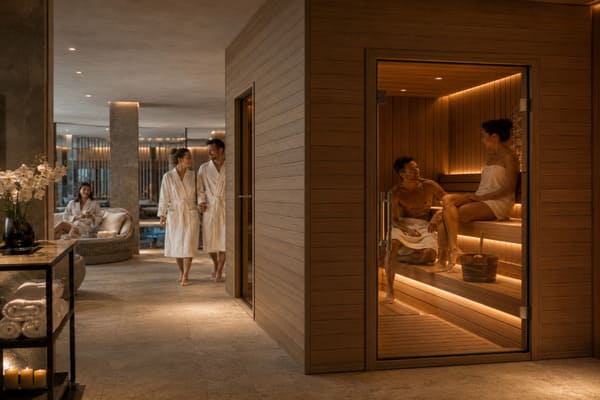
This guide covers indoor hotel saunas. If you're planning an outdoor sauna for a resort, glamping site, or wellness retreat, see our outdoor resort & glamping sauna buyer's guide instead.
Why Planning a Hotel Sauna Is Different
Before any numbers, it's worth being clear on why a hotel sauna can't be planned like a residential or single-room one.
A hotel sauna runs at high load for long hours, serves multiple guests simultaneously, operates on fixed business hours, and must be cleaned and maintained without disrupting guests. This demands commercial-grade equipment, a capacity based on peak demand, and an operating plan — considerations that simply don't apply to a private or single-project sauna.
A home sauna heats up for one household, a few times a week. A hotel sauna may run twelve hours a day, seven days a week[^2], with guests cycling through continuously at peak times. That difference drives every planning decision: the size, the equipment durability, the ventilation, the cleaning schedule, and the need for backup. Plan a hotel sauna like a home sauna, and it will be undersized, overworked, and offline for repairs during your busiest periods.
Sizing to Your Property: Rooms, Occupancy and Guest Flow
The first question owners ask is "how big?" — but the honest answer starts with your guests, not your floor plan.
Size a hotel sauna to expected usage, driven by room count, occupancy rate, and the share of guests likely to use the spa — not by the room dimensions alone. A larger property, a higher occupancy, or a wellness-focused guest profile all point to more capacity, whether through a bigger sauna or several rooms.
Rather than a single formula, think in tiers of provision:
| Property type | Typical sauna provision |
|---|---|
| Small boutique hotel | One well-sized sauna, possibly mixed-use |
| Mid-size hotel with spa | One larger sauna or separate men's/women's |
| Large hotel / resort | Multiple saunas + steam, gender-zoned |
| Dedicated wellness resort | Several saunas, varied types, high capacity |
The precise dimensions and bench capacity are a separate calculation — our sauna size guide covers how to translate a target number of users into physical dimensions. Here, the goal is to decide how much provision your property needs before sizing any single room.
Peak Guest Flow: The Number That Really Matters
This is the single most important — and most overlooked — number in hotel sauna planning.
Plan capacity around peak simultaneous use, not average or total guest numbers. Hotel spa use clusters into predictable peaks — early morning, after the gym, and especially evening[^3] — and a sauna sized for the daily average will be overcrowded exactly when guests most want to use it. Design for the busy hour, not the quiet ones.
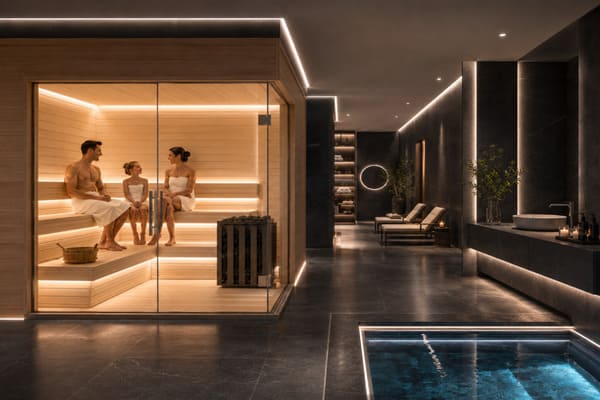
Consider a resort where most guests want the spa between 6 and 8 pm, or a ski hotel where everyone arrives back at once in the late afternoon. A sauna that comfortably serves the daily total can still leave guests queuing at the peak — the moment that shapes their review. Identify your property's peak pattern (leisure, business, and seasonal hotels differ sharply) and size for that window. It's better to have slight spare capacity off-peak than a bottleneck at prime time.
Gender Zoning and Layout Options
How you handle mixed or separated use depends heavily on your market and guest expectations.
Decide early between mixed-use saunas (swimwear-based), separate men's and women's facilities, or bookable private sessions. The right choice depends on your market's cultural norms, your guest demographic, and your available space. Gender zoning affects the number of rooms, the changing-area layout, and the overall footprint, so it must be settled before design begins.
Cultural expectations vary widely[^4]: some markets expect strictly separated facilities, others are comfortable with mixed swimwear use, and luxury properties increasingly offer private, bookable spa suites. Whichever model you choose, plan the changing rooms, showers, and circulation to match — separate facilities effectively double parts of the layout, while a well-designed mixed area can serve more guests in less space. Settle this before spa design, because it's expensive to change later.
Operating Hours and Scheduling
A hotel sauna's operating hours define its duty cycle — and therefore the equipment it needs.
Set operating hours that reflect commercial use, and choose control systems that support scheduling. Long daily hours mean the equipment must be rated for continuous commercial duty[^5], while timers, time-of-day scheduling, and remote start let staff manage heat-up, opening, and shutdown efficiently and control energy use.
Decide when the sauna opens and closes, and how it's brought up to temperature before guests arrive. Scheduling and remote-start features — common on commercial control systems — let staff pre-heat the sauna for opening and shut it down cleanly at night without manual attendance. For the control-system options themselves, see our commercial sauna control units guide; the planning point here is simply that your operating hours dictate a commercial duty cycle and a controller that can schedule it. Long hours also make energy efficiency a real operating cost[^6], so insulation and heater sizing matter for the running budget.
Spa Circulation: Where the Sauna Fits
A sauna doesn't work in isolation — it's one stage in a guest's spa journey.
Plan the sauna as part of a wet-area circulation: guests typically move between sauna, steam room, showers, and a relaxation area[^7], often near a pool or gym. Position the sauna so this flow is natural, with showers adjacent, a cool-down space nearby, and clear routing between wet and dry zones. Poor circulation makes even good equipment feel awkward to use.
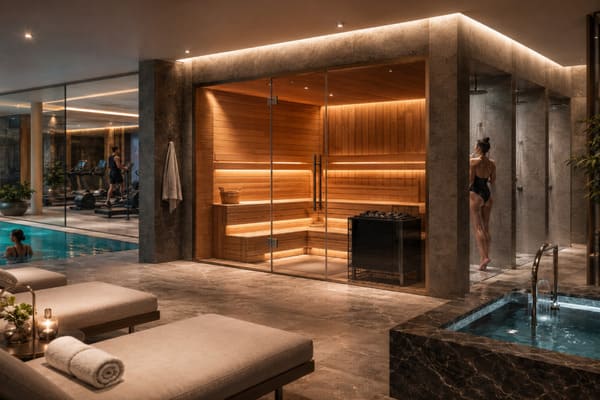
The best hotel spas guide guests smoothly through the experience — a shower before and after the sauna, an easy step to the steam room, a comfortable place to rest and rehydrate. Think about the adjacencies: proximity to the pool and gym drives usage, while the wet and dry zones need clear separation for safety and cleaning. Whether you pair the sauna with a steam room is a design choice worth making early; our commercial steam generator guide covers that side. The layout is what turns individual facilities into a coherent wellness experience.
Housekeeping, Cleaning and Downtime
For a hotel, a sauna is only an asset when it's open — so cleaning and downtime must be planned in.
Schedule cleaning around operating hours so the sauna is hygienic without being closed at peak times. Wet, warm environments need daily cleaning, and a hotel must build cleaning windows into the operating schedule — typically early morning or late night — so guests aren't turned away during busy periods. A visibly unclean or frequently closed sauna damages guest satisfaction quickly.
Plan the cleaning windows before opening: who cleans, when, and how long it takes to bring the sauna back to temperature afterwards. High guest turnover in a wet area demands consistent hygiene, and a sauna that's often "closed for cleaning" at prime time frustrates guests. The day-to-day cleaning and upkeep methods are covered in our maintenance resources — the planning task here is simply to reserve the time in the schedule so hygiene never competes with availability.
Backup and Redundancy for Hotels
This is a consideration unique to commercial operations — and one home-focused planning ignores entirely.
Plan for equipment redundancy and spare parts so a single fault doesn't take the amenity offline. In a hotel, a broken sauna during a full house is a stream of guest complaints. Multiple rooms, a stock of critical spare parts, and a reliable service relationship keep the facility available even when something needs repair.
For larger properties, multiple saunas mean one can stay open while another is serviced. For any hotel, keeping genuine spare parts and accessories on hand — and a supplier who can support you quickly — turns a potential multi-day closure into a minor fix. Build this into the plan and budget from the start; it's far cheaper than emergency downtime during peak season.
Equipment Considerations for Hotels
Equipment comes last in planning — chosen to serve the operational decisions above.
Specify commercial-grade equipment rated for continuous duty, with a control system suited to scheduled operation and full certification for your market. The heater, controller, and any steam system should be selected to match your capacity, operating hours, and layout — not chosen first and forced to fit.
The right heater and control unit follow from your capacity and duty-cycle decisions, and must carry the certifications your market requires, verified against bodies like UL or under CE marking. Whether you offer traditional sauna, steam, or both is a guest-experience decision that shapes the equipment list. The detailed selection sits in our equipment guides; the planning principle is that operations lead, and equipment follows.
What Hotel Groups and Renovation Contractors Should Plan For
Hotel groups and renovation specialists face planning challenges beyond a single sauna — and getting them right pays off across every property.
Hotel groups should plan for standardisation across properties, and renovation contractors for the constraints of existing buildings. A consistent sauna specification across a group simplifies procurement, maintenance, and staff training[^8], while a renovation must work within existing space, power, and drainage — often the biggest constraints in an upgrade.
| Planning point | Hotel groups | Renovation contractors |
|---|---|---|
| Specification | Standardise across sites | Match to existing building limits |
| Procurement | Volume, one supplier | Confirm access & delivery routes |
| Power & space | Consistent requirements | Verify existing supply & drainage |
| Maintenance | Shared spares & training | Assess condition of existing area |
| Guest experience | Consistent brand standard | Upgrade without long closures |
For wellness and health-resort renovation contractors, the existing building is usually the hardest constraint — available power, ceiling height, and drainage often dictate what's possible before guest experience even enters the picture. Surveying these early, and choosing a supplier who can specify equipment to fit real-world limits, is what keeps a renovation on time and on budget.
Common Hotel Sauna Planning Mistakes
Most disappointing hotel saunas trace back to the same planning errors.
The most common mistakes are: sizing by total room count instead of peak use[^9], using residential-grade equipment, ignoring gender-zoning expectations, leaving no cleaning windows, planning no backup or spares, and choosing equipment before settling operations. Each one shows up as guest complaints once the hotel is running.
| # | Mistake | Consequence |
|---|---|---|
| 1 | Sizing by total rooms, not peak | Overcrowding at prime time |
| 2 | Residential-grade equipment | Fails under commercial load |
| 3 | Ignoring gender-zoning norms | Layout doesn't suit guests |
| 4 | No cleaning windows scheduled | Closed at peak, or unhygienic |
| 5 | No backup or spare parts | Amenity offline during full house |
| 6 | Equipment chosen before operations | Poor fit to real usage |
Avoid these six, and the sauna becomes a reliable asset that guests remember for the right reasons.
How ROC Sauna-Solution Supports Hotel and Resort Projects
The right partner helps you plan operations first, then specifies equipment to match.
ROC Sauna-Solution supplies commercial-grade saunas for hotels and resorts — specifying equipment to match your capacity, guest flow, operating hours, and layout, with standardisation for hotel groups and practical solutions for renovation projects. We help you plan a sauna that guests love and staff can run reliably.
We work with hotels, resorts, spa operators, hospitality groups, and wellness/health-resort renovation contractors across 50+ countries, supplying genuine Harvia heaters, control units, steam generators, timber, and accessories — from compact rooms using the Harvia The Wall to larger installations built around the Harvia Vega Pro. Tell us your property, expected guest flow, and operating plan, and we'll specify equipment built for it.
Conclusion
A great hotel sauna starts long before the equipment arrives. Size it to your guests' peak demand, plan gender zoning and spa circulation around your market, set operating hours that call for commercial-grade equipment, and build cleaning and backup into the schedule so the amenity is always available. Get the operational planning right, and the equipment selection becomes straightforward — and the sauna becomes an amenity guests choose your hotel for.
Planning or renovating a hotel sauna? Tell ROC Sauna-Solution your property, guest flow, and operating plan for equipment specified to match — built for commercial duty and your market's certification. Start your hotel project enquiry here. You can also ask our AI assistant how to plan a sauna for your property.
Frequently Asked Questions
How big should a hotel sauna be? Size a hotel sauna to expected peak use rather than floor area alone. Base it on your room count, occupancy rate, and the share of guests likely to use the spa, then translate that target number of simultaneous users into dimensions. Larger properties and wellness-focused hotels often need multiple saunas rather than one big room, so provision comes before precise sizing.
How do I plan capacity for a hotel sauna? Plan around peak simultaneous use, not the daily average or total guest count. Hotel spa use clusters into predictable peaks — morning, post-gym, and especially evening — so a sauna sized for the average will overcrowd at prime time. Identify your property's busy window and size the sauna, or number of saunas, to serve it comfortably.
Should a hotel have separate men's and women's saunas? It depends on your market and guest demographic. Options include mixed swimwear-based use, separate men's and women's facilities, and bookable private sessions. Cultural norms vary widely between regions, and the choice affects the number of rooms, the changing-area layout, and the footprint — so it should be decided before spa design begins.
What kind of sauna equipment do hotels need? Hotels need commercial-grade equipment rated for continuous daily duty, a control system that supports scheduling and remote start, and full certification for the market such as CE or ETL/UL. Residential equipment isn't built for the long hours and heavy use of a hotel and will fail prematurely, so equipment should be specified to match capacity and operating hours.
How do hotels keep saunas clean without closing them at peak times? By scheduling cleaning windows into the operating hours — typically early morning or late at night — so hygiene is maintained without turning guests away during busy periods. Larger properties with multiple saunas can clean one while another stays open. Planning these windows before opening keeps the sauna both hygienic and consistently available.
What should hotel groups consider when planning saunas across multiple properties? Hotel groups benefit from standardising the sauna specification across sites, which simplifies procurement, maintenance, spare-parts stocking, and staff training, and ensures a consistent guest experience. Renovation projects, by contrast, must work within existing space, power, and drainage constraints, so both benefit from a supplier who can specify equipment to fit each situation reliably.
About ROC Sauna-Solution
[^1]: "Hospitality Trends: Wellness and wellbeing", https://insights.ehl.edu/hospitality-trends-wellness-and-wellbeing. For example, travel industry reports and booking platform data indicate a growing trend of travelers searching for and prioritizing hotels with wellness amenities, such as spas, fitness centers, and saunas. Evidence role: statistic; source type: research. Supports: That wellness amenities, including saunas, are an increasingly important factor for travelers when selecting accommodation.. Scope note: The source may discuss wellness or spa facilities as a general category rather than isolating saunas as a specific search term. [^2]: "22 Best practices for your Spa and Wellness during post ...", https://insights.ehl.edu/spa-and-wellness-best-practices. Spa management guidelines often recommend operating hours that extend from early morning to late evening to maximize guest access, resulting in long daily duty cycles of 10-14 hours for equipment like saunas. Evidence role: general_support; source type: institution. Supports: That commercial spas and their amenities typically operate for long daily hours to accommodate guest schedules.. Scope note: The source may provide a range of typical hours or general principles rather than the exact 'twelve hours a day' figure. [^3]: "Harness the Power: Data Analytics in Hospitality", https://lesroches.edu/blog/data-analytics-hospitality-industry/. Studies on hotel guest behavior and spa utilization confirm that demand for wellness amenities is often concentrated in specific time blocks, particularly in the morning before daily activities and in the evening upon return to the hotel. Evidence role: general_support; source type: research. Supports: That guest usage of hotel wellness facilities is not evenly distributed but tends to concentrate in the morning and evening hours.. Scope note: The exact peak times can vary based on the hotel's primary clientele (e.g., business vs. leisure resort). [^4]: "Sex segregation", https://en.wikipedia.org/wiki/Sex_segregation. For instance, traditional sauna cultures in countries like Finland and Germany often involve nudity and have different norms for mixed-gender use compared to North American or British contexts, where swimwear and gender-separated facilities are more common in public settings. Evidence role: historical_context; source type: encyclopedia. Supports: That traditions and etiquette regarding nudity and gender separation in saunas differ significantly between regions, such as between Germanic/Nordic countries and North America.. [^5]: "Purchasing Energy-Efficient Commercial Refrigerators and ...", https://www.energy.gov/cmei/femp/purchasing-energy-efficient-commercial-refrigerators-and-freezers. Electrical and mechanical equipment is often classified by its duty cycle. A 'continuous duty' rating (e.g., S1 per IEC 60034-1) signifies that the equipment is designed and tested to operate at its rated load for an unlimited period without exceeding temperature limits, a key requirement for commercial applications. Evidence role: definition; source type: institution. Supports: The definition of 'continuous duty' as an engineering classification for equipment designed to operate at a constant load for long periods without failure.. [^6]: "Energy Savings Tips for Small Businesses: Lodging", https://www.energystar.gov/buildings/resources-audience/small-biz/lodging. Research on energy use in the hospitality sector indicates that high-temperature amenities like saunas are energy-intensive. Their long operating hours can make them a notable contributor to a facility's utility costs, underscoring the financial impact of insulation and heater efficiency. Evidence role: statistic; source type: research. Supports: That heating for amenities like saunas can constitute a significant portion of a hotel's energy consumption and operating costs.. Scope note: The source may provide data for the entire spa or hotel's energy use rather than isolating the sauna's cost specifically. [^7]: "22 Best practices for your Spa and Wellness during post ...", https://insights.ehl.edu/spa-and-wellness-best-practices. This sequence reflects established principles of spa design, which often create a 'thermal circuit' to guide guests through cycles of heating (sauna, steam), cooling (showers, cold plunge), and rest. This process is believed to enhance physiological benefits and the overall user experience. Evidence role: mechanism; source type: education. Supports: That spa design often incorporates the concept of a 'thermal journey' or 'hydrothermal circuit,' guiding users through a sequence of hot, cold, and relaxation experiences.. [^8]: "The impact of a management company's scale on hotel market ...", https://digitalcommons.pepperdine.edu/cgi/viewcontent.cgi?article=2232&context=etd. This aligns with established principles of operations management, where component and equipment standardization across an enterprise creates economies of scale in procurement, reduces the complexity and cost of maintenance inventories, and streamlines employee training procedures. Evidence role: general_support; source type: education. Supports: That standardization of equipment and processes across multiple business units is a recognized strategy for achieving operational efficiencies.. Scope note: The source would likely discuss the general business principle of standardization rather than applying it specifically to hotel saunas. [^9]: "NR Demand Response and Peak Load Management", https://greenmanual.rutgers.edu/nr-demand-response-and-peak-load-management/. This is a classic error in capacity planning, as explained by queueing theory. Sizing a service facility for average demand guarantees that it will be overwhelmed during periods of peak demand, leading to queues and customer dissatisfaction, while being underutilized during off-peak times. Evidence role: mechanism; source type: education. Supports: That designing service capacity based on average demand rather than peak demand is a fundamental error in operations management that leads to congestion and poor service quality.. Scope note: The source will discuss this as a general principle of operations management, not specifically in the context of hotel saunas.