You have a brand. Your customers already trust it. So why sell someone else's name on the sauna? With private label and OEM manufacturing, you put your own logo, packaging, and identity on quality sauna equipment and sell it as your own product. This guide gives you the specifics: exactly what you can brand, how sampling and MOQ work, how long production takes, and how certification is handled — so you can launch your own sauna line with confidence.
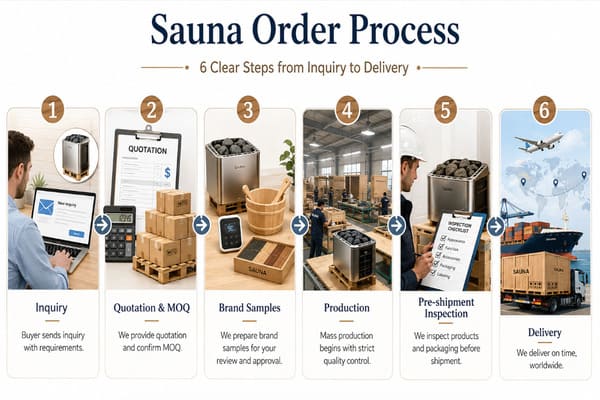
Private label sauna manufacturing lets a brand sell saunas under its own name — controlling the logo, packaging, colours, and manuals — while a factory produces the equipment. The process runs through six clear stages: enquiry, quotation and MOQ, branded sample, production, pre-shipment inspection, and delivery. It suits brand owners, hospitality groups, wellness businesses, and large buyers who want branded product, not a one-off installation.
Private Label vs OEM: Which One Do You Need?
These two terms get mixed up constantly, and the difference decides your cost, MOQ, and timeline.
Private label[^1] means selling an existing product under your brand — your logo, your packaging, minimal changes to the product itself. OEM means the factory builds the product to your specification, including colours, materials, or features. Private label is faster, cheaper, and lower-MOQ; OEM gives full control but costs more and takes longer.
| Private Label | OEM | |
|---|---|---|
| Product changes | Logo & packaging only | Colours, materials, features |
| MOQ | Lower | Higher |
| Cost | Lower | Higher |
| Timeline | Faster | Longer |
| Best when | You want your brand fast | You want a unique product |
Start with private label to enter the market quickly, and move to OEM once your volume justifies deeper customisation. Most brands begin with private label for exactly this reason.
Exactly What You Can Brand
This is where most buyers underestimate the options — branding a sauna goes far beyond a logo sticker.
On a private label sauna you can brand the logo (laser-etched or printed on the heater, control panel, door frame, and glass), the packaging and cartons, the product colours and finishes, the user manuals and documentation, and the accessories such as buckets and ladles.
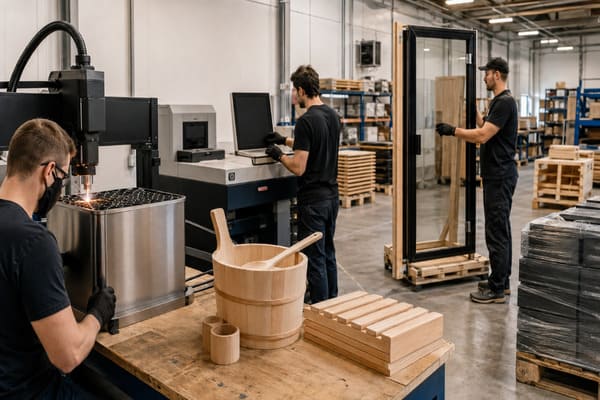
Here's what each option actually involves:
- Logo — laser-etched onto the heater casing and control panel, printed or frosted onto glass doors, embossed on the door frame. Etching looks premium and lasts; printing is cheaper and more flexible.
- Packaging — fully branded cartons, printed inserts, your labelling and barcodes. This is what your customer sees first on delivery.
- Colours & finishes — heater casing colour, timber type and tone, glass tint. Wider colour changes fall under OEM and raise the MOQ.
- Manuals & documents — your brand, your language, your market's safety details and warranty terms.
- Accessories — branded buckets, ladles, thermometers, and headrests to complete a consistent range.
A basic private label package is usually logo + packaging + manuals. Adding custom colours or materials moves you into OEM territory.
The Six-Stage Production Process
Here is exactly how a private label order runs from first email to branded goods at your door.
A private label sauna project runs through six stages: (1) enquiry and specification, (2) quotation and MOQ agreement, (3) branded sample and sign-off, (4) deposit and mass production, (5) pre-shipment inspection, and (6) delivery. Sampling and production are the longest stages, so plan your launch date around them.
| Stage | What happens | Typical time |
|---|---|---|
| 1. Enquiry & spec | Define products, branding scope, market | A few days |
| 2. Quotation & MOQ | Confirm price and minimum order | A few days |
| 3. Branded sample | Factory makes and you approve a sample | 2–4 weeks |
| 4. Production | Full order manufactured | 4–8 weeks |
| 5. Inspection | Goods checked and documented | A few days |
| 6. Delivery | Branded product shipped | Per shipping terms |
Realistically, allow 2–4 months from first enquiry to shipment for a private label order — most of that is sampling and production. For what to include in your first enquiry, see our RFQ checklist; the inspection stage follows our pre-shipment inspection checklist.
Samples: Never Skip This Step
The sample stage is short, but skipping it is the single most expensive mistake in private label.
Before mass production, the factory makes a branded sample so you can approve the logo placement, packaging, colours, and build quality in person. Sign it off in writing and keep photos — that approved sample becomes the reference standard the entire production run and the final inspection are checked against.
A sample costs a small fee and a few weeks. A full production run in the wrong logo colour or with a misplaced etch costs the whole order. Always approve a physical sample before paying the production deposit — no exceptions on a first order.
Understanding MOQ (Minimum Order Quantity)
MOQ is usually the number that decides whether a private label project is viable for you.
MOQ is the minimum number of units a factory will produce for a branded order. It exists because branding set-up — etching, custom cartons, colour changes — has fixed costs that only pay off across a minimum volume. Simple logo-and-packaging orders have a lower MOQ; full OEM with custom colours or materials requires a higher one.
If your target volume is below a quoted MOQ, you have real options:
- Start with lighter branding (logo + packaging only) to keep the MOQ low.
- Combine several models into one order to reach the minimum.
- Begin with private label, then scale to OEM once sales prove the demand.
Plan your MOQ around realistic first-year sales, not optimistic ones — over-ordering ties up cash in stock. Factor the order into your overall commercial sauna cost planning.
Certification: Your Brand, Your Responsibility
This is the part brands most often overlook — and it matters because your name is on the product.
A private label sauna must carry the certifications your market legally requires — CE for the EU, ETL/UL for North America — exactly like any other commercial sauna. Agree with the factory before production how certification applies to branded units and who holds it, and keep the documentation on file.
The equipment underneath your brand must be genuinely certified — CE marking[^2] for Europe, a UL[^3] or ETL listing for North America. Because your logo is on the product, your customers hold you responsible for its safety and compliance, not the factory. Our self-developed heaters, steam generators and controllers carry their own certification, so the quality and compliance stay solid beneath your brand. Genuine Harvia[^4] equipment is supplied alongside with its original branding when a project calls for it.
Who Private Label Saunas Are For
Private label fits a specific kind of buyer — and it's worth knowing if that's you.
Private label and OEM saunas suit brand owners building a product line, wellness and fitness businesses wanting saunas in their own identity, hospitality and resort groups branding equipment across sites, large project buyers, and wellness or health-resort renovation contractors delivering branded rooms at scale.
- Brand owners — add a branded sauna range to your catalogue.
- Wellness & fitness businesses — saunas that carry your identity, not a supplier's.
- Hospitality & resort groups — one consistent brand across every property.
- Wellness / health-resort renovation contractors — a unified look across many rooms and sites.
If you just need saunas for a single project, private label is overkill — configuring standard equipment is faster and cheaper, and that's a different process.
Five Private Label Mistakes to Avoid
These five errors cause almost every private label problem — and all are avoidable.
The most common mistakes are: skipping sample approval, underestimating the MOQ, ignoring certification on branded units, over-customising before testing demand, and not documenting the approved specification in writing.
| # | Mistake | Consequence |
|---|---|---|
| 1 | Skipping sample approval | Whole run comes out wrong |
| 2 | Underestimating MOQ | Order unviable or overstocked |
| 3 | Ignoring certification | Branded goods can't be sold legally |
| 4 | Over-customising too early | High cost, unproven demand |
| 5 | No written, documented spec | Disputes and reorder errors |
Get the sample, the MOQ, and the certification right, and private label becomes a repeatable way to grow your brand.
How ROC Sauna-Solution Handles Private Label & OEM
Here's exactly what we do for brands building their own sauna line.
ROC Sauna-Solution manufactures private label and OEM saunas on genuine, certified equipment — custom logo, packaging, colours, and manuals, with a branded sample before production, clear MOQ terms, documented manufacturing, and pre-shipment inspection on every order. You launch your own sauna line without compromising quality or compliance.
We build branded product on our own self-developed equipment — heaters, steam generators and controllers — with branded interiors and accessories to complete the range. Harvia items such as the Harvia The Wall or Harvia Vega Pro are supplied as genuine Harvia, never rebranded. Full details are on our OEM & ODM page. Tell us three things — your brand, your target market, and your volume — and we'll send you the branding options, MOQ, sample plan, and timeline.
Conclusion
Private label turns quality equipment into your own branded sauna line. Decide between private label and OEM, approve a physical sample before production, plan around a realistic MOQ, and keep certification firmly in your control. Do those four things with an established manufacturer, and you can bring a branded sauna range to market — with the quality and compliance your customers expect from your name.
Ready to build your own sauna brand? Send ROC Sauna-Solution your brand, target market, and volume for a private label and OEM proposal — branding options, MOQ, samples, and timeline. Start your enquiry here. You can also ask our AI assistant how private label sauna sourcing works.
Frequently Asked Questions
What is a private label sauna? A private label sauna is quality sauna equipment sold under your own brand rather than the manufacturer's. You control the logo, packaging, colours, and manuals while the factory produces the equipment, letting you offer saunas as part of your own product line instead of reselling another company's branded product.
What's the difference between private label and OEM saunas? Private label means putting your brand, logo, and packaging on an existing product with minimal changes. OEM (original equipment manufacturer) means the factory builds the product to your specification — colours, materials, or features included. Private label is faster and lower-MOQ; OEM offers full customisation but requires higher volume and longer timelines.
What can I customise on a private label sauna? The logo (etched or printed on the heater, control panel, door frame, and glass), the packaging and cartons, the product colours and finishes, the user manuals and documentation, and the accessories. Logo and packaging are standard private label; custom colours and materials move the order into OEM.
What is the MOQ for private label saunas? MOQ is the smallest quantity a factory will produce for a branded order. It varies by product and customisation level — simple logo-and-packaging orders have a lower MOQ than full OEM orders with custom colours or materials. If your volume is below the MOQ, lighter branding or combining models can often bridge the gap.
How long does a private label sauna order take? Typically two to four months from first enquiry to shipment. Sampling usually takes two to four weeks and production four to eight weeks, plus enquiry, inspection, and shipping time. Plan your launch date around the sampling and production stages, which are the longest.
Do private label saunas still need certification? Yes. A private label sauna must carry the certifications your market requires — CE for the EU, ETL/UL for North America — like any commercial sauna. Because your brand is on the product, you are responsible for its compliance, so agree how certification is handled before production and keep the documentation.
About ROC Sauna-Solution
ROC Sauna-Solution is an official authorized Harvia distributor and commercial sauna sourcing partner based in China, with over 12 years of experience supplying sauna projects worldwide. We help brand owners, hospitality and resort groups, wellness and fitness businesses, large project buyers, and wellness/health-resort renovation contractors across 50+ countries develop private label and OEM sauna products — supplying self-developed, certified heaters, control units, steam generators, and accessories with custom branding, alongside genuine Harvia equipment, samples, clear MOQ terms, documented production, pre-shipment inspection, CE/ETL/RoHS certification, and technical and after-sales support.
References
[^1]: Private label — products manufactured by one company and sold under another company's brand. Wikipedia. https://en.wikipedia.org/wiki/Private_label [^2]: CE marking — EU product compliance marking. Your Europe (European Commission). https://europa.eu/youreurope/business/product-requirements/labels-markings/ce-marking/index_en.htm [^3]: UL — safety certification organisation for North America. https://www.ul.com/ [^4]: Harvia — Official sauna heater manufacturer. https://www.harvia.com/en/