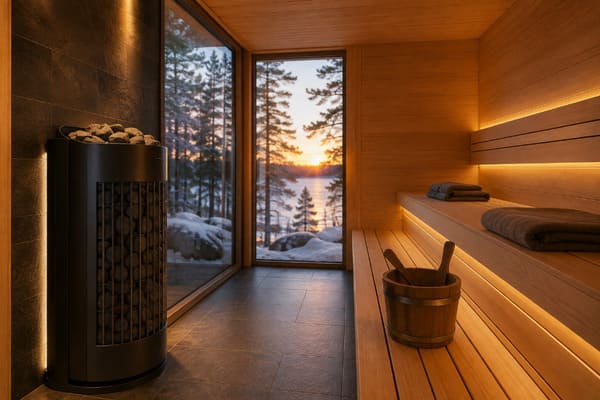
A commercial sauna project requires more than choosing a heater. The right solution depends on space planning, user capacity, heating requirements, ventilation, and long-term operation needs — because a hotel, spa, or gym sauna runs for hours a day, serves dozens of guests, and has to pass inspection. This guide walks you through the equipment decisions that actually matter.
Specifying a custom commercial sauna means getting six things right: room size and capacity, heater output, timber, ventilation, layout, and the control system — all matched to heavy, continuous commercial use. Get these right and you get a sauna that performs reliably for years; get one wrong and it fails under load.
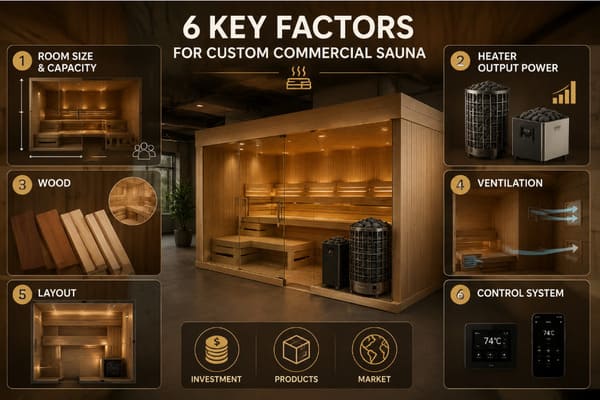
I have seen operators install a beautiful sauna that could not hold temperature once ten guests walked in, because the heater was sized for a home. Below is how to specify a commercial sauna properly — understanding your project requirements, selecting the right heater, choosing materials and components, and why sourcing the whole project through one experienced solution provider protects your result.
Understanding Your Commercial Sauna Project Requirements
Every commercial project starts with the space and the people using it — not the product catalog. Get the requirements right and the equipment choices follow logically.
A commercial sauna must be specified around its setting: a hotel, spa, gym, or resort each has different traffic, hours, and space constraints. Define your dimensions, expected peak capacity, daily operating hours, and location first — these determine every equipment decision that follows.
The setting changes the specification more than most buyers expect:
- Hotels — guests use the sauna in unpredictable bursts, so the room must reach and hold temperature reliably at all hours.
- Spas — often run long continuous hours and expect a premium finish, so timber quality and even heat matter.
- Gyms — high throughput and frequent door openings drain heat fast, demanding heaters sized above the room volume alone.
- Resorts — larger capacity and sometimes outdoor exposure, which increases heating requirements.
Start by documenting your exact space dimensions, expected peak users, daily hours, and location type. These four facts drive the heater size, timber choice, ventilation, and control system you will need — and adequate ventilation is a recognised requirement for indoor air quality in occupied spaces.[^2] If you are still choosing who to source from, our guide on how to choose a reliable sauna supplier covers the vetting process.
How to Select the Right Sauna Heater for a Commercial Space
The heater is the single most important — and most often mis-specified — piece of equipment in a commercial sauna. Get it wrong and everything else underperforms.
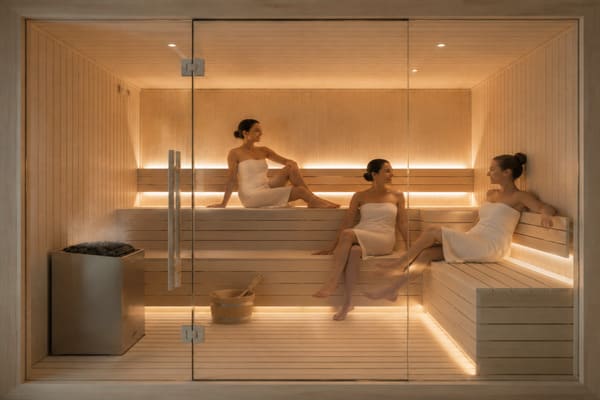
Select a commercial sauna heater by matching its kW output to the room volume, then increasing it for heavy usage, frequent door openings, and glass or stone surfaces. Commercial heaters must be built to run for long hours continuously — a home-grade heater sized to the same room will fail under commercial load.
What Drives Heater Selection
Four factors decide the right heater for a commercial room:
| Factor | What It Affects | Commercial Consideration |
|---|---|---|
| Sauna size (volume) | Base kW requirement | Start from room m³, then adjust up |
| Usage frequency | Heat recovery needs | High traffic needs extra output |
| Door / glass exposure | Heat loss | Glass walls and frequent openings drain heat |
| Commercial durability | Heater lifespan | Must be rated for continuous daily operation |
The most common mistake is sizing a heater just to reach temperature, not to hold it as guests come and go. A commercial room needs enough output to recover heat quickly between users — and glass walls, stone surfaces, and frequent door openings all demand extra kW. For the full sizing method, including these adjustments, see our detailed sauna heater size guide. This is also where genuine, commercial-grade heaters from established brands earn their price — they are built for the duty cycle a hotel or gym demands, they meet the dedicated sauna-heater safety standard IEC 60335-2-53,[^3] and they come with the warranty and certification a public installation requires.
Choosing Sauna Materials and Components
A sauna is a complete system, not just a heater in a box. The timber, stones, controls, and accessories all affect performance, safety, and how long the installation lasts.
Beyond the heater, a commercial sauna needs the right timber (heat-stable and durable), quality sauna stones, a commercial-grade control system, and matched accessories. Specifying these together — from one source — ensures they work as a system and simplifies your project.
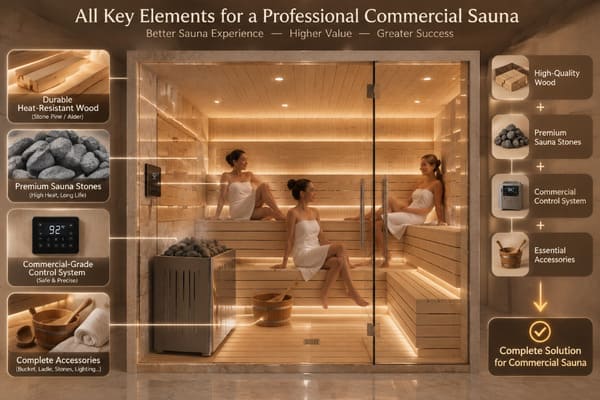
Here is what to define for each component:
- Timber / wood panels — commercial rooms cycle through heat and humidity far more than home units, so heat-stable, durable species matter for both feel and lifespan; the behaviour of different species under heat and moisture is documented in timber research from the USDA Forest Products Laboratory.[^4] Our guide on how to choose the right wood for a sauna room breaks down the options.
- Sauna stones — quality stones hold and release heat efficiently and need periodic replacement in high-use settings, so a reliable supply matters.
- Control system — commercial-grade controls with scheduling and safety features let staff run the sauna safely over long operating hours.
- Accessories — benches, lighting, doors, and ventilation fittings all affect usable capacity and guest experience.
Sourcing these as a coordinated package — rather than piecing them together from different suppliers — ensures everything is compatible and arrives together, which is exactly where an experienced solution provider adds value.
How Is a Commercial Sauna Different From a Home Sauna?
Buyers who have only seen residential saunas underestimate this — and it is the single biggest cause of failed commercial installs.
A commercial sauna differs from a home sauna in duty cycle, durability, and compliance: it runs many hours daily rather than occasionally, uses heavier-duty heaters and timber built to last under that load, and must meet the safety certifications required for public premises. A home-grade unit specified for commercial use fails early and creates compliance problems.
The practical differences come down to three things. Duty cycle: a hotel or gym sauna may run 12+ hours a day, so components must be rated for continuous operation. Durability: heavier construction and commercial-grade heaters cost more up front but survive the load. Compliance: public installations must carry the right marks (such as CE,[^5] ETL,[^6] or RoHS[^7] for the equipment) and meet local safety rules — a serious supplier provides this documentation. For a fuller comparison, see our guide on home sauna vs commercial sauna.
Why Work With an Experienced Commercial Sauna Solution Provider?
A commercial sauna is a project, not a single purchase. Piecing it together from separate suppliers — a heater here, timber there, controls from a third — multiplies the risk of mismatched parts, delays, and no one accountable when something goes wrong.
An experienced commercial sauna solution provider handles the whole project: matching you to the right genuine, certified equipment, sourcing every component from one place, and providing technical and after-sales support. This gives you one accountable partner instead of a dozen suppliers to manage.

This is where the right partner changes the outcome of your project. Instead of you researching heaters, sourcing timber, and hoping the controls are compatible, a solution provider does this:
- Understands your project requirement — space, capacity, hours, and setting.
- Selects the right equipment — heater sizing, controls, and materials matched to your use.
- Matches you to genuine, certified brands — authentic product with real engineering and warranty behind it.
- Supplies the complete package — heater, room, controls, timber, and accessories consolidated in one shipment.
- Provides technical support — installation guidance, documentation, and after-sales backing.
ROC Sauna-Solution fills exactly this role. As an official authorized Harvia distributor and commercial sauna solution provider, we help hotels, spas, gyms, and resorts specify the right equipment, source genuine certified product with full CE/ETL/RoHS documentation, consolidate the entire order into one shipment, and back it with technical and after-sales support — so you deal with one experienced partner from specification to installation.
Conclusion
A commercial sauna lives or dies on the equipment behind it. Start from your project requirements, size the heater for real peak traffic, choose heat-stable timber and a commercial-grade control system, and insist on the right certifications for public installation. Most importantly, source the whole project through one experienced partner rather than piecing it together — it protects your timeline, your compatibility, and your result.
Planning a commercial sauna project? Send us your space dimensions, expected traffic, and setting — we'll reply with equipment recommendations, genuine certified product options, and a complete project proposal. Request a commercial sauna consultation here. You can also chat with our AI product assistant first to explore the options.
Frequently Asked Questions
How do I specify a custom commercial sauna? Start from your project: room dimensions, peak user capacity, daily operating hours, and setting (hotel, spa, gym, or resort). These determine the heater output, timber, ventilation, layout, and control system you need. An experienced solution provider turns these details into a complete equipment specification for you.
What size heater does a commercial sauna need? It depends on the room volume and how heavily it is used — commercial heaters must be sized to hold temperature as guests come and go, not just to reach it once. Glass walls and frequent door openings drain heat, so the heater is often sized above the room volume alone. Have your supplier calculate the correct kW output for your exact space and traffic.
How is a commercial sauna different from a home sauna? A commercial sauna runs many hours daily, so it uses heavier-duty heaters and timber built for continuous use and must meet the safety certifications required for public premises. A home-grade unit specified for commercial use tends to fail early and can create compliance problems.
What components does a commercial sauna project include? Beyond the heater, a complete commercial sauna includes heat-stable timber, quality sauna stones, a commercial-grade control system, ventilation, and accessories such as benches, lighting, and doors. Sourcing these together ensures they work as a compatible system.
Why source a commercial sauna through one solution provider instead of separate suppliers? Piecing a project together from multiple suppliers risks mismatched components, delays, and no single point of accountability. A solution provider matches you to the right genuine equipment, consolidates everything into one shipment, and provides technical and after-sales support — giving you one accountable partner.
What certifications does a commercial sauna need? The equipment must carry the marks required for your market and for public installation, such as CE,[^5] ETL,[^6] or RoHS,[^7] and meet local safety rules. A reliable supplier provides this documentation so your sauna is legal to install and operate commercially.
About ROC Sauna-Solution
ROC Sauna-Solution is an official authorized Harvia distributor and commercial sauna solution provider based in China, with over 12 years of experience supplying and integrating sauna projects worldwide. We help hotels, spas, gyms, resorts, and wholesalers across 50+ countries specify and source genuine, certified sauna heaters, sauna rooms, controllers, steam generators, timber panels, and accessories — consolidated into one shipment, with full CE/ETL/RoHS documentation, technical and after-sales support, and spare-parts supply. We help buyers complete commercial sauna projects with confidence.
[^1]: "Global Wellness Economy Monitor", Global Wellness Institute, https://globalwellnessinstitute.org. Evidence role: general_support; source type: research institute. Supports: Demand for commercial saunas in hospitality and wellness is growing. Scope note: Specific figures vary by report year and market segment.
[^2]: "ANSI/ASHRAE Standard 62.1: Ventilation for Acceptable Indoor Air Quality", ASHRAE, https://www.ashrae.org/technical-resources/bookstore/standards-62-1-62-2. Evidence role: general_support; source type: industry standards body. Supports: Adequate mechanical ventilation is a recognised requirement for indoor air quality in occupied commercial spaces, and must be planned into a commercial sauna alongside heating and layout.
[^3]: "IEC 60335-2-53: Household and similar electrical appliances — Safety — Particular requirements for electric sauna heating appliances", International Electrotechnical Commission (IEC), https://webstore.iec.ch/publication/1627. Evidence role: general_support; source type: international standards body. Supports: Commercial sauna heaters must meet a dedicated electrical-safety standard covering continuous operation, safety cut-offs, and heater clearances.
[^4]: "Wood Handbook — Wood as an Engineering Material", USDA Forest Products Laboratory, https://www.fpl.fs.usda.gov/. Evidence role: general_support; source type: government research laboratory. Supports: Wood species differ in their stability and resistance to heat and moisture, which determines their suitability and lifespan as sauna room timber under repeated commercial heat cycling.
[^5]: "CE marking", European Commission — Your Europe (official EU portal), https://europa.eu/youreurope/business/product-requirements/labels-markings/ce-marking/index_en.htm. Evidence role: direct_support; source type: government (EU). Supports: CE marking is mandatory for placing applicable electrical products, including commercial sauna equipment, on the European Economic Area market.
[^6]: "ETL Listed Mark", Intertek, https://www.intertek.com/marks/etl/. Evidence role: direct_support; source type: accredited testing and certification body. Supports: The ETL Listed Mark demonstrates that equipment meets North American safety standards and is recognised for commercial installation in the US and Canada.
[^7]: "RoHS Directive", European Commission — Environment (official EU portal), https://environment.ec.europa.eu/topics/waste-and-recycling/rohs-directive_en. Evidence role: direct_support; source type: government (EU). Supports: The RoHS Directive restricts the use of specified hazardous substances in electrical and electronic equipment sold in the EU.