Sourcing saunas at scale is easy to get wrong. Pick the wrong supplier and you don't just lose money — you lose a shipment at customs, a season of inventory, and a customer's trust. This is not a beginner's lecture; it's the checklist an experienced buyer runs before wiring a deposit.
To vet a sauna supplier, verify three things before you pay: genuine certified product (CE/ETL/RoHS with documents on hand), proven export experience to your market, and a minimum order that matches your risk. A trading company resells at a markup; an authorized brand agent — especially one that can also manufacture to your own spec — supplies certified goods with real engineering behind them. Get them to state, in writing, exactly what they are.

I have watched buyers chase a 3% lower quote and lose ten times that when the container got held at the border. Below is the working method — the supplier types, the exact questions to ask, the documents to demand, and the red flags most guides never mention.
What Kind of Sauna Supplier Are You Actually Talking To?
Every listing says "supplier," but they are not the same business. Confusing them is where most sourcing headaches begin.
There are three types of sauna supplier: manufacturers who make the product, trading companies who resell at a markup, and authorized brand agents who supply genuine certified goods backed by the brand. Each one changes your price, your quality control, and who is accountable when something goes wrong. The strongest partners combine more than one role.
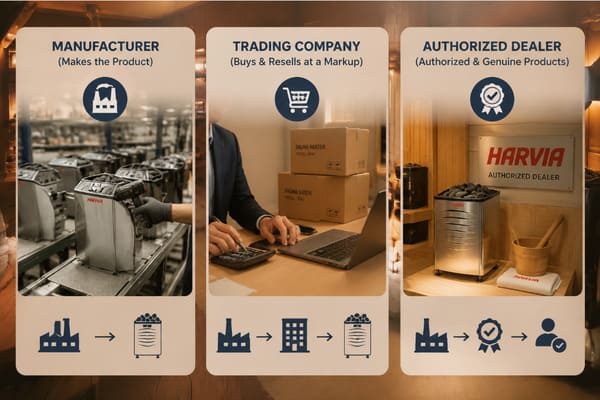
The Quick Reference Table
Here is the comparison I keep on hand when a buyer asks who to trust.
| Supplier Type | Pricing | Quality Control | Documents | Accountability | Best For |
|---|---|---|---|---|---|
| Pure manufacturer | Lowest unit price | Direct, but varies by factory | Depends on the factory | You chase QC yourself | Large-volume, single-SKU buyers |
| Authorized brand agent | Fair, transparent | Certified, brand-backed | Full CE/ETL/RoHS on hand | One point of accountability | Buyers who need genuine brand-name product |
| Agent + manufacturer (both) | Fair, flexible | Certified + in-house control | Full docs, per your model | Single accountable partner | Buyers who want genuine product or their own OEM brand |
One habit matters most: make the supplier state, in writing, which type they are. A partner who is vague about this is telling you something. Clarity here stops most disputes before they start.
The strongest position of all is a supplier who is both an authorized brand agent and an experienced manufacturer. They can hand you genuine, certified brand-name product when you want it, or produce to your own specification and label when you'd rather build your own brand — giving you brand-backed quality and OEM flexibility from one accountable partner, without adding a trading-company markup in between.
8 Red Flags That Should Stop the Deal
You don't need to be an expert to spot a risky supplier — you need this list. Any two of these together, walk away.
- They quote a price but "can't find" the Declaration of Conformity or test reports.
- The CE/ETL certificate names a different company or a different model than what you're buying.
- They dodge the question "how many markets have you exported to?"
- No batch-level test documents — only a blanket verbal "yes, it's certified."
- The MOQ jumps or the price changes every time you ask.
- They can't name a single reference project or client in your region.
- Slow, evasive replies before payment (it only gets worse after).
- They resist putting supplier-type, warranty, and lead time in writing.
Why Do Certifications Decide the Whole Deal?
You found a great price, the samples look fine — and then the shipment is stopped at the port. The problem is compliance, and it is invisible until it costs you.
For most export markets, saunas and heaters must carry the right marks. CE marking is mandatory for electrical equipment sold in the European Economic Area,[^1] and it acts as a "passport" that lets the product move freely across all EU and EEA countries.[^2] North America requires an ETL or UL listing instead,[^4] and both markets restrict hazardous substances under RoHS.[^5] A serious supplier proves this with documents, not promises.
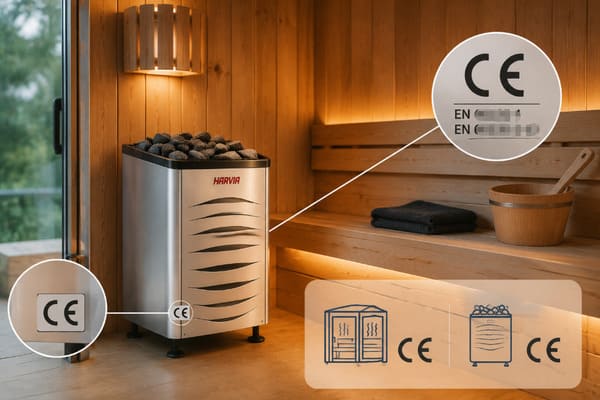
The Certification Checklist by Market
Match the mark to where the goods are actually going — then ask for the physical document before you pay.
| Destination Market | Required Marks | Document to Request |
|---|---|---|
| EU / EEA | CE + RoHS[^5] | Declaration of Conformity + test report |
| North America (US/Canada) | ETL or UL / cETL[^4] | Listing certificate + test report |
| UK | UKCA (+ CE in transition)[^6] | Declaration of Conformity |
| Global electrical safety | IEC/EN 60335 test basis[^7] | Batch test report |
A Real Example
A buyer sources 40 heaters at a tempting price. No Declaration of Conformity, no test reports — just a verbal "yes, it's certified." The container reaches Rotterdam and customs asks for the paperwork. There is none. The goods sit in bond, storage fees climb, and the buyer's own client cancels.
This is where most sourcing losses happen. Non-compliant electrical product is not a discount — it is a liability, and authorities regularly fine or withdraw non-compliant goods from the market.[^2] Ask for the CE/ETL/RoHS documentation up front. A supplier who tests every batch and hands you the paperwork is protecting your business, not just theirs. Reputable sauna brands publish these certificates openly.[^3]
What Do B2B Buyers Miss About Minimum Orders and One-Stop Sourcing?
A rock-bottom factory price looks like a win. Then you learn the minimum order is a full container, and you are sourcing heaters, controllers, and timber from four different places.
Some manufacturers won't take you unless you buy a full container, which traps smaller buyers testing a new market. And splitting an order across multiple suppliers multiplies the chance of late, wrong, or mismatched shipments. The fix is a flexible MOQ plus a single supplier who can consolidate everything.
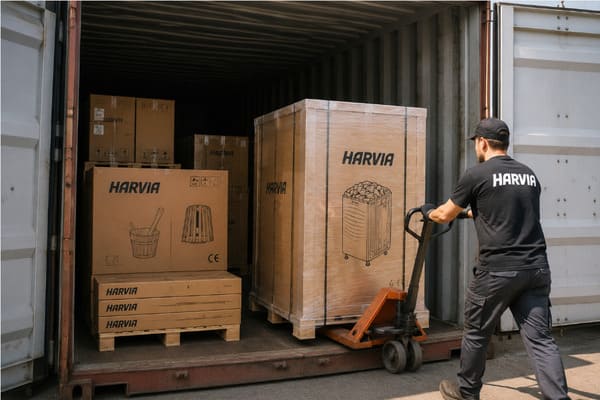
Minimum Orders, Consolidation, and Support
The unit price is only part of the cost. A punishing minimum order forces you to over-commit cash and warehouse space before you have proven the market. For context, ROC Sauna-Solution keeps order quantities flexible and agrees them per project, precisely because a serious buyer testing demand should not have to gamble on a full container on day one; contact our sales team for specific MOQ details.
Consolidation is the other quiet money-saver. Sourcing heaters from one place, controllers from another, steam generators from a third, and timber from a fourth is a logistics trap — every extra supplier is another chance for a delay or a mismatch. A partner who can ship heaters, controllers, steam generators, timber panels, and accessories in one order gives you one invoice, one shipment, and one point of accountability. If you want to go further and sell under your own name, an OEM/ODM-capable supplier can also produce private-label saunas to your specification — turning you from a reseller into a brand owner.
Conclusion
Choose by supplier type and proof, not just the quote. Run the red-flag list, demand the certification documents for your market, confirm a workable MOQ, and favor a partner who can consolidate your whole order — and, ideally, one who can supply genuine brand-name product and manufacture to your own spec. When in doubt, treat the supplier as a long-term partner, not a one-time vendor.
As an official authorized Harvia agent with over 12 years of OEM/ODM experience, ROC Sauna-Solution supplies genuine, certified sauna heaters, controllers, steam generators, timber panels, and accessories — as well as private-label OEM production — to brand owners, spa chains, hotel contractors, and wholesalers across 50+ countries, with flexible order quantities and full CE/ETL/RoHS documentation.
Comparing suppliers right now? Send us your model list and destination market — we'll reply with a quote, the matching certification documents, and a consolidation plan. Request a quote or download our product catalog here.
Frequently Asked Questions
What is the difference between a sauna manufacturer and a sauna supplier? A sauna manufacturer produces the goods, while a supplier delivers them to you — and some companies are both, which is often the strongest option. What matters most is whether they can guarantee genuine, certified product and handle the export process reliably, not the label they use.
How do I verify a sauna supplier is legitimate? Ask for certification documents (CE, ETL, RoHS) that name your exact model, confirm how many markets they have exported to, review the clients or projects they have served, and note how responsive they are before you place an order. Legitimate suppliers are transparent about all of this.
What is a reasonable minimum order when sourcing saunas? It varies widely. Large factories may require a full container, while more flexible partners accept smaller runs. ROC Sauna-Solution, for example, keeps order quantities flexible, which lets buyers test a market or restock without overcommitting; contact our sales team for specific MOQ details.
Can one supplier provide the heater, controller, and accessories together? Yes, and you should prefer those who can. Consolidating your order under one supplier reduces cost, simplifies logistics, and gives you a single point of accountability if anything needs sorting out.
Can a supplier make saunas under my own brand? Yes. An OEM/ODM-capable supplier can produce private-label saunas to your specification, branding, and packaging. This lets you sell under your own name instead of reselling someone else's, while still relying on the supplier's certified production and compliance documentation.
Are Chinese sauna suppliers reliable for export markets? They can be, provided they hold the correct certifications and have proven export experience. A supplier such as ROC Sauna-Solution — an official Harvia agent with 12+ years of OEM/ODM experience serving 50+ countries — combines competitive pricing, genuine brand-name product, and private-label capability with compliant documentation.
About ROC Sauna-Solution
ROC Sauna-Solution is a professional sauna supplier from China and an official authorized Harvia agent, with over 12 years of OEM/ODM experience. We supply commercial and residential sauna heaters, sauna rooms, controllers, steam generators, timber panels, and accessories — as well as private-label OEM production — to distributors, hotels, and wellness projects across 50+ countries. With flexible order quantities, full CE/ETL/RoHS documentation, and pre-shipment inspection, we help buyers source genuine, certified sauna products with confidence.
[^1]: "CE marking – obtaining the certificate, EU requirements", https://europa.eu. This official EU source confirms that CE marking is required before many products, including electrical and electronic equipment, can be sold in the EU, and that the manufacturer is responsible for ensuring compliance. Evidence role: expert_consensus; source type: government. Supports: CE marking is mandatory for electrical equipment sold in the European Economic Area. Scope note: CE marking is only required for products covered by harmonised EU rules.
[^2]: "When is CE Marking Not Required?", https://compliancetesting.com. This source explains that CE marking is a mandatory conformity mark acting as a "passport" across the EEA, and that the EU regularly fines or withdraws non-compliant products from the market. Evidence role: general_support; source type: education. Supports: CE acts as a passport across EU/EEA countries; non-compliant goods face legal action. Scope note: Requirements vary by product category and destination market.
[^3]: "Certificates - HUUM", https://huum.eu. This manufacturer source shows that reputable sauna brands publish CE and related certificates (SZU, ISO 9001) openly to give buyers confidence. Evidence role: example; source type: industry. Supports: Reputable sauna brands publish these certificates openly. Scope note: Specific certificates held vary by manufacturer.
[^4]: "ETL Listed Mark", Intertek, https://www.intertek.com/marks/etl/. Evidence role: direct_support; source type: accredited testing and certification body. Supports: North American markets require an ETL or UL/cETL listing demonstrating the equipment meets US and Canadian safety standards. Scope note: The specific standard applied depends on product type.
[^5]: "RoHS Directive", European Commission — Environment (official EU portal), https://environment.ec.europa.eu/topics/waste-and-recycling/rohs-directive_en. Evidence role: direct_support; source type: government (EU). Supports: The RoHS Directive restricts the use of specified hazardous substances in electrical and electronic equipment sold in the EU.
[^6]: "Using the UKCA marking", UK Government (GOV.UK), https://www.gov.uk/guidance/using-the-ukca-marking. Evidence role: direct_support; source type: government (UK). Supports: The UKCA mark is the conformity marking for products placed on the market in Great Britain, with CE accepted during a transition period. Scope note: Transition timelines and product scope are set by UK regulation and subject to change.
[^7]: "IEC 60335-2-53: Household and similar electrical appliances — Safety — Particular requirements for electric sauna heating appliances", International Electrotechnical Commission (IEC), https://webstore.iec.ch/publication/1627. Evidence role: general_support; source type: international standards body. Supports: Sauna heaters are tested against the IEC/EN 60335 electrical-safety basis, providing the batch test evidence buyers should request. Scope note: EN 60335 is the European adoption of the IEC standard.