You've already made the big decision — this build is infrared, not traditional. Now comes the harder, quieter question that decides whether the finished cabin actually performs: which heating components go inside it? Flat carbon panels or infrared tube emitters? How many, where on the wall, and how do they wire back to the control system? For a manufacturer, brand or bulk project buyer specifying dozens of cabins, getting this component layout right is the difference between a cabin that heats evenly and one that leaves cold spots — and between an order that's easy to service for years and one that isn't.
This article is not about whether to stock infrared at all — if you're still weighing that, see our guide on commercial infrared vs traditional saunas. This one assumes the infrared decision is made, and walks through selecting the infrared sauna panels and emitters inside the cabin: panel shapes and mounting positions, back and side coverage, seat count and component configuration, matching the control system, replaceable construction, the full component list, and the drawings and documents to confirm on a bulk order.
Carbon Panels vs Infrared Tube Heaters: The Core Choice
Everything downstream starts with the emitter type, so start here.
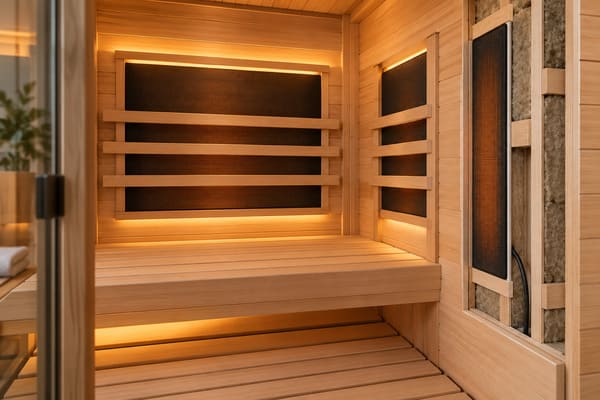
The core choice inside an infrared cabin is between flat carbon-crystal panels and infrared tube (rod) emitters. Carbon-crystal panels are thin, wide, flat emitters that spread lower-intensity heat evenly over a large surface, so they warm a broad area of the body gently at a lower surface temperature. Infrared tube emitters are compact, higher-intensity units that deliver more concentrated, deeper heat — often used for focused back treatment. Carbon-crystal panels suit even, comfortable whole-body warmth across bench-height walls; tube emitters suit targeted, higher-output zones. Most commercial cabins use a combination — panels for broad coverage plus a tube emitter where more intensity is wanted.
The practical trade-off for a buyer specifying cabins:
- Carbon-crystal panels — large flat area, even and gentle heat, lower surface temperature, comfortable against a wide span of the back and legs. Easy to mount flush across wall sections. The workhorse for even whole-body warmth.
- Infrared tube emitters — compact, higher intensity, concentrated output from a smaller footprint, typically for focused back treatment or where wall space is limited.
- Combination layouts — most well-designed commercial cabins mix both: broad carbon-crystal coverage on the main bench walls, with a tube emitter adding intensity where the layout calls for it.
There's no single "better" emitter — the right answer depends on cabin size, seat layout and the heat feel you want to deliver. This is exactly why the ROC Infrared Heating Panels set combines a 300 W infrared therapy tube, carbon-crystal wall panels in three sizes and glass foot-warming panels — so a cabin can be built from matching components rather than a single emitter type everywhere.
Panel Shapes, Sizes and Mounting Positions
Once the emitter type is chosen, the physical layout decides comfort.
Infrared panel shape, size and mounting position are chosen to match where the body sits against the cabin walls. Panels are positioned so heat reaches the back, sides and legs of a seated occupant directly, which means back-wall panels are mounted at seated-back height, side panels flank the shoulders, and foot or lower-leg heaters sit near floor level. Panel size is matched to the available wall area between the bench, the door and any window, so the emitter covers the body without wasting output on empty wall. Getting the positions right is what delivers even, direct warmth rather than heating the air around the occupant.
Think about the seated body and work outward:
- Back-wall panels — the largest coverage, mounted at the height a seated back rests against, so radiant heat reaches the spine and shoulders directly.
- Side panels — flank the occupant at shoulder/torso height, wrapping warmth around the sides rather than only from behind.
- Foot and lower-leg heaters — smaller emitters near floor level, because feet are furthest from the main panels and benefit from dedicated output.
- Sizing to the wall — panel dimensions are chosen to fit the usable wall area between bench, door and window, so output lands on the body, not on empty wall or behind the backrest.
This is why the seat layout drawing matters more than the cabin's outside dimensions — panels are fitted around the bather, sized to the seat positions rather than to the room volume.
Back and Side Coverage: Wrapping Heat Around the Occupant
Coverage is about surrounding the body, not just facing it.
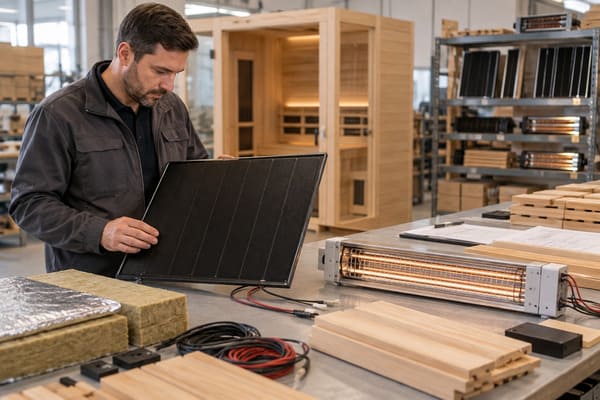
Good infrared coverage wraps heat around the occupant from the back and sides, not only from a single wall. A cabin with panels only on the back wall heats the spine but leaves the sides and front cool, so occupants feel unevenly warmed. Distributing emitters across the back wall plus the side walls — and adding foot heaters low down — surrounds the seated body with direct radiant heat from multiple directions. For multi-seat commercial cabins, coverage is planned per seat, so every occupant, not just the one in the middle, sits within direct reach of the panels.
The coverage principles:
- Back + sides together — back-only layouts leave cold flanks. Side panels close the gap so warmth arrives from several directions at once.
- Low-level foot heat — feet sit far from the main panels; dedicated foot-warming panels stop the "warm back, cold feet" complaint.
- Per-seat planning — in a two-, three- or four-person cabin, each seat needs its own coverage. Plan emitters so the end seats are as well-served as the centre, not just clustered where one person would sit.
Coverage planned per seat is the single biggest driver of perceived comfort in a commercial cabin — and it's decided entirely by the seat layout you supply.
Seat Count and Component Configuration
Component count scales with seating — predictably, if you plan it.
The number and configuration of infrared components is driven by the cabin's seat count and layout. A one- or two-person cabin needs fewer, smaller panels; a larger multi-seat commercial cabin needs more panels distributed across more wall area, plus additional foot heaters and often a higher total output. Each seat position adds a coverage requirement — back and side panels for that seat and a foot heater near it — so the component list scales with seating rather than with floor area alone. Configuring components per seat, and totalling them for the cabin, gives a predictable, repeatable specification across a bulk order.
A clean way to configure:
- Start from the seat layout — how many seats, and where each one sits along which walls.
- Assign coverage per seat — back panel(s), side panel(s) where the seat meets a side wall, and a foot-warming panel near each seat.
- Total per cabin — sum the carbon-crystal panels, tube emitter and foot panels into a per-cabin component set.
- Repeat across identical cabins — an order of identical cabins is just the per-cabin set multiplied, which keeps specification and pricing consistent.
Because the configuration is built from seats, mixed cabin types in one project stay manageable: define the component set for each cabin type once, then multiply. The ROC Infrared Heating Panels range gives you the tube, three carbon-crystal panel sizes and two foot-panel sizes to build these sets from matching parts.
Matching the Control System
Emitters are only half the system — the control must match them.
Infrared components must be matched to a compatible control system that can handle their total load and switching. The controller governs temperature, session timing and the on/off switching of the emitters, so it has to be rated for the combined wattage of all the panels and the tube emitter in the cabin, and wired to control them as intended. Mismatching the control to the emitters — too little capacity, or the wrong switching configuration — leads to unreliable heating or overloaded circuits. On a bulk order, the emitter set and its matched controller are specified together as a package, not sourced separately, so the total load and wiring are correct for every cabin.
What "matched" means in practice:
- Rated for total load — the controller must handle the sum of every emitter's wattage in the cabin, with headroom, not just a nominal figure.
- Correct switching — panels and tube emitter need to be wired and switched the way the controller expects, so zones behave as designed.
- Specified as a package — emitters + matched controller quoted and shipped together, so nothing is under-rated or incompatible on site.
The ROC panels are driven by a dedicated spectrum room controller on a 220–240 V supply, so the emitter set and its controller are specified as one package — the simplest way to avoid the classic field problem of panels that arrive fine but a controller that can't drive them all. It also makes the electrical spec identical and repeatable across every cabin in the order.
Replaceable Construction: Designing for Service Life
Commercial cabins run for years — components must be serviceable.
Infrared components should be specified so individual emitters can be replaced without dismantling the cabin. In commercial use, an emitter may eventually need replacement, and a design where a single panel or tube can be removed and swapped — rather than one where emitters are built permanently into the structure — keeps the cabin serviceable and minimises downtime. Buyers specifying bulk cabins should confirm that panels and the tube emitter are a replaceable component with available spare parts, and note the model and rating of each emitter so a matching replacement can be ordered later. Planning for replacement at the specification stage is what keeps a commercial installation running for its full service life.
Build service life in from the start:
- Removable, not built-in — specify emitters that can be individually removed and swapped, so a single failure doesn't mean rebuilding a wall.
- Spare-parts availability — confirm the panels and tube emitter are stocked as infrared sauna parts, so replacements can be sourced years after the original order.
- Record model and rating — note each emitter's size and wattage in the cabin documentation, so a like-for-like infrared sauna heater replacement can be ordered without guesswork.
For a commercial operator, "can I get a replacement emitter in two years" is as important as the initial heat performance — so confirm it before the order, not after.
The Full Component List to Specify
Pull it all together into one specification the factory can build from.
A complete infrared component specification lists every emitter and control element per cabin, with quantity, size and rating. It should cover the carbon-crystal wall panels (with size and wattage), the infrared tube emitter (with rating), foot-warming panels, the matched controller (rated for the total load), and the emitter placement per the seat layout. Listing components this way — item, quantity, size, rating, position — gives the manufacturer an unambiguous build spec and gives the buyer a repeatable configuration to reorder. It also becomes the reference for spare parts and future replacements.
As a worked reference, the ROC Infrared Heating Panels set is a six-panel configuration you can specify from directly:
| Component | Size | Rating | Role |
|---|---|---|---|
| Infrared therapy tube | slatted wooden housing | 300 W | Focused back treatment |
| Carbon-crystal wall panel (L) | 1000 × 400 mm | 350 W | Main back/side coverage |
| Carbon-crystal wall panel (M) | 1000 × 300 mm | 300 W | Back/side coverage |
| Carbon-crystal wall panel (S) | 600 × 300 mm | 180 W | Narrow walls / infill |
| Foot-warming panel (L) | 1000 × 350 mm | 120 W | Floor-level foot heat |
| Foot-warming panel (S) | 700 × 350 mm | 70 W | Floor-level foot heat |
| Spectrum room controller | 220–240 V | — | Rated for total emitter load |
Kept this way, the list doubles as the reorder and spare-parts sheet: every emitter's size and rating is recorded, so identical cabins reorder cleanly and future replacements match exactly. Note that this is a component specification — it defines the heating parts inside the cabin, not the whole-appliance certification of the finished sauna, which is handled separately. (The ROC panels are CE marked as standard, with UL certification available on request per project.)
Drawings and Documents to Confirm on a Bulk Order
Before a bulk order is placed, a few documents lock the specification.
Before placing a bulk infrared order, confirm the cabin drawings, seat layout, emitter placement plan, component list and electrical rating in writing. The cabin drawing and seat layout drive panel positions; the emitter placement plan shows where each panel, tube emitter and foot panel mounts; the component list states quantities, sizes and ratings; and the electrical documentation confirms the controller is rated for the total load. Confirming these together, per cabin type, before production means every cabin in the order is built to the same verified specification — and gives the buyer a complete record for installation, service and future reorders.
The documents worth confirming up front:
- Cabin drawing + seat layout — the basis for everything; panels follow the seats.
- Emitter placement plan — a drawing showing each panel, tube emitter and foot panel's mounting position.
- Component list with ratings — quantities, sizes and wattages per cabin type.
- Electrical / control documentation — confirming the controller is rated for the combined emitter load and wired correctly, plus the certification you need for your market (CE as standard, UL on request).
Confirm these per cabin type before production, and the whole order is built to one verified spec — no cabin-to-cabin surprises, and a full record for the operator's installation and service teams.
From Cabin Drawing to Component Configuration and Quote
With the method clear, the fastest route is to configure the components with us from your drawings.
For a bulk infrared project, send us your cabin drawings, seat layout and the number of cabins, and we can turn them into an emitter placement plan and full component list — carbon-crystal panels, the tube emitter, foot panels and a matched spectrum room controller, with quantities and ratings per cabin type — and a quote to match. Because the ROC Infrared Heating Panels set supplies the tube, carbon-crystal panels in multiple sizes, foot panels and the matched controller as one coordinated range — available OEM/ODM under your own brand — we can configure the whole cabin from matching parts rather than mixing incompatible components, and keep the same spec repeatable across every cabin in the order.
To configure accurately, it helps to include: internal cabin dimensions, the seat layout (how many seats and where), door and window positions, your preference on carbon-crystal panels vs a tube emitter (or let us recommend a mix), the certification your market needs, and how many identical cabins the project requires. With those, we can return an emitter placement plan, a component list with ratings, and a bulk quote.
Conclusion
Once the infrared decision is made, cabin performance comes down to the components inside. Choose deliberately between carbon-crystal panels and an infrared tube emitter — or a mix; position panels to wrap heat around the seated body from the back, sides and feet; scale the component count from the seat layout, not just floor area; match the controller to the total emitter load; and specify replaceable emitters with available spares so the cabin stays serviceable for years. Capture it all in a component list and confirm the drawings, placement plan and electrical rating before a bulk order. Do that, and every cabin in the order heats evenly, wires correctly and can be serviced for its full life.
Have your cabin drawings and seat layout ready? Send them to ROC Sauna-Solution and we'll turn them into an emitter placement plan, a full component list with ratings, and a bulk quote — built from matching infrared parts. Start your enquiry here. You can also ask our AI assistant your infrared sauna panels and component questions.
Frequently Asked Questions
What's the difference between carbon panels and infrared tube heaters? Carbon-crystal panels are thin, wide, flat emitters that spread lower-intensity heat evenly over a large surface, so they warm a broad area of the body gently at a lower surface temperature. Infrared tube (rod) emitters are compact, higher-intensity units that deliver more concentrated heat from a smaller footprint, often used for focused back treatment. Carbon-crystal panels suit even, comfortable whole-body warmth across bench-height walls, while tube emitters suit targeted, higher-output zones or spots where wall space is limited. Most commercial cabins use both — broad carbon-crystal coverage plus a tube emitter where more intensity is wanted — so the right answer is usually a deliberate mix rather than one type everywhere.
How many infrared panels does a commercial sauna cabin need? The number is driven by the seat count and layout, not floor area alone. Each seat needs back panel coverage at seated-back height, side panels where the seat meets a side wall, and a foot panel near floor level, so the component count scales with the number of seats. A one- or two-person cabin needs fewer, smaller panels; a larger multi-seat cabin needs more panels distributed across more wall area plus additional foot panels. The reliable method is to assign coverage per seat, total the components per cabin, then multiply across identical cabins for a consistent bulk specification.
Do infrared sauna panels need a special control unit? Yes — the controller must be matched to the emitters. It governs temperature, session timing and the switching of the panels and tube emitter, so it has to be rated for the combined wattage of every emitter in the cabin and wired to control them as intended. Mismatching the control — too little capacity or the wrong switching configuration — leads to unreliable heating or overloaded circuits. On a bulk order, specify the emitter set and matched controller together as a package so the total load and wiring are correct for every cabin.
Can individual infrared emitters be replaced? They should be. In commercial use an emitter may eventually need replacing, so specify a design where a single panel or tube can be removed and swapped without dismantling the cabin, rather than emitters built permanently into the structure. Confirm the panels and tube emitter are available as spare parts, and record each emitter's size and rating in the cabin documentation so a matching infrared sauna heater replacement can be ordered later. Planning for replacement at the specification stage keeps a commercial installation running for its full service life.
What documents should I confirm before placing a bulk infrared order? Confirm the cabin drawing and seat layout, an emitter placement plan, a component list with ratings, and the electrical documentation — all per cabin type, in writing, before production. The drawing and seat layout drive panel positions; the placement plan shows where each panel, tube emitter and foot panel mounts; the component list states quantities, sizes and wattages; and the electrical documentation confirms the controller is rated for the total emitter load and carries the certification your market needs. Confirming these together means every cabin is built to the same verified specification, and gives you a complete record for installation, service and future reorders.