Infrared saunas are everywhere in the wellness press right now, and every sauna distributor, importer, and facility owner faces the same question: which type should I stock or install, and which performs better in a commercial setting? It's a fair question — but the answer that works for a home buyer is often the wrong answer for a business. Let me break it down from a commercial point of view, not a consumer's.
For most commercial settings — gyms, hotels, spas — a traditional electric sauna is the more robust, higher-capacity choice[^1], while a commercial infrared sauna suits low-traffic wellness studios and clients who prefer a gentler, lower-temperature session. The right pick depends on your traffic, your positioning, and your running costs, not on which one is trending.

Before you compare heating types, make sure you're shopping commercial in the first place — the difference between a home and a commercial sauna is bigger than most buyers expect. Once that's clear, here's how infrared and traditional actually stack up for a paying facility.
How Is a Commercial Infrared Sauna Different from a Traditional One?
The two heat you in completely different ways, and that difference drives everything else — comfort, capacity, and cost.
A traditional sauna heats the air with an electric heater and rocks, warming the room to around 65–90°C[^2] so your body heats from the surrounding air. A commercial infrared sauna uses infrared emitters to warm your body directly at a much lower air temperature, typically around 43–57°C[^3], so the room feels gentler while still making you sweat.

Because infrared warms the body rather than the air, guests often find it more tolerable and can stay longer without the intense heat of a traditional room [^1]. A traditional sauna, on the other hand, delivers that classic high-heat, steam-and-löyly experience[^4] many spa and gym members specifically expect. Neither is "better" — they're different products for different audiences, and that's exactly the decision you're making for your facility.
What Are the Health Benefits Guests Are Looking For?
Your members don't buy heating technology — they buy how the session makes them feel. Knowing what each delivers helps you market it.
Both types make users sweat and raise the heart rate[^5], and research links regular sauna use to relaxation and cardiovascular benefits[^6]. Infrared's appeal is that it produces a similar effect at a lower, more comfortable temperature, which suits guests who can't tolerate intense heat.
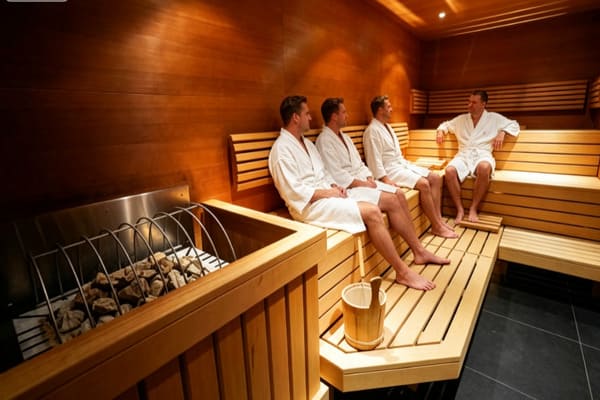
Infrared saunas can create a workout-like response at lower temperatures, which makes them accessible to people who find a traditional sauna too hot [^2]. That said, the health research is still developing and no sauna is a medical treatment — so market the experience (recovery, relaxation, wellness) rather than making clinical claims. For a gym or spa, that "gentler but still effective" angle is a genuine selling point for a certain type of member.
Which Handles Commercial Traffic Better?
This is where the home-versus-business gap really shows. A unit that's perfect in someone's garage can struggle under all-day commercial use.
Traditional electric saunas are generally better suited to high, continuous commercial traffic — they reheat quickly between guests and hold up to constant back-to-back sessions. A commercial infrared sauna is often a smaller-capacity, cabin-style unit better matched to lower-volume, appointment-based wellness settings.
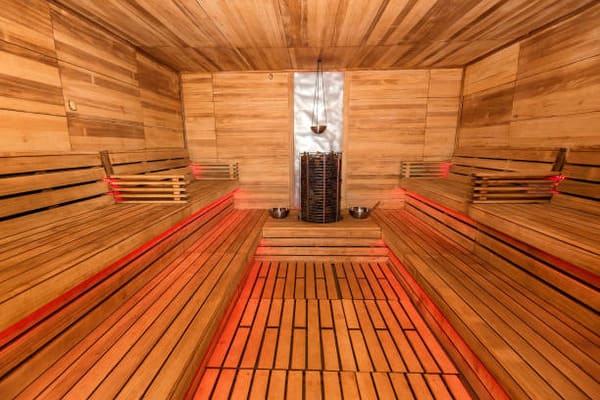
Think about your peak hour. A busy gym or hotel spa with a steady stream of users needs a room that recovers heat fast and seats several people at once — that's traditionally the traditional sauna's strength. Many infrared units are designed for one to a few users, which fits a boutique studio or a private wellness suite far better than a packed 6 p.m. gym floor. Match the technology to your throughput, or you'll create a bottleneck.
Which Costs More to Run?
Sticker price is only half the story for a business. What matters is the daily cost of keeping the amenity open.
Infrared saunas generally draw less power per session and heat up almost instantly, which can lower running costs for low-traffic use. Traditional saunas use more energy to heat the air but serve more people per session, so cost-per-guest can actually be lower in a high-traffic facility.
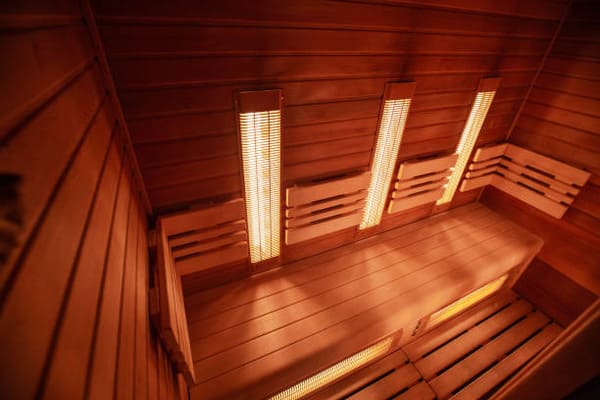
Here's the operator's math: an infrared unit sitting idle most of the day, switched on per booking, is cheap to run. But a traditional sauna serving 8 people at once during a busy block spreads its energy cost across far more guests. So the real question isn't "which uses less electricity" — it's "which gives me the lowest cost per paying guest at my actual traffic level." Run that number against your peak hours before you decide.
Commercial Infrared vs Traditional: Quick Comparison
| Factor | Commercial Infrared Sauna | Traditional Electric Sauna |
|---|---|---|
| Heat method | Warms the body directly | Warms the air (65–90°C) |
| Temperature | Lower (~43–57°C), gentler | Higher, classic sauna heat |
| Best for | Boutique studios, wellness suites, low traffic | Gyms, hotels, spas, high traffic |
| Capacity | Usually 1–few users | Scales to 6–12+ users |
| Heat-up time | Almost instant | Longer warm-up |
| Running cost | Low per session | Low per guest at high volume |
| Guest expectation | Gentle, modern wellness | Classic sauna experience |
Use this as a starting filter, then pressure-test it against your own venue, traffic, and brand positioning.
Conclusion
A commercial infrared sauna is a strong fit for boutique studios and wellness suites where sessions are gentle, private, and appointment-based. But for a gym, hotel, or busy spa serving many guests through a peak hour, a traditional electric sauna usually wins on capacity, durability, and cost-per-guest. Decide on your traffic and positioning first — the heating technology should follow that, not the trend cycle.
If your setting is a busy gym, hotel, or spa serving guests through peak hours, a traditional electric sauna is almost always the more robust, higher-capacity choice — and that's exactly what we build. Tell us your market or venue and your capacity needs, and we'll help you spec the right traditional commercial sauna, from single units to full containers. Browse our commercial saunas to get started.
[^1]: "What is the minimum room size needed for an indoor sauna?", https://saunum.com/en/blog/what-is-the-minimum-room-size-needed-for-an-indoor-sauna/. A commercial sauna design or public-facility planning source can substantiate that conventional sauna rooms are commonly specified for larger shared occupancy and repeated public use; this supports the capacity context, not a universal performance guarantee for every model. Evidence role: general_support; source type: institution. Supports: Traditional electric saunas are typically better suited to higher-capacity commercial use than small infrared cabins.. Scope note: Capacity and robustness depend on heater sizing, room construction, ventilation, and maintenance practices. [^2]: "Finnish sauna - Wikipedia", https://en.wikipedia.org/wiki/Finnish_sauna. A clinical review or encyclopedia entry can document that Finnish or traditional saunas commonly operate at approximately 70–100°C, placing the article’s 65–90°C range within accepted conventional sauna temperatures. Evidence role: definition; source type: paper. Supports: Traditional saunas commonly operate in the high-temperature range stated in the article.. Scope note: Reported temperature ranges differ by sauna tradition, sensor location, humidity, and operating protocol. [^3]: "Infrared Saunas: What They Do and 6 Health Benefits", https://health.clevelandclinic.org/infrared-sauna-benefits. A medical reference can support that infrared saunas are commonly operated at about 110–135°F, or roughly 43–57°C, which aligns with the article’s stated lower-temperature range. Evidence role: definition; source type: institution. Supports: Infrared saunas typically operate around 43–57°C.. Scope note: Commercial infrared models may advertise different temperature ranges depending on emitter type and cabin design. [^4]: "Finnish sauna - Wikipedia", https://en.wikipedia.org/wiki/Finnish_sauna. An encyclopedia or cultural-history source can define löyly as the steam or heat sensation produced by throwing water on heated sauna stones in Finnish sauna practice, supporting the article’s description of the traditional sauna experience. Evidence role: historical_context; source type: encyclopedia. Supports: Traditional saunas are associated with high heat and löyly produced from heated stones and water.. Scope note: This supports the cultural and technical meaning of löyly, not the market expectation of every gym or spa member. [^5]: "Can regular sauna sessions support a healthy heart? - Harvard Health", https://www.health.harvard.edu/heart-health/can-regular-sauna-sessions-support-a-healthy-heart. A physiological study or medical review can document that sauna bathing produces acute cardiovascular responses, including increased heart rate and changes in circulation, similar in some respects to mild-to-moderate exercise stress. Evidence role: mechanism; source type: paper. Supports: Sauna sessions can acutely raise heart rate.. Scope note: The magnitude of heart-rate response varies with temperature, humidity, session duration, hydration, age, and cardiovascular health. [^6]: "Sauna use linked to longer life, fewer fatal heart problems", https://www.health.harvard.edu/blog/sauna-use-linked-longer-life-fewer-fatal-heart-problems-201502257755. Peer-reviewed reviews of Finnish sauna bathing report associations between regular sauna use and cardiovascular outcomes, including blood pressure, vascular function, and reduced cardiovascular risk markers; these findings are largely observational and do not establish sauna use as a medical treatment. Evidence role: expert_consensus; source type: paper. Supports: Regular sauna use has been associated in research with relaxation and cardiovascular benefits.. Scope note: Much of the cardiovascular evidence is observational, often based on Finnish sauna populations, and may not generalize to all sauna types or users. [^7]: "Infrared Sauna: Health Benefits, Risks, and More", Cleveland Clinic, https://health.clevelandclinic.org. Used for infrared vs traditional temperature ranges and direct-body heating comfort. [^8]: "Infrared sauna: What's the buzz?", Mayo Clinic, https://www.mayoclinic.org. Used for lower-temperature effect and developing state of the health research.