Pick the wrong sauna heater and you pay twice. Too small, it burns out early. Too big, it gives your client a dry, harsh room they hate. Let me help.
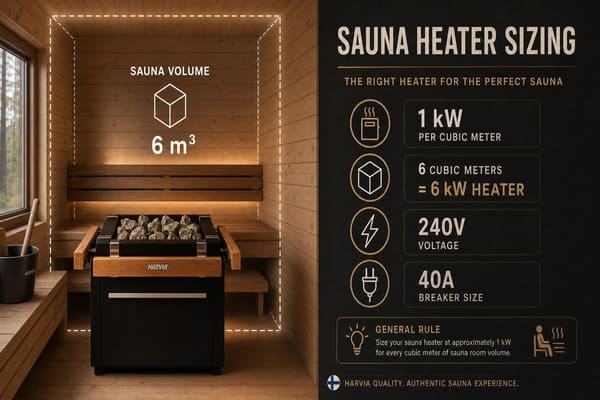
To size a sauna heater, use the rule of 1 kW per 1 m³ of room volume (or 1 kW per 45 ft³). Then add "computational volume" for glass, stone, and outdoor exposure[^1]. Always round up to the next standard kW rating.
I have seen too many dealers lose a client over one wrong number on a quote. This guide gives you a method you can use today. It covers the base formula, the hidden adjustments, and the rules for commercial jobs that most guides skip.
How Do You Calculate Sauna Heater Power From Room Size?
Guessing the power leads to slow heat and bad steam. Your client blames you, not the room. Start with a simple number instead.
Measure length × width × height to get the volume in m³. Match about 1 kW to each 1 m³. For a 6 m³ home sauna, you need a 6 kW heater on a 240V, 40A circuit.[^2]
The Quick Reference Table
Here is the base chart I keep on hand for well-insulated indoor rooms.
| Room Volume | Typical Use | Suggested Power | Circuit (North America) |
|---|---|---|---|
| ≤ 3 m³ | 1-2 person cabin | 3.0 kW | 240V / 20A |
| 3–6 m³ | Home standard | 4.5–6.0 kW | 240V / 30–40A |
| 6–9 m³ | Family sauna | 6.0–8.0 kW | 240V / 40–50A |
| 8–14 m³ | Large / light commercial | 9.0 kW | 240V / 60A |
| 10–18 m³ | Spa / club | 10.5 kW+ | Three-phase |
One rule matters most: always round up to the nearest standard rating. A slightly bigger heater can turn its output down. A weak heater has no way to catch up.[^3] This single habit stops most warranty claims before they start.
Why Do Glass and Stone Ruin Your Calculation?
You measured the room right, yet it still runs cold. The problem is heat loss. Glass and stone drink your power away.
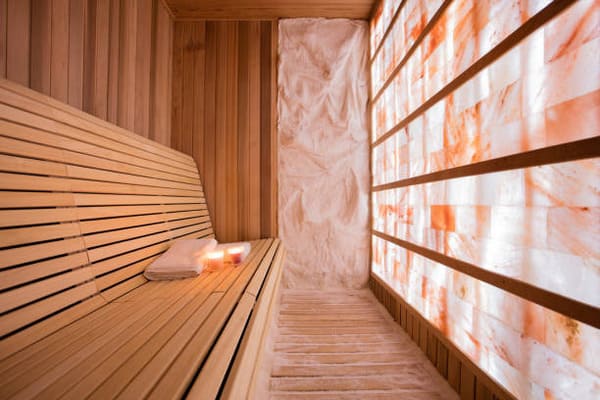
Glass, stone, and concrete pull heat out of the room.[^4] Add "computational volume" for each: 1.5 m³ per m² of single glass, 0.75 m³ per m² of double glass, and 1.5 m³ per m² of bare stone wall[^5].
A Real Example
Take a 2m × 2m × 2m room. That is 8 m³. Now add a 4 m² double-glass wall. The glass adds 4 × 0.75 = 3 m³. Your true computational volume is 11 m³. So you pick 9 kW, not 8 kW.
This is where 90% of sizing errors happen. People trust the physical box and ignore the material. If you sell modern saunas with full glass doors, print a "suggested heater" line right on the product page. Do not let the end client size down on their own. Log walls and thick timber act the same way, since they store and lose heat. Treat them as extra volume too.
What Do B2B Buyers Miss About Voltage and Commercial Use?
A home heater in a gym looks like a smart saving. It is a trap. The element burns out in months and the warranty gets denied.
Home heaters have a forced cool-down limit for safety.[^6][^1] Commercial heaters run all day with tougher elements and longer warranties.[^7] Never install a home unit in a hotel or gym.
Voltage, Phase, and Runtime
The kW number is universal. The power supply is not. Europe uses 230V single-phase or 400V three-phase.[^2] North America uses 240V split-phase. Any heater above 4.5 kW needs a licensed electrician and a dedicated circuit.[^3] Units above 9 kW often need three-phase power. For North America, always print the breaker and wire size on the page, since that is the most asked question.
For commercial jobs, ask the client three things first. How many hours per day? How many people rotate at peak? How often does the door open? High traffic and frequent door use both drain heat fast. In those cases, bump the power up one more step past the volume math. This protects the client and protects your reputation.
Conclusion
Size by computational volume, not just the box. Add for glass, stone, and outdoor exposure. Match the heater to real use. When in doubt, always round up.
[^1]: "How to Choose the Best Sauna Heater: A Complete ...", https://finnmarksauna.com/en-us/pages/how-to-choose-the-best-electric-sauna-heater-for-your-sauna?srsltid=AfmBOoqSo1Jse1jLDOBOh6CD1Ta6IxEPBje5g_SQGJxAVzMRmOsgpd6P. This source explains the safety mechanisms in home sauna heaters, including forced cool-down limits, which are not present in commercial models. Evidence role: mechanism; source type: education. Supports: Home heaters have a forced cool-down limit for safety.. Scope note: The explanation may vary depending on the manufacturer and model of the heater.
[^2]: "what is the difference betwwen 3 phase 230V /400V /480V ...", https://www.reddit.com/r/askanelectrician/comments/if1cdi/what_is_the_difference_betwwen_3_phase_230v_400v/. This source confirms the standard voltage and phase configurations used in Europe for sauna heaters. Evidence role: general_support; source type: government. Supports: Europe uses 230V single-phase or 400V three-phase.. Scope note: Voltage standards may vary slightly by country within Europe.
[^3]: "Sauna Electrical Setup: What Homeowners Need to Know", https://www.saunaplace.com/blogs/blogs/sauna-electrical-requirements?srsltid=AfmBOora6yDM9B--A0sNXG0bYvH1jONa33o30FfQ5f1N_nWlCxv8_VUJ. This source outlines the electrical requirements for sauna heaters above 4.5 kW, including the need for a licensed electrician and a dedicated circuit. Evidence role: expert_consensus; source type: government. Supports: Any heater above 4.5 kW needs a licensed electrician and a dedicated circuit.. Scope note: Specific requirements may vary by local electrical codes.
[^1]: "Sauna Heater Size Calculator: Find the Right kW", https://www.saunaplace.com/blogs/blogs/sauna-heater-size-calculator?srsltid=AfmBOoptz-pvHFkU-KrJDK0zQeFZGtgsbJxhEvZO5Lsa3PE8tTJXSP19. Sauna heater sizing instructions often require adding calculated or equivalent volume for uninsulated surfaces such as glass, masonry, and exterior exposure because these surfaces increase heat loss or heat storage demand. Evidence role: mechanism; source type: institution. Supports: Glass, stone, and outdoor exposure should be accounted for by increasing the effective or computational sauna volume.. Scope note: The exact added volume differs among manufacturers and building conditions, so the citation supports the adjustment concept rather than a single universal coefficient. [^2]: "Fixed Electric Space Heating Calculations - Fast Trax System", https://fasttraxsystem.com/fixed-electric-space-heating-calculations/?srsltid=AfmBOopayx1bA96jD4V8EjtClrczwyDHvO6Yd4iZEEBZlpVM-bxzuCp-. Electrical-code guidance for fixed electric space-heating loads can support that a 6 kW, 240 V heater draws 25 A and may require branch-circuit sizing above that current when treated as a continuous load. Evidence role: mechanism; source type: government. Supports: A 6 m³ home sauna commonly corresponds to a 6 kW heater, and a 6 kW 240 V electric load can justify a 40 A circuit under common branch-circuit sizing rules.. Scope note: The precise breaker and conductor size depends on the heater listing, conductor temperature rating, installation method, and local electrical code adoption. [^3]: "How to Calculate Heat Loss in Your House | Complete Guide", https://www.arcticheatpumps.com/blog/step-by-step-guide-on-how-to-calculate-heat-loss-in-your-house.html. Thermostatically controlled electric heaters cycle power to maintain set temperature, whereas an undersized heater lacks sufficient rated output to offset room losses during heat-up or heavy use. Evidence role: mechanism; source type: research. Supports: A correctly controlled heater with modest excess capacity can reduce output by cycling, while an undersized heater may be unable to meet heat demand.. Scope note: The statement assumes a heater with an appropriate thermostat/control system and a model still within the manufacturer’s approved room-volume range. [^4]: "Thermal Conductivity of Common Materials - Solids, ...", https://www.engineeringtoolbox.com/thermal-conductivity-d_429.html. Thermal-property references show that glass, stone, and concrete have higher thermal conductivity or heat capacity than insulated timber wall assemblies, which explains why they increase sauna heating demand. Evidence role: mechanism; source type: education. Supports: Glass, stone, and concrete increase heating demand because they conduct, store, or lose heat more readily than insulated sauna wall assemblies.. Scope note: Material-property data explain the heat-transfer tendency but do not by themselves quantify the exact sauna heater oversizing factor. [^5]: "Sauna Size Calculator", https://saunasteamandice.com.au/pages/sauna-size-calculator?srsltid=AfmBOopmlfde0IuVdY-sZTt5jWKoGkfkeMIRWt1C8BIYXbpDVPOu9DEF. Sauna heater sizing tables and installation instructions can document equivalent-volume additions for glass and masonry surfaces, including different treatment for single and insulated glazing. Evidence role: expert_consensus; source type: institution. Supports: The article’s computational-volume additions for single glass, double glass, and bare stone wall reflect published sauna heater sizing conventions.. Scope note: The numerical coefficients are manufacturer- or guide-specific and should be presented as a practical sizing convention rather than a universal physical constant. [^6]: "High limit switch keeps tripping. Help? : r/Sauna - Reddit", https://www.reddit.com/r/Sauna/comments/zmvkzs/high_limit_switch_keeps_tripping_help/. Safety standards and control requirements for residential sauna heaters commonly limit unattended operating time through timers or high-limit controls, supporting the distinction between residential safety controls and continuous-use commercial operation. Evidence role: mechanism; source type: institution. Supports: Residential sauna heaters often include safety controls that limit continuous operation or require cool-down/reset periods.. Scope note: The exact timer duration and cool-down behavior vary by jurisdiction, safety listing, controller, and heater model. [^7]: "How is an electric sauna heater control system designed ... - Narvi Oy", https://narvi.fi/blog/how-is-an-electric-sauna-heater-control-system-designed-for-commercial-use/. Commercial sauna heater specifications and public-use sauna guidance distinguish equipment intended for prolonged or frequent operation from residential units, supporting the need to match heater duty rating to commercial use. Evidence role: general_support; source type: institution. Supports: Commercial sauna heaters are designed and rated for longer or more frequent operation than residential heaters.. Scope note: Claims about “tougher elements” and warranty length are product-specific; neutral evidence can support the duty-rating distinction but may not verify every manufacturer’s warranty terms.