Big sauna cabins. Sky-high LCL freight. Split shipments that stall your project for weeks. Sound familiar? There is a smarter way to buy. I’ve seen it happen too many times. Senders of sauna equipment pay way more in freight, wait weeks for partial shipments to arrive, and then realize they could have saved time and money with one smart decision. What if there was a way to reduce delays, cut freight costs, and get everything you need all at once? That’s where mixed full containers come in.
A mixed full container is when you combine different sauna product types and models in one dedicated container.[^1] You import once, clear customs once, and get all your goods ready for use or sale when they arrive. It cuts down on freight costs, lowers the risk of damage, and ensures your project stays on track. That’s the key to efficient and reliable sauna supply chain management.
I’ve shipped sauna equipment for over a decade. In that time, I’ve seen buyers waste money on freight and lose weeks waiting for split cargo. Let me show you how to plan one smart container instead.
What Exactly Is a Sauna Equipment Mixed Full Container?
Buying multiple sauna models in small amounts feels risky. Single-model MOQs block you. Mixed loading breaks that wall.
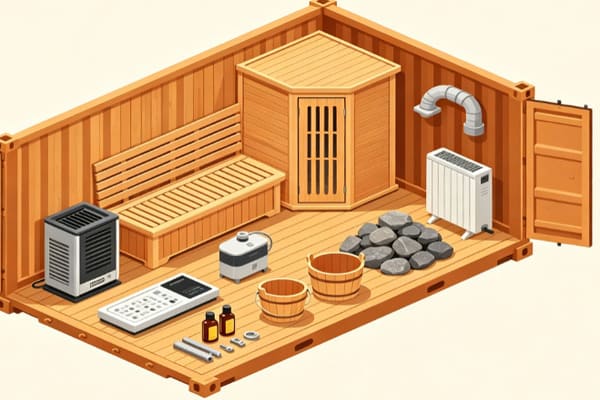
A mixed full container is when you pack many categories and models into one private container. You can combine traditional and infrared saunas, heaters, stones, controllers, lighting, buckets, oils, and spare parts. It gives you full control over stacking and far lower damage risk.
What You Can Load Together
| Category | Example Items |
|---|---|
| Sauna cabins | Traditional and infrared, various sizes |
| Heaters | Sauna stoves, sauna stones |
| Electrical parts | Controllers, lighting, thermo-hygrometers |
| Accessories | Buckets, ladles, headrests, essential oils |
| Spare parts | Wear-part kits |
Compare this with LCL. With LCL, you share space and give up control. With a single-product container, you wait for many batches and clear customs many times. Mixed loading solves both. My rule of thumb: once cargo passes about 13–15 CBM, LCL freight plus destination unpacking fees often match or beat a 20GP container[^2]. At that point, a full container almost always wins.
I have shipped sauna equipment for over a decade. In that time, I have seen buyers waste money on freight and lose weeks waiting for split cargo. Let me show you how to plan one smart container instead.
How Do You Plan a Container Around Your Delivery Deadline?
A rushed order and a big project need very different plans. Buy without a timeline, and delay will find you.
Match your stock plan to your deadline. Rush orders need in-stock models on fast vessels. Regular orders follow standard production with locked shipping slots. Project orders ship in phased batches to match construction progress and lock in prices early.
Three Common Timelines
| Scenario | Timeline | Best Approach |
|---|---|---|
| Rush order | 2–4 weeks | In-stock models, fast shipping; air-freight small urgent parts, sea-freight the rest |
| Regular order | 6–10 weeks | Standard production, pre-booked slots, best cost |
| Project order | 3+ months | Phased container shipments matched to site progress |
A good supplier gives you a clear schedule at the quote stage. That schedule shows production time, loading date, transit time, and arrival. Uncertainty is the real cause of project delay. When I quote a client, I put dates on paper first. This lets the buyer plan warehouse space, staff, and cash flow. It also protects long orders from raw material and freight price swings.
I have shipped sauna equipment for over a decade. In that time, I have seen buyers waste money on freight and lose weeks waiting for split cargo. Let me show you how to plan one smart container instead.
Which Container Type Fits Your Purchase Scale?
Pick the wrong container, and you either overpay or run out of space. Both hurt your margin.
Small buyers under 15 CBM should use LCL or fill a 20GP with accessories. Mid-size dealers should choose a 40HQ mixed container of about 76 CBM[^3]. Chain projects should run phased containers with a yearly framework deal.
Match Scale to Container
| Your Scale | Recommended Plan |
|---|---|
| First trial / small SPA | LCL, or fill a 20GP with accessories to lower per-unit cost |
| Mid dealer / single hotel | 40HQ mixed container, best for bulky cabins |
| Chain project / large distributor | Phased containers plus yearly framework agreement |
Here is my advice for new dealers. A mixed container is a great test tool. Do not bet on one model. Load 5–8 models in small amounts in your first container. Then let real sales data pick your future top sellers. This lowers risk and shows you the market before you commit big money. I have watched many buyers grow this way, from one trial box to steady annual programs.
I have shipped sauna equipment for over a decade. In that time, I have seen buyers waste money on freight and lose weeks waiting for split cargo. Let me show you how to plan one smart container instead.
How Do You Load a Container to Cut Freight by Over 30%?
Sauna cabins are light but bulky. Poor loading burns your money in wasted air space and freight cost.
Use flat-pack cabins to add 30–50% loading volume.[^4] Ask for a 3D loading plan that puts heavy heaters and stones at the bottom and boards standing up. Reinforce glass doors and controllers, and record the whole loading process on camera.

Loading Methods That Save Money
| Method | Benefit |
|---|---|
| Flat-pack packing | Adds 30–50% loading volume |
| 3D loading plan | Balances heavy and light cargo, uses every cubic meter |
| Reinforced packing | Protects glass doors and electronic controllers |
| Photo and video record | Proof of condition and seal number |
Sauna cabins are classic light cargo. Volume, not weight, sets your cost.[^5] So the fill rate decides your landed price. A skilled supplier lays heavy heaters and stones first. Then boards stand up. Then accessories fill the gaps. Glass doors and controllers get wood frames, foam, and corner guards. During loading, we shoot photos layer by layer and log the seal number. We send it all to the buyer at once. That gives peace of mind and a record if any claim comes up.
I have shipped sauna equipment for over a decade. In that time, I have seen buyers waste money on freight and lose weeks waiting for split cargo. Let me show you how to plan one smart container instead.
What Hidden Details Must You Confirm Before Buying?
These details stay quiet until they blow up. Then you face held containers and stuck customs.
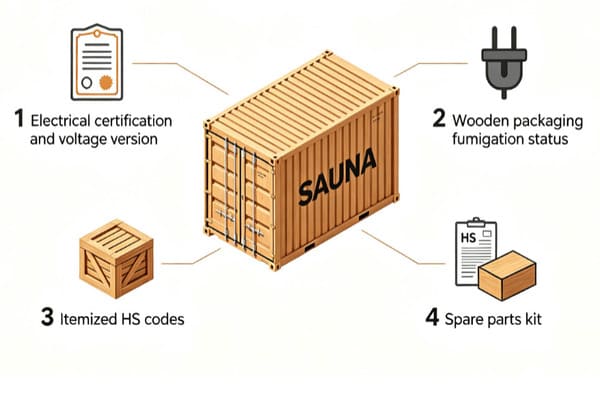
Confirm four things: electrical certification and voltage version, wood packaging fumigation, item-by-item HS codes, and a spare parts kit. Miss any one, and you risk customs delay, cargo detention, or angry end customers.
The Four Must-Check Items
| Item | Requirement |
|---|---|
| Certification and voltage | ETL/UL 110–120V/60Hz for North America; CE 220–240V/50Hz for Europe |
| Wood fumigation | Meet ISPM15 standard or use treated plywood |
| HS codes | List every code on invoice and packing list |
| Spare parts kit | Add 3–5% wear parts: heating elements, thermostats, hinges |
If your container ships to different markets, confirm each unit’s voltage. Ask the supplier to mark it by zone on the carton. Wood that fails ISPM15 can hold your whole container. A mixed container has many HS codes, so list each one clearly.[^6] That keeps customs smooth. And always add spare parts. A broken unit that waits three months for a part hurts your end customer most.
I have shipped sauna equipment for over a decade. In that time, I have seen buyers waste money on freight and lose weeks waiting for split cargo. Let me show you how to plan one smart container instead.
Conclusion
A mixed full container means lower trial cost, faster cash flow, and a simpler supply chain. The key is a supplier who knows the product, the loading, and your market rules.
[^1]: "LCL - Wikipedia", https://en.wikipedia.org/wiki/LCL. A standard logistics reference defining full container load as the use of an entire container by one shipper supports the container-control aspect of this definition; the term “mixed full container” is an applied commercial phrase rather than a formal Incoterms or customs term. Evidence role: definition; source type: encyclopedia. Supports: A mixed full container is when you combine different sauna product types and models in one dedicated container.. Scope note: The source will likely define FCL generally, not sauna-specific mixed loading. [^2]: "How to Calculate Ocean Freight Charges (FCL & LCL) - iContainers", https://www.icontainers.com/help/how-to-calculate-ocean-freight-charges/. A freight-pricing source explaining LCL weight/measure charging, destination handling fees, and FCL container-rated pricing supports the break-even logic behind the 13–15 CBM rule of thumb; the exact threshold is route- and rate-dependent and should be treated as an illustrative estimate. Evidence role: mechanism; source type: other. Supports: Once cargo passes about 13–15 CBM, LCL freight plus destination unpacking fees often match or beat a 20GP container.. Scope note: This does not establish a universal 13–15 CBM threshold for all ports, seasons, or commodities. [^3]: "40' Standard High Cube - Hapag-Lloyd", https://www.hapag-lloyd.com/en/services-information/cargo-fleet/container/40-standard-high-cube.html. A container-specification reference listing the internal volume of a 40-foot high-cube container supports the stated capacity of approximately 76 cubic meters; actual usable volume is lower after packaging, palletization, and loading constraints. Evidence role: definition; source type: encyclopedia. Supports: A 40HQ mixed container has about 76 CBM of internal volume.. Scope note: The source supports nominal container capacity, not the exact usable volume for sauna cargo. [^4]: "3D Packing Agent for Real Furniture in Last-Mile Delivery", https://arxiv.org/pdf/2608.01427. A packaging or logistics study on flat-pack design and transport-volume reduction can support the general claim that disassembled products improve container utilization; the specific 30–50% gain for sauna cabins would require product-level loading data. Evidence role: mechanism; source type: paper. Supports: Flat-pack cabins can add 30–50% loading volume.. Scope note: Likely contextual support unless the source studies sauna cabins or comparable timber cabin kits directly. [^5]: "How to Calculate CBM for Ocean Freight Shipments - Allison Shipping", https://www.allisonshipping.com/insights/how-to-calculate-cbm-for-ocean-freight-a-simple-guide-for-shippers/. A shipping-pricing reference explaining weight/measure revenue tons supports the mechanism that low-density cargo is charged by cubic volume rather than actual weight in ocean freight; the rule may differ by carrier tariff and commodity. Evidence role: mechanism; source type: institution. Supports: For bulky light sauna cabins, volume rather than weight often sets freight cost.. Scope note: The source supports the pricing mechanism for volumetric cargo generally, not all sauna shipments on all routes. [^6]: "What is the Harmonized System (HS)? - World Customs Organization", https://www.wcoomd.org/en/topics/nomenclature/overview/what-is-the-harmonized-system.aspx. World Customs Organization and customs-authority materials on the Harmonized System support that internationally traded goods must be classified under HS codes for customs declarations; mixed consignments require accurate classification of each distinct item type. Evidence role: definition; source type: institution. Supports: A mixed container has many HS codes, so each one should be listed clearly.. Scope note: The evidence supports classification requirements generally, while the exact invoice format varies by importing country.