Add the wrong sauna to your gym and members feel it fast. A weak unit that never gets hot. A power bill that eats your margin. A steam room that grows mold. The type you choose decides all of it. Let me help.
For most commercial gyms, a traditional electric sauna is the best choice. It delivers the authentic high heat members expect and handles all-day use. Infrared suits boutique or recovery studios with limited power. Steam rooms work for premium clubs but cost far more to maintain.
I have watched gym owners pick a sauna on price alone, then rip it out a year later. This guide gives you a decision you can defend. It covers the three real options, the numbers that matter to a facility, and how to match the right unit to your space and your members.
What Are the Three Sauna Options for a Gym?
Members lump every hot room together and call it "the sauna." They are not the same. Each type heats differently, costs differently, and fails differently.
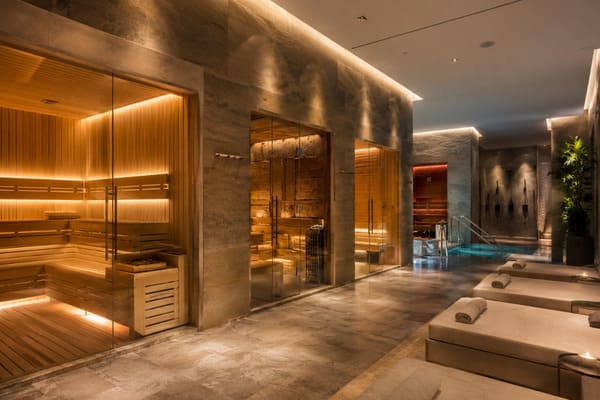
Gyms have three realistic options: a traditional electric sauna (dry, high heat), an infrared sauna (gentle radiant heat, lower power), and a steam room (wet heat, high maintenance). Only the first two are true saunas.
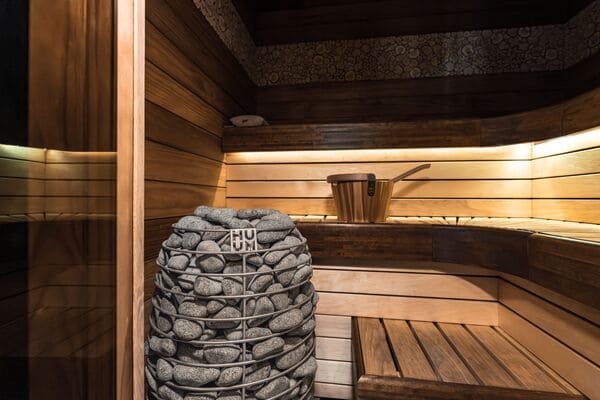
Traditional Electric Sauna
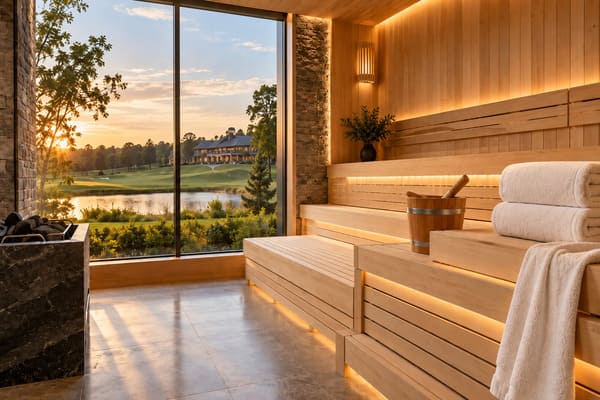
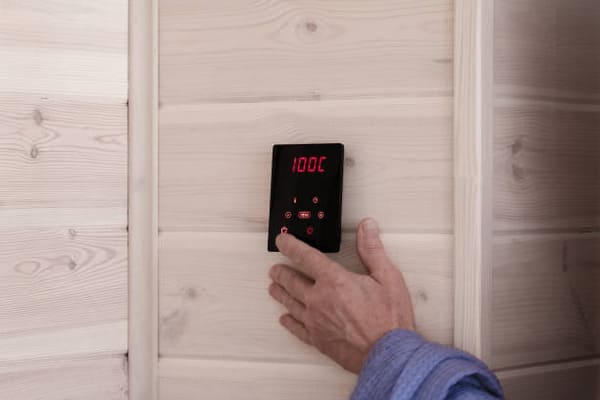
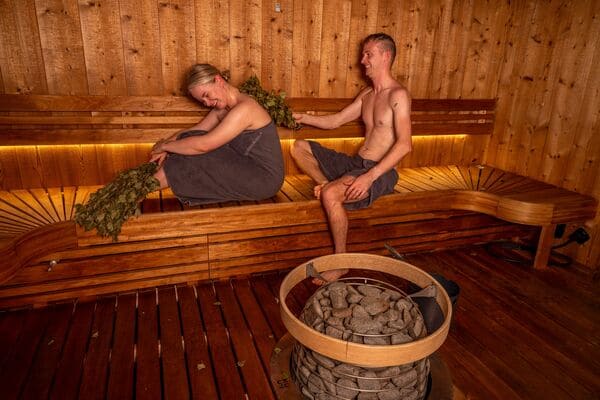
This is the sauna members picture. A wood-lined room heated by an electric heater and stones. Leading Finnish brands like Harvia recommend running a traditional sauna at 80–100°C[^1], with the option to pour water on the stones for a burst of steam. Heater power follows a simple rule used across the industry: roughly 1 kW for every 1 m³ of room volume. It is built for busy facilities and back-to-back daily use. For a full-service gym or health club, this is the safe default — and the reason we stock commercial-grade Harvia units for exactly these jobs.
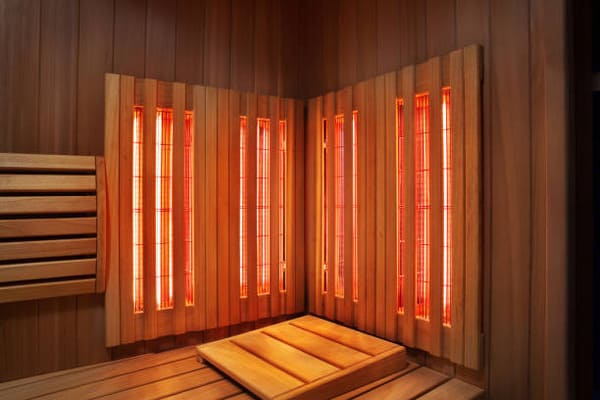
Infrared Sauna
Instead of heating the air, infrared panels warm the body directly[^2][^1]. Infrared specialists such as Finnleo and Sunlighten typically run their cabins at a lower 45–60°C. It uses less energy, warms up faster, and often runs on simpler single-phase power. It fits boutique studios and recovery-focused gyms. The trade-off: members expecting "real" high heat may feel let down.
Steam Room
A steam generator fills the room with near-100% humidity at around 40–50°C. Many members love wet heat, and offering both signals a premium club. But constant moisture means waterproofing, drainage, and relentless mold control[^3][^2]. It is the highest-maintenance option on this list.
Which Sauna Is Cheapest to Run in a Gym?
The sticker price is the smallest number in the deal. What kills a budget is what the unit costs every single day for years. Run cost decides your real margin.
Infrared saunas cost the least to run because they heat at a lower temperature and often use single-phase power.[^4][^3] Traditional electric saunas use more energy but handle heavier traffic. Steam rooms carry the highest ongoing cost from water, energy, and maintenance.[^5]
The Side-by-Side Comparison
Here is the chart I hand to every gym owner before they choose.
| Factor | Traditional Electric | Infrared | Steam Room |
|---|---|---|---|
| Temperature | 80–100°C | 45–60°C | 40–50°C (high humidity) |
| Member experience | Authentic high heat | Gentle radiant heat | Wet heat |
| Energy use | Higher | Lower | Moderate–High |
| Electrical needs | Often 3-phase | Often single-phase | Generator + plumbing |
| Installation | Moderate | Easiest | Most complex |
| Maintenance | Low | Low | High (mold control) |
| Best fit | Full-service gyms | Boutique / recovery | Premium spas & clubs |
One line matters most on this table: maintenance. A dry sauna is nearly hands-off. A steam room needs constant attention or it turns into a liability. Price that labor in before you commit.
How Do You Match the Sauna to Your Gym?
The "best" sauna is not a product. It is a fit. The same unit that is perfect for a boutique studio is wrong for a 24-hour chain. Answer four questions first.
Match the sauna to four things: what your members expect, how much space you have, your electrical capacity, and your daily traffic. Get any one wrong and the unit underperforms or fails early.
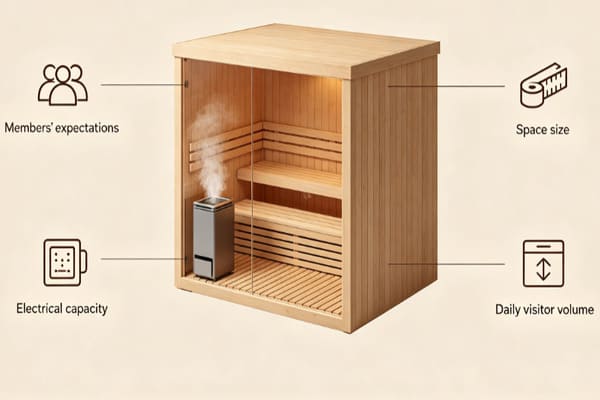
1. What Do Your Members Expect?
A serious health club or a strength gym with a recovery culture will expect the high heat of a traditional sauna. A yoga or Pilates studio may fit better with the gentle, wellness-branded feel of infrared. Sell the experience your members actually want, not the one you like.
2. How Much Space Do You Have?
Traditional saunas need room for the heater and proper air flow.[^6] Infrared units are more compact. Measure your footprint before you fall for a model, and leave space for members to move around the unit.
3. What Is Your Electrical Capacity?
This is where gym projects stall. The kW rating is universal, but the power supply is not. North America uses 240V split-phase; Europe uses 230V single-phase or 400V three-phase. As a general safety rule, any heater above 4.5 kW needs a dedicated circuit and a licensed electrician[^7][^4], and commercial units above 9 kW often require three-phase power[^5]. Brands like Harvia print the exact circuit and breaker requirements for each heater, so confirm the spec with an electrician early — not after the unit arrives.
4. What Is Your Daily Traffic?
A busy gym runs the sauna all day, with the door opening every few minutes. Each open door dumps heat. For high traffic, never use a home-grade heater. Choose a unit rated for commercial continuous operation, and step the power up one level past the room math. This single choice prevents most early burnouts.
What Do Gym Owners Forget After They Choose?
You picked the right sauna. The job is only half done. A commercial sauna is a large, heavy, fragile shipment of timber, glass, and a dense heater. This is where timelines and budgets quietly break.
The most overlooked step is delivery. Poor packing means damage in transit. Surprise freight and customs fees blow the budget. Delays push back your opening. A supplier who also handles logistics removes all three risks.

Unlike most sauna suppliers, we run our own freight operation. So we do not just ship you a box and hope. We pack for the reality of long-haul transport, load it right, and move it by full container or consolidated shipment with the cost known upfront. For a gym working toward a fixed opening date, that certainty is often worth more than a small saving on the unit itself. A cracked glass panel or a two-week customs hold costs far more than it saves.
Conclusion
For most gyms, a traditional electric sauna is the best choice — authentic heat, built for heavy use. Go infrared for boutique or low-power spaces, and save the steam room for premium clubs. Match the unit to your members, space, and power, and plan the delivery before it becomes a problem.
Tell us your space size and peak traffic, and we'll spec the right commercial Harvia sauna — and get it to you with full cost transparency.
[^1]: "Sauna - Wikipedia", https://en.wikipedia.org/wiki/Sauna. The source should document that Finnish or traditional dry saunas commonly operate at high air temperatures around 80–100°C, supporting this temperature range as a conventional setpoint. Evidence role: definition; source type: institution. Supports: Traditional electric saunas commonly run at 80–100°C.. Scope note: Actual operating temperatures vary by country, user preference, ventilation, and heater design. [^2]: "The Science Behind Infrared Sauna Use - West Omaha Cryotherapy", https://www.westocryo.com/post/the-science-behind-infrared-sauna-use. The source should explain that infrared sauna systems transfer radiant heat to skin and tissue rather than primarily heating room air, supporting the stated heating mechanism. Evidence role: mechanism; source type: paper. Supports: Infrared sauna panels warm the body directly through radiant heat.. Scope note: The source may describe the physical mechanism of infrared heating without comparing member satisfaction or commercial gym suitability. [^3]: "Prevention and Remediation of Damp Indoor Environments - NCBI - NIH", https://www.ncbi.nlm.nih.gov/books/NBK215647/. The source should establish that persistent moisture and high humidity are major conditions for mold growth and require moisture control, supporting the need for mold management in steam rooms. Evidence role: mechanism; source type: government. Supports: Steam rooms require careful moisture management because constant moisture promotes mold growth.. Scope note: A general mold source supports the moisture-mold relationship but may not address steam-room construction details such as waterproofing and drainage directly. [^4]: "Muscle temperature increases during a single far infrared sauna session ...", https://journals.physiology.org/doi/full/10.1152/japplphysiol.00067.2025. The source should support the underlying basis that infrared saunas use lower ambient air temperatures and radiant heating, which can reduce energy demand relative to heating a larger air volume to traditional-sauna temperatures. Evidence role: mechanism; source type: paper. Supports: Infrared saunas can have lower operating energy demand because they operate at lower air temperatures and use radiant heating.. Scope note: This would be contextual support; actual operating cost depends on room size, insulation, occupancy, electricity tariff, warm-up schedule, and equipment wattage. [^5]: "27 Best Practice Guidelines on Saunas & Steam Rooms", https://www.healthandfitness.org/27-best-practice-guidelines-on-saunas-steam-rooms/. The source should document that steam rooms require steam generation, water supply, drainage, ventilation, cleaning, and moisture control, supporting the claim that they create multiple recurring operating-cost categories. Evidence role: general_support; source type: institution. Supports: Steam rooms tend to have high ongoing costs because they require water, energy for steam generation, and moisture-related maintenance.. Scope note: The source may support higher maintenance complexity rather than prove that steam rooms are always the highest-cost option in every facility. [^6]: "Sauna Ventilation: Why It Matters and How to Get It Right (2026)", https://finnmarksauna.com/en-us/blogs/sauna-how-to-guides/sauna-ventilation-guide. The source should state that sauna heaters require clearance from combustible materials and that sauna rooms need planned ventilation or air exchange, supporting the space and airflow requirements. Evidence role: mechanism; source type: institution. Supports: Traditional saunas require heater clearance and adequate airflow or ventilation.. Scope note: Clearance and ventilation requirements differ by heater model, jurisdiction, and installation standard. [^7]: "Dedicated circuit? - Electrical Inspections - InterNACHI®️ Forum", https://forum.nachi.org/t/dedicated-circuit/54918. The source should establish that fixed electric heating equipment must be installed on an appropriately rated branch circuit and in accordance with electrical code, supporting the need for professional electrical assessment. Evidence role: expert_consensus; source type: government. Supports: Higher-power sauna heaters require dedicated, code-compliant electrical circuits and professional installation review.. Scope note: The exact 4.5 kW threshold and licensing requirement are jurisdiction-specific and may need confirmation from local code or the heater manufacturer’s installation manual.