"How much does a commercial sauna cost?" is usually the first question a hotel, spa, gym, or wellness developer asks — and the honest answer is that there is no single price. A compact equipment-only order and a fully installed multi-room spa project can differ by an order of magnitude. This guide breaks down what actually drives commercial sauna cost, so you can build a realistic budget, compare quotes fairly, and avoid the hidden expenses that catch first-time buyers out.
A commercial sauna's cost is driven by its size and capacity, the heater and control system, the wood grade and bench build, the electrical and ventilation work, and how much of the project you buy — from equipment only, to a full material package, to a prefabricated cabin, to a fully installed room. Because labour rates and site conditions vary enormously by country, the most reliable way to budget is to price the equipment and materials separately from local installation, rather than relying on a single all-in figure.
Why There Is No Single Commercial Sauna Price
Anyone quoting one fixed price for "a commercial sauna" is either guessing or hiding assumptions. The cost depends on decisions you make about size, materials, brand, and scope — and on where the sauna is installed. A four-person gym sauna and a large hotel spa suite are different products with different budgets.
The practical approach is to separate the two things you can control from the one you often can't:
- Equipment and materials — largely predictable, quotable, and comparable between suppliers.
- Local installation and site work — highly variable, driven by your country's labour rates, permits, and building conditions.
Keeping these apart is the single most useful habit for accurate budgeting.
The Main Cost Drivers
Six factors account for most of the variation in commercial sauna cost.
The main cost drivers of a commercial sauna are its size and seating capacity, the heater and control system, the grade and species of wood, the bench construction, the electrical and ventilation requirements, and any custom design or steam functionality. Larger rooms need more materials and a higher-output heater, premium woods and smart controls raise the price, and steam or combi functionality adds another layer of cost.
- Size and capacity — more seats mean more timber, a larger heater, and more floor area. Start from our commercial sauna size and capacity guide to fix this first, because everything else scales from it.
- Heater and controls — heater output is matched to room volume, and commercial-grade heaters with smart/WiFi controllers cost more than basic units. See our rock and heater capacity guide.
- Wood grade and species — bench and cladding wood is a major line item; low-conductivity premium species cost more but perform better. Our sauna wood selection guide explains the trade-offs.
- Electrical and ventilation work — commercial heaters need the correct supply, and proper airflow is non-negotiable. See our electrical requirements guide and ventilation design guide.
- Custom design — bespoke layouts, glass fronts, and branded finishes raise cost versus standard configurations.
- Steam or combi functionality — adding a steam generator or a combi heater increases both equipment and running costs.
Genuine Harvia vs Generic OEM: What the Price Difference Buys
One of the biggest cost questions in commercial sourcing is whether to buy a genuine branded heater or a generic OEM unit. The gap is real, and it is worth understanding what it pays for.
A genuine Harvia heater costs more than a generic OEM equivalent, but the difference buys certified safety, durable commercial-grade components, replaceable parts, warranty support, and reliable performance under heavy daily use. For a commercial sauna that runs many hours a day, the lower failure rate and longer lifespan usually outweigh the higher upfront price.
Certification is a large part of that value. Genuine commercial heaters carry recognised safety marks such as CE, ETL, or UL certification[^1], which many hotels, insurers, and building inspectors require. A cheaper uncertified unit can fail inspection, void insurance, or need premature replacement — turning an apparent saving into a larger cost. For a high-duty-cycle commercial installation, certified, serviceable equipment is generally the lower total cost over time.
Four Ways to Buy — and How Cost Changes
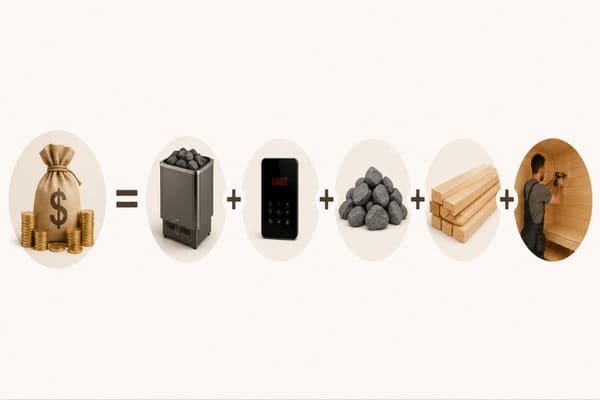
The single biggest reason buyers see wildly different quotes is that they are pricing different scopes. Deciding how much of the project you buy is the clearest way to control and compare cost.
A commercial sauna can be purchased in four main ways, each with a different cost profile: equipment-only (heater, controls, stones), a complete material package (equipment plus timber, benches, door, and fittings), a prefabricated cabin (a ready-to-assemble room), and a fully installed project (everything delivered and built on site). Cost rises with each step because more materials, labour, and coordination are included.
- Equipment-only — lowest cost; you or a local contractor supply the room and installation. Best for buyers who already have a builder.
- Complete material package — equipment plus all sauna materials, shipped together. A popular choice for project contractors who install locally.
- Prefabricated cabin — a ready-made or flat-pack room; faster to install but higher shipped cost and volume.
- Fully installed project — turnkey, including local installation. Highest cost, because it adds site labour that varies by country.
This is exactly why a single "all-in" figure is misleading: a fully installed price in one country tells you almost nothing about a fully installed price in another. Price the equipment and materials centrally, then add local installation separately.
Beyond the Purchase Price: Total Cost of Ownership
The quoted price is only part of the picture. A proper commercial budget includes the costs that arrive after the invoice.
The total cost of ownership of a commercial sauna includes the purchase price plus shipping and import duties, local installation and electrical work, ongoing energy consumption, and long-term maintenance and spare parts. For a high-use commercial sauna, running and maintenance costs over several years can rival the original equipment cost, so they belong in the budget from the start.
- Shipping and logistics — sea freight, volume, and destination affect landed cost; freight rates fluctuate, as trackers like the Freightos Baltic Index[^2] show.
- Import duties and taxes — vary by country and can be significant; confirm your tariff before ordering.
- Energy consumption — a commercial heater running many hours daily is a real operating cost. Manufacturer data from Harvia[^3] shows heaters run at full power to heat up, then draw roughly half power to maintain temperature; local electricity rates decide the bill. UK rates are published by Ofgem[^4], and US averages by the US EIA[^5] — both useful for estimating running cost in your market.
- Maintenance and spares — stones, elements, and control parts are consumables; genuine parts and serviceable designs keep long-term cost predictable.
Where Buyers Overspend — or Save
A few patterns separate well-budgeted projects from expensive ones:
- Overspending: buying an oversized heater "to be safe" (higher purchase and running cost), paying for custom design where a standard layout would do, or air-freighting when sea freight had time to work.
- Saving wisely: fixing size and capacity correctly first, choosing certified equipment that lasts, buying a material package and installing locally where labour is affordable, and consolidating orders to cut per-unit shipping.
- False economy: uncertified heaters, under-specified ventilation, or skipping documentation — each can cost far more later than it saves now.
How ROC Sauna-Solution Helps You Budget
Accurate budgeting is easier with a partner who prices equipment and materials transparently and understands how your local installation fits in.
ROC Sauna-Solution helps hotels, spas, gyms, and contractors build realistic commercial sauna budgets by quoting genuine certified Harvia equipment and material packages clearly, advising on the right scope — from equipment-only to a full package — and flagging the shipping, duty, and installation factors that affect landed cost. This lets buyers compare quotes fairly and avoid hidden costs.
Tell us your capacity, market, and whether you have a local installer, and we will recommend the most cost-effective scope — whether that is equipment-only around a compact heater like the Harvia The Wall or Glow Corner, a stainless unit like the Harvia Vega Pro, or a full material package. For the wider purchasing process, see our sauna sourcing guide.
Conclusion
There is no single commercial sauna cost — but there is a reliable way to budget for one. Fix your size and capacity first, choose certified equipment sized to the room, decide how much of the project you are buying, and price equipment and materials separately from local installation. Add shipping, duties, energy, and maintenance to see the true total cost of ownership. Do that, and the question shifts from "how much does a commercial sauna cost?" to "what is the right specification for my project and budget?" — which is the question that actually protects your investment.
Want a clear, itemised budget for your project? Contact ROC Sauna-Solution with your capacity and market for a transparent quote on certified Harvia equipment and material packages, plus guidance on shipping, duties, and installation. Get in touch here. You can also ask our AI product assistant about costs for your specific setup.
Frequently Asked Questions
How much does a commercial sauna cost? There is no single price, because cost depends on size and capacity, the heater and controls, wood grade, electrical and ventilation work, and how much of the project you buy — equipment only, a full material package, a prefabricated cabin, or a fully installed room. The most reliable way to budget is to price equipment and materials separately from local installation, since labour rates vary greatly by country.
What is the main factor that affects commercial sauna cost? Size and seating capacity is the primary driver, because it determines how much timber and how large a heater you need and sets the floor area. From there, the heater and controls, wood grade, and whether you add steam functionality have the largest additional impact.
Is a genuine Harvia heater worth the extra cost over a generic OEM unit? For commercial use, usually yes. A genuine Harvia heater costs more but provides certified safety (CE/ETL/UL), commercial-grade durability, replaceable parts, and warranty support. In a sauna running many hours a day, the lower failure rate and longer lifespan typically make it the lower total cost over time.
How much does it cost to run a commercial sauna? Running cost depends on heater output, hours of use, insulation, and local electricity rates. A commercial heater runs at full power to heat up and then about half power to maintain temperature. For a high-use commercial sauna, energy is a meaningful ongoing cost, so it should be estimated using your local electricity rate and included in the budget.
What costs are there beyond the purchase price? Beyond the equipment and materials, budget for shipping and logistics, import duties and taxes, local installation and electrical work, ongoing energy consumption, and long-term maintenance and spare parts such as stones and heating elements. Together these form the total cost of ownership.
How can I reduce commercial sauna costs without cutting quality? Fix your size and capacity correctly to avoid an oversized heater, choose certified equipment that lasts, buy a material package and install locally where labour is affordable, consolidate orders to lower per-unit shipping, and use sea freight when time allows. Avoid false economies like uncertified heaters or under-specified ventilation, which cost more later.
About ROC Sauna-Solution
ROC Sauna-Solution is an official authorized Harvia distributor and commercial sauna sourcing partner based in China, with over 12 years of experience supplying and integrating sauna projects worldwide. We help hotels, spas, resorts, gyms, and project contractors across 50+ countries budget and specify commercial saunas — supplying genuine certified Harvia heaters, steam generators, control systems, timber, stones, and accessories, with transparent equipment and material pricing, full technical documentation, CE/ETL/RoHS certification, OEM options, and technical and after-sales support.
References
[^1]: UL Solutions — safety certification body (official site). https://www.ul.com/ [^2]: Freightos Baltic Index — international sea freight rate index. https://www.freightos.com/freight-resources/freight-rate-index/ [^3]: Harvia — sauna heater manufacturer (official site). https://www.harvia.com/ [^4]: Ofgem — Energy Price Cap, UK energy regulator. https://www.ofgem.gov.uk/energy-price-cap [^5]: U.S. Energy Information Administration — Electricity data. https://www.eia.gov/electricity/