Before a commercial sauna heater ever gets switched on, the building has to supply it correctly. Under-sized cable, the wrong phase, or a missing safety device does not just fail inspection — it can damage the heater or create a real hazard. This guide covers what hotels, spas, and project contractors need to know about the electrical side of a commercial sauna, so the installation is safe, compliant, and right the first time.
A commercial sauna's electrical requirements depend on heater output: small heaters may run on single-phase power, but most commercial heaters (roughly 9 kW and above) need a three-phase supply, a dedicated circuit, correctly sized cable, a matched circuit breaker, RCD/GFCI protection, and proper grounding — all installed by a qualified electrician to local code. Getting the supply right is a prerequisite, not an afterthought.
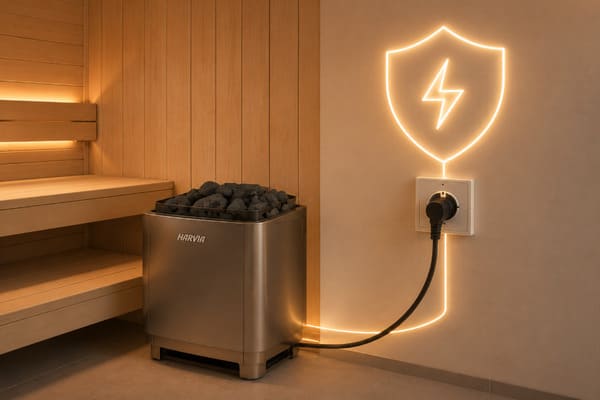
I have seen otherwise well-planned sauna projects stall at the last step because the electrical supply was never confirmed against the heater. The heater arrives, and only then does the team discover the room was wired for single-phase while the heater needs three-phase. This article prevents that — it walks through power supply, cabling, protection devices, grounding, and where professional installation is non-negotiable.
Note: This is a planning guide for buyers and project managers. All electrical work must be carried out by a licensed electrician in accordance with your local electrical code — such as the NEC (NFPA 70)[^1] in the United States or the IEC 60364[^2] framework used internationally. Always follow the heater manufacturer's installation manual, which specifies the exact requirements for that model.
Why Electrical Planning Comes Before the Heater Arrives
The electrical supply is the one part of a sauna project you cannot fix after the fact without expensive rework. Choosing the heater output is the first decision — our sauna heater size guide explains how to match kW to room size — but the heater's rated output then dictates everything electrical that follows.
Electrical planning must happen before the heater arrives because the heater's kW rating determines the phase, cable size, and breaker required. Confirming the building's supply against the chosen heater during the design stage avoids the most common commercial sauna delay: a heater that cannot be connected to the power that is actually available.
The logical order is:
- Size the heater to the room (see our heater size guide).
- Read the heater's electrical rating — voltage, kW, and phase requirement from the manual.
- Confirm the building can supply it — or plan the electrical upgrade before installation day.
Skip step three and you risk a heater sitting in its box while an electrician re-runs cable or upgrades the supply.
Power Supply: Single-Phase vs Three-Phase
The single biggest electrical question for a commercial sauna is which type of power supply the heater needs. This depends almost entirely on the heater's output.
Small sauna heaters can run on single-phase power, but commercial heaters — typically 9 kW and larger — usually require a three-phase supply. Three-phase spreads the high electrical load across three conductors, which is why nearly all commercial-grade sauna heaters are designed for it. Always confirm the phase requirement from the specific heater's specification before planning the supply.
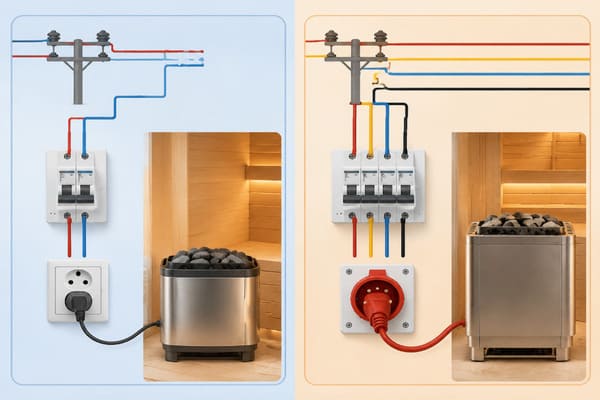
As a general guide (always verify against the actual model):
| Heater Output (approx.) | Typical Supply | Common Use |
|---|---|---|
| Up to ~8 kW | Single-phase possible | Small rooms, light use |
| ~9 kW and above | Three-phase usually required | Most commercial saunas |
| Large commercial (15 kW+) | Three-phase required | Hotels, spas, high-traffic facilities |
The distinction between single- and three-phase supply is defined in international wiring frameworks such as IEC 60364[^2], which governs low-voltage electrical installations. Because most commercial installations use higher-output heaters, three-phase is the norm for hotel and spa projects. If your building only has single-phase available, that is something to identify early — bringing in three-phase power is a job for the design stage, not installation day.
Cable Sizing and Circuit Breakers
Once you know the heater's output and phase, the cable and breaker must be matched to it. This is where under-specification quietly becomes dangerous.
Cable and circuit breaker must be sized to the heater's current draw as specified in its manual. Under-sized cable overheats and is a fire risk; an incorrectly rated breaker either trips constantly or fails to protect the circuit. Commercial saunas also require a dedicated circuit so the heater does not share power with other equipment.
Key points for the electrician (and for you to confirm are planned):
- Dedicated circuit — the sauna heater must have its own circuit, not shared with lighting, HVAC, or other loads.
- Cable cross-section — sized to the heater's amperage and the cable run length, per local code. Higher kW heaters need thicker cable.
- Correctly rated breaker — matched to the heater's current draw, protecting the circuit without nuisance tripping.
- Cable rating for heat and environment — appropriate for routing near a hot, humid sauna environment.
Cable and overcurrent-protection sizing is governed by national wiring codes — for example the NEC (NFPA 70)[^1] in North America and BS 7671 (the IET Wiring Regulations)[^3] in the UK. The heater's installation manual gives the exact current draw and recommended protection — this is not a place to estimate. A qualified electrician sizes these to code based on that data.
Safety Devices: RCD/GFCI and Grounding
A commercial sauna combines high power, heat, and (in many cases) proximity to moisture. That makes electrical protection devices essential, not optional.
Commercial saunas require proper grounding and residual-current protection (RCD in Europe, GFCI in North America) to protect against electric shock. Grounding provides a safe path for fault current, while the RCD/GFCI cuts power instantly if it detects leakage. Both are typically mandatory under local electrical codes for this type of installation.
The two core protections:
- Grounding (earthing) — the heater and metal parts must be properly grounded so any fault current has a safe path away from people.
- RCD / GFCI — this device monitors the circuit and disconnects power within milliseconds if it detects current leaking to ground, which is the main protection against shock.
Requirements vary by country, which is one reason certification matters: a heater carrying the right marks (ETL for North America, CE for Europe) has been built and tested to the relevant electrical safety standards. Our guide on what CE, ETL, and RoHS certifications actually cover explains which apply to your market. Using a certified heater plus a code-compliant installation is what keeps a commercial sauna both legal and safe.
The Control System and Its Wiring
The heater is not the only electrical component. A commercial sauna is run by a separate control system, and it has its own wiring considerations.
Commercial sauna control systems are wired separately from the heater's main power feed, usually with a control unit and a temperature/safety sensor connected by dedicated low-voltage wiring. Proper controls provide scheduling, over-temperature cut-off, and safe operation over the long hours a commercial sauna runs — which is why control wiring must follow the manufacturer's diagram exactly.
For commercial use, the control system does more than set temperature — it manages safe operation across a full day of use, with safety cut-offs that protect the installation. See our sauna controllers for the systems that pair with commercial heaters, and browse our sauna heaters for the units themselves. Steam-based wellness suites add a steam generator, which has its own electrical and water connections to plan.
Why Professional Electrical Installation Is Non-Negotiable
This is the point that protects your budget, your building, and your guests: commercial sauna electrical work is not a DIY or general-handyman job.
Commercial sauna electrical installation must be done by a licensed electrician working to local code. The combination of high power, three-phase supply, heat, and moisture means incorrect wiring is a genuine fire and shock risk — and non-compliant work will fail inspection and can void the heater's warranty. Professional installation is the only compliant option for a commercial installation.
The hazards of incorrect electrical work — shock, arc flash, and fire — are well documented by safety authorities such as OSHA[^4], which is exactly why high-load installations like commercial saunas are reserved for licensed professionals. A qualified electrician will:
- Confirm the building supply matches the heater (phase, voltage, capacity).
- Size cable and breaker correctly for the load and run.
- Fit the required RCD/GFCI protection and grounding.
- Wire the control system per the manufacturer's diagram.
- Ensure the whole installation meets local code and passes inspection.
Based on our experience supporting commercial sauna projects worldwide, the projects that go smoothly are the ones where the electrical supply is confirmed against the heater during design — not discovered on installation day.
Electrical Planning Checklist for Buyers
Use this as a pre-installation checklist regardless of who supplies or installs your sauna:
- Heater output confirmed and matched to room size.
- Phase requirement known (single vs three-phase) from the heater spec.
- Building supply verified — does it provide the required phase and capacity?
- Dedicated circuit planned for the heater.
- Cable and breaker sized to the heater's rating by an electrician.
- RCD/GFCI and grounding specified per local code.
- Control system wiring planned per the manufacturer's diagram.
- Certified heater carrying the marks required for your market.
- Licensed electrician booked to carry out and certify the work.
Tick all nine before installation day and the electrical side of your project will not be what holds it up.
How ROC Sauna-Solution Helps
Electrical requirements are exactly where buyers get caught out — the heater is chosen, but the supply was never checked against it. As an authorized Harvia distributor and sourcing partner, we help hotels, spas, and project contractors get the specification right before the equipment ships.
ROC Sauna-Solution supplies certified commercial sauna heaters and control systems with full technical documentation — including the exact electrical specifications your electrician needs — so the supply can be confirmed during design. We provide product recommendations, certification documents, and technical support to keep the electrical side of your project compliant and on schedule.
We supply the heater's electrical data up front, provide CE/ETL/RoHS documentation for your market, and give technical guidance so your electrician has everything needed to install to code. If you are still selecting equipment, our commercial sauna heater buying guide walks through how to choose the right heater, and our sourcing guide covers the wider purchasing decision.
Conclusion
The electrical requirements of a commercial sauna are simple to get right and expensive to get wrong. Size the heater, read its electrical rating, confirm the building can supply it, and have a licensed electrician install a dedicated circuit with correctly sized cable, matched protection, and proper grounding. Do this during design rather than on installation day, and the power side of your project becomes a non-event instead of a costly delay.
Planning a commercial sauna and need the electrical specifications confirmed before you buy? Contact ROC Sauna-Solution for certified equipment, full technical documentation, and project support. Get in touch here. You can also ask our AI product assistant about a specific heater's requirements.
Frequently Asked Questions
What are the electrical requirements for a commercial sauna? A commercial sauna needs a power supply matched to the heater's output — usually a three-phase supply for heaters around 9 kW and above — on a dedicated circuit with correctly sized cable, a matched circuit breaker, RCD/GFCI protection, and proper grounding. All work must be done by a licensed electrician to local code, following the heater manufacturer's manual.
Does a commercial sauna heater need three-phase power? Most do. Small heaters (up to around 8 kW) can sometimes run on single-phase, but commercial heaters of roughly 9 kW and above typically require three-phase power to spread the high electrical load. Always confirm the phase requirement from the specific heater's specification before planning the supply.
Can I install a commercial sauna heater myself? No. Commercial sauna electrical work must be carried out by a licensed electrician. The combination of high power, three-phase supply, heat, and moisture makes incorrect wiring a genuine fire and shock hazard, and non-compliant work will fail inspection and can void the heater's warranty.
What size cable and breaker does a sauna heater need? Cable and breaker must be sized to the heater's current draw as stated in its installation manual, taking the cable run and local code into account. Higher-output heaters need thicker cable and a higher-rated breaker. This should always be calculated by a qualified electrician rather than estimated.
Do commercial saunas need a GFCI or RCD? Yes, in most jurisdictions. Residual-current protection (RCD in Europe, GFCI in North America) disconnects power instantly if it detects current leaking to ground, protecting against electric shock. Combined with proper grounding, it is typically mandatory for this type of installation under local electrical codes.
How do I know a sauna heater's electrical requirements before buying? A reputable supplier provides the heater's full electrical specification — voltage, kW, phase, and current draw — in its technical documentation. Confirm these against your building's supply during the design stage so your electrician can plan the circuit before the heater arrives.
About ROC Sauna-Solution
ROC Sauna-Solution is an official authorized Harvia distributor and commercial sauna sourcing partner based in China, with over 12 years of experience supplying and integrating sauna projects worldwide. We help hotels, spas, gyms, resorts, and project contractors across 50+ countries source genuine, certified sauna heaters, control systems, steam generators, and accessories — complete with full technical and electrical documentation, CE/ETL/RoHS certification, OEM options, and technical and after-sales support. We help global buyers specify and install with confidence.
References
[^1]: NFPA 70 (National Electrical Code) — National Fire Protection Association. https://www.nfpa.org/codes-and-standards/nfpa-70-standard-development/70 [^2]: IEC 60364 — International Electrotechnical Commission, low-voltage electrical installations. https://www.iec.ch/ [^3]: BS 7671 — IET Wiring Regulations, Institution of Engineering and Technology. https://electrical.theiet.org/bs-7671/ [^4]: OSHA — Electrical safety, U.S. Occupational Safety and Health Administration. https://www.osha.gov/electrical