Many sellers say "CE, ETL, RoHS certified, works worldwide." That claim misleads buyers. Certifications never go to a brand. They go to a specific model and voltage version.
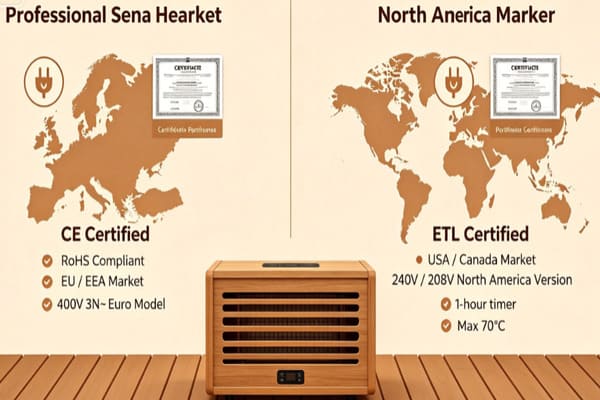
Harvia's CE (with RoHS) covers the EU/EEA market and needs a 400V 3N~ Euro-version model. ETL covers the US and Canada and needs a 240V/208V North American version with a 1-hour timer and 194°F limit. Certification follows the model, not the brand.
I have spent over 12 years in OEM/ODM manufacturing. I have seen buyers lose money because they trusted a "full-range certified" promise. Let me break down what each certificate really means, model by model.
What Is the Real Difference Between CE, ETL, and RoHS?
Sellers throw these three names together. But each one serves a different purpose and a different market. Mixing them up leads to compliance risk.
CE is a self-declared conformity mark for the EU[^1]. ETL is a third-party safety mark for North America[^2]. RoHS is a hazardous-substance rule inside the CE framework[^2])[^3]. They do not replace each other.
The Core Nature of Each Mark
Let me lay out the facts in a simple table.
| Certificate | Nature | Market | Who Issues/Verifies |
|---|---|---|---|
| CE | Conformity mark (maker's self-declaration) | EU/EEA | Maker issues a DoC under LVD and EMC directives |
| ETL | Third-party safety listing | US, Canada | Intertek tests to UL/CSA standards |
| RoHS | Restriction of hazardous substances (2011/65/EU) | EU (part of CE compliance) | Maker's declaration + material proof |
Three points matter here. First, CE is not a quality award. It is the entry gate for the EU. For sauna heaters, the harmonized standard is EN 60335-1 plus EN 60335-2-53. Second, CE and ETL do not cross over[^4]. A CE mark has no legal power in North America[^5]. An ETL mark cannot enter the EU. Third, RoHS is not a standalone market pass[^6]. It controls lead, mercury, and cadmium. It has nothing to do with electrical safety.[^3]
Why Is the Euro Version Not the Same as the US Version?
Buyers often assume one model fits all markets. That belief causes real problems. The same series splits into two different machines.
Harvia builds separate voltage and certification versions for each market. Euro versions run 400V 3N~ under CE[^4][^7]. North American versions run 240V/208V under ETL[^5][^8], with a forced 1-hour timer and a 194°F temperature limit.
Model-by-Model Breakdown
Let me walk through the main series. Always check the rating plate and the manual to confirm.
| Series | Euro Version (CE) | North American Version (ETL) |
|---|---|---|
| KIP (wall-mount) | 400V 3N~ | KIP-USA / JH30B–JH80B, 240V or 208V |
| Cilindro (pillar) | PC70/PC90, 400V 3N~ | PC60/PC80/PC90, 240V |
| Spirit | CE version, different suffix | SP80E, HSPE60UM etc., 240V |
| Virta / Virta Pro | 400V 3N~, 6–17 kW | HL160E, 240V/208V three-phase |
| Club (commercial) | CE + RoHS | 240V single-phase or 208V three-phase |
Here is the classic trap. If you buy a KIP Euro version at 400V and ship it to the US, it has no ETL listing. The voltage does not match either. Installation there breaks the rules[^9]. The North American version also carries safety features the Euro one lacks: a 1-hour run limit and a 194°F cap[^6]. These come straight from UL/ETL rules.
How Can a Buyer Verify One Specific Machine's Certification?
Sales talk is cheap. A promise on a call means nothing at customs. You need proof tied to the exact unit you buy.
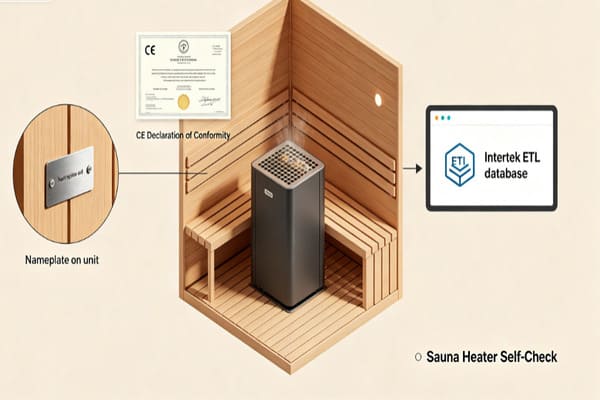
Check three things yourself: the rating plate on the body, the Declaration of Conformity for CE products, and the Intertek ETL listing database. Voltage on the plate is the fastest clue[^10]—400V 3N~ means Euro, 240V/208V means North America.
Common "Blanket Promise" Traps
I keep a list of misleading claims and why they fail.
| Sales Claim | The Problem |
|---|---|
| "Whole Harvia range passes CE/ETL/RoHS" | Certs go by model; Euro units have no ETL |
| "CE lets you sell in the US" | CE has no legal power in North America |
| "RoHS proves the product is safe" | RoHS only covers substances, not safety |
| "Just swap the plug for the US" | Voltage, timer logic, and cert all differ |
| "One cert works for home and commercial" | 240V single-phase and 208V three-phase differ |
So verify at three points. Read the rating plate for the mark, model, and voltage. Ask the dealer for the DoC that lists the model and directives. Search the Intertek Directory of Listed Products by maker and model.[^7] If an "ETL product" does not appear there, treat it with caution.
Conclusion
CE with RoHS goes to the EU (400V Euro models). ETL goes to the US and Canada (240V/208V models). Certification follows the model and voltage, never the brand.
[^1]: "CE marking – obtaining the certificate, EU requirements", https://europa.eu/youreurope/business/product-rules-compliance/general-product-compliance/ce-marking/index_en.htm. The European Commission explains that CE marking indicates a manufacturer’s declaration that a product conforms to applicable EU requirements before being placed on the EEA market. Evidence role: definition; source type: government. Supports: CE marking is an EU/EEA conformity mark generally based on the manufacturer’s declaration of conformity.. Scope note: Some product categories require notified-body involvement, so CE is not universally only self-declared in every sector. [^2]: "RoHS Directive - Environment - European Commission", https://environment.ec.europa.eu/topics/waste-and-recycling/rohs-directive_en. The European Commission’s RoHS guidance explains that Directive 2011/65/EU restricts specified hazardous substances in electrical and electronic equipment and is implemented through EU conformity-assessment and CE-marking obligations. Evidence role: definition; source type: government. Supports: RoHS restricts hazardous substances and forms part of the EU compliance framework for relevant electrical and electronic equipment.. Scope note: RoHS is one element of EU compliance and does not by itself cover all CE requirements for a sauna heater. [^3]: "RoHS - Wikipedia", https://en.wikipedia.org/wiki/RoHS. Directive 2011/65/EU lists restricted substances such as lead, mercury, and cadmium in electrical and electronic equipment, showing that RoHS addresses material composition rather than electrical shock, fire, or thermal safety testing. Evidence role: definition; source type: government. Supports: RoHS restricts hazardous substances and is not an electrical-safety certification.. Scope note: RoHS is only one compliance obligation; other EU directives and standards may address electrical safety for the same product. [^4]: "Electric heater Harvia Vega BC45 4,5 kW Steel", https://www.harvia.com/en-US/products/HCB450400S/vega-bc45-45-kw-steel. Harvia product documentation for European-market heater models lists 400 V 3N~ electrical supply specifications and CE-related conformity documentation, supporting the distinction between European voltage configurations and other market versions. Evidence role: case_reference; source type: other. Supports: Harvia European-version sauna heaters are specified for 400 V 3N~ supply and CE conformity.. Scope note: This is direct manufacturer documentation for selected models; it should not be generalized to every Harvia product without checking the relevant model manual or Declaration of Conformity. [^5]: "Harvia Kip series sauna heater installation guide", https://www.youtube.com/watch?v=e_4jPk1-Bro. Harvia North American installation manuals and Intertek listings identify specific heater models with 240 V or 208 V supply configurations and ETL listing, supporting the market-specific voltage and certification distinction. Evidence role: case_reference; source type: institution. Supports: Harvia North American-version sauna heaters are sold in 240 V or 208 V configurations and can carry ETL listing when the exact model is listed.. Scope note: The support is model-specific; each heater model and suffix must be checked separately. [^6]: "HARVIA KIP Series Sauna Heater Instruction Manual - device.report", https://device.report/manual/17158766. North American sauna-heater safety requirements and manufacturer installation manuals commonly specify a maximum operating time and a high-temperature limit near 90°C/194°F, supporting the statement that listed North American versions include these control limits. Evidence role: mechanism; source type: institution. Supports: North American sauna-heater versions include operating-time and temperature-limit controls such as a 1-hour timer and 194°F cap.. Scope note: The exact limit may be stated in proprietary UL/CSA standards or in model manuals; verification should be tied to the specific listed model. [^7]: "ETL Listed Mark Directory - Intertek", https://www.intertek.com/directories/etl-listed-mark/. Intertek’s Directory of Listed Products provides a searchable record of ETL-listed products by manufacturer and model, supporting the verification method described for checking whether a specific unit is listed. Evidence role: mechanism; source type: institution. Supports: Buyers can verify ETL listing status through Intertek’s product directory by manufacturer and model.. Scope note: Directory search results depend on exact model names, file numbers, and listing status at the time of search.