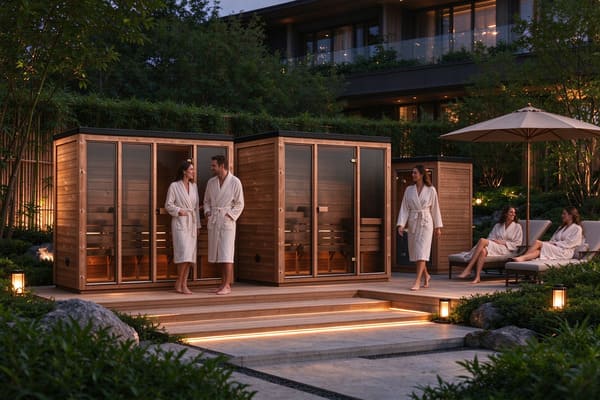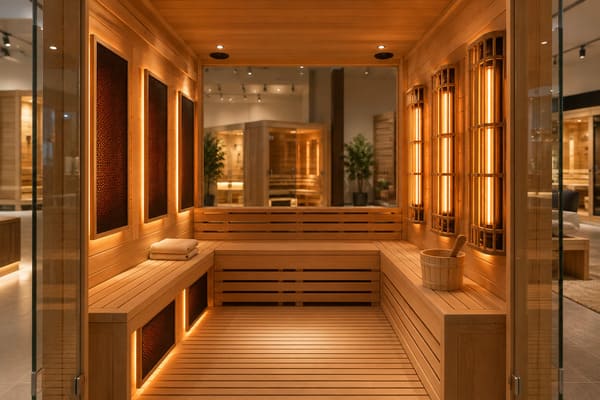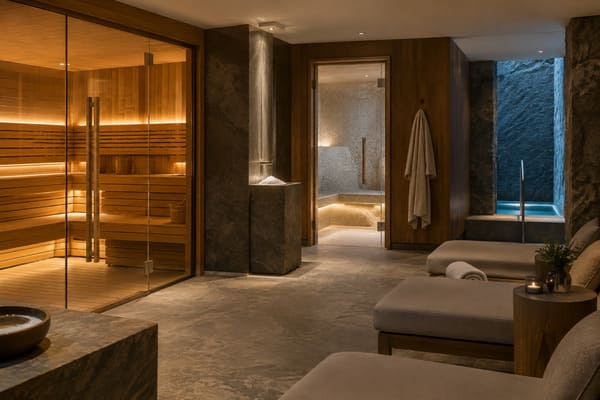
A sauna built for a downtown hotel spa and a sauna built beside the sea are not the same specification — even if the room size and capacity are identical. Salt air, outdoor exposure, high humidity, and cold climates all change what wood, heater, and protection your project needs. This guide is for B2B buyers whose sauna will not sit in a sheltered indoor room, and who need to get the environment-specific choices right before ordering.
A commercial sauna's materials should be chosen for two things at once: the environment (which mainly decides the cladding wood and heater) and comfort/safety (which decides the bench wood). Coastal and humid sites favour naturally moisture-resistant cladding like cedar or yellow cypress with a stainless heater; outdoor sites need durable spruce or hemlock cladding on a well-insulated structure; and every sauna, in every climate, benefits from low-conductivity bench woods like obeche or aspen that stay cool to the touch.
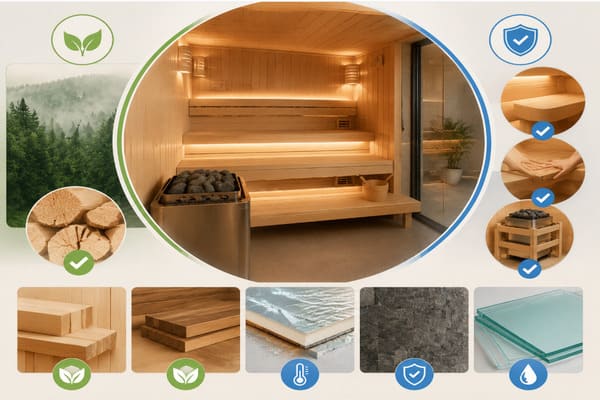
Most sauna buying advice assumes a standard indoor installation. But a growing share of commercial projects — seaside resorts, outdoor wellness cabins, rooftop spas, poolside wellness suites — sit in conditions that punish the wrong material choice. Below, each section gives you a direct answer: which cladding wood, which bench wood, and which heater suit that environment.
Two Jobs, Two Wood Choices: Cladding vs Benches
Before the environments, one distinction that most buyers miss — and that changes how you read every section below. In a sauna, wood does two very different jobs, and the best wood for each is not the same.
Cladding wood lines the walls and ceiling, and its main job is to handle heat and moisture well — so it changes with the environment. Bench wood is touched directly by bare skin, so its main job is to stay cool and splinter-free — which is about comfort and safety, not climate. That is why bench woods like obeche and aspen suit almost any sauna, while cladding wood should be matched to where the sauna is built.
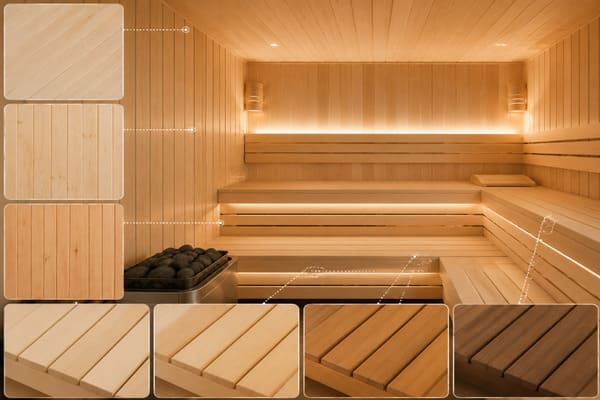
We offer a full range for both jobs:
Cladding and structure woods (matched to environment):
- Western red cedar (Canadian) — naturally oily and aromatic, with good natural resistance to moisture and decay. A premium choice for damp and coastal settings.
- Burmese cedar — an aromatic, durable cedar with good moisture resistance.
- Yellow cypress — aromatic and naturally durable, with strong moisture and decay resistance. A premium humid-climate option.
- Hemlock — knot-free, dimensionally stable, clean-looking with a mild scent. A reliable, modern mid-range cladding.
- Nordic (Finnish) spruce — the traditional, economical Scandinavian sauna wood. Light in colour and dependable for standard and outdoor cladding.
Bench woods (matched to comfort and safety):
- Obeche (abachi) — an African wood with very low thermal conductivity, so it stays cool to the touch even when the sauna is hot. Lightweight, smooth, and free of knots and splinters — a premium bench material.
- Aspen — pale, low-conductivity, resin-free and odourless, with naturally hygienic properties. Comfortable against the skin and well suited to allergy-sensitive and high-hygiene commercial settings.
We also supply profiled bench components (L-shaped bench edging and rounded stool-front trim) that finish bench edges smoothly to prevent burns and splinters.
For the full breakdown of species, grades, and finishes, see our sauna wood selection guide — we will not repeat it here. The natural durability that makes some woods better for damp and exposed conditions is well documented in timber research from the USDA Forest Products Laboratory,[^1] while reference databases such as The Wood Database[^2] detail the thermal and mechanical properties — like the low heat conductivity of obeche and aspen — that make certain species ideal for benches. With that split in mind, here is what to prioritise in each environment.
Coastal and Poolside Saunas: Corrosion and Moisture
Salt air and constant humidity are relentless. In coastal locations and poolside wellness suites, the deciding factors are moisture resistance in the wood and corrosion resistance in the metal.
For coastal and poolside saunas, choose a naturally moisture-resistant cladding wood — western red cedar, Burmese cedar, or yellow cypress — and an all-stainless-steel heater to resist corrosion, such as the Harvia Vega Pro, which is built with a full stainless body specifically for spas, hotels, resorts, and indoor-pool environments. For benches, obeche or aspen stay cool and cope well with the humid conditions.
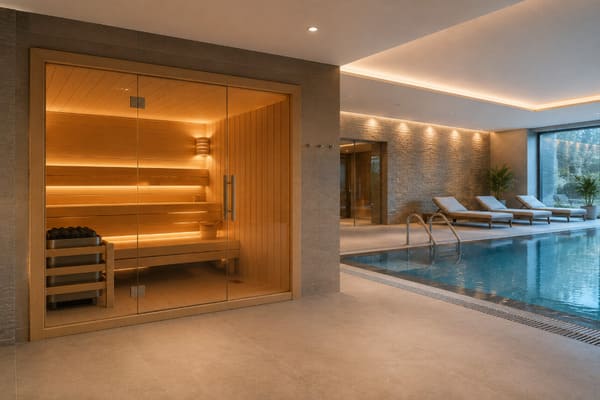
The direct answers for a seaside or poolside build:
- Cladding wood — cedar (Canadian or Burmese) or yellow cypress; their natural oils resist moisture and decay far better than economical softwoods here.
- Bench wood — obeche or aspen, both of which stay cool to the touch and handle humidity well.
- Heater — an all-stainless-steel unit. The Harvia Vega Pro is purpose-built for this, with a full stainless body and stable heat-and-humidity performance for pools, spas, and resorts. Marine and poolside atmospheres fall into the most aggressive corrosivity categories for metals, which is why stainless construction matters here.[^4]
- Ventilation — moist, salt-laden air must be moved out effectively; good airflow is non-negotiable here.
Outdoor and Forest Saunas: Built to Face the Weather
Outdoor and forest saunas — an increasingly popular commercial format — face a challenge indoor units never do: the structure is exposed to rain, sun, and snow, and it constantly loses heat to a cold exterior.
For outdoor and forest saunas, use durable, dependable cladding such as Nordic spruce or hemlock, insulate and weather-seal the structure thoroughly, and choose a high-output electric heater that overcomes heat loss to the outside — such as the Harvia Dragon, which reaches 110°C in about 20 minutes, or a large-capacity Cilindro Pro. Benches stay obeche or aspen for comfort, as they do indoors.
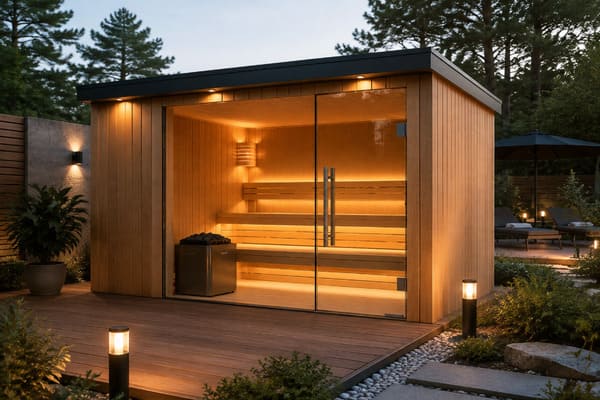
Direct answers for an outdoor build:
- Cladding wood — Nordic spruce (the traditional, economical outdoor choice) or hemlock for a cleaner finish; cedar is an option where budget allows a more moisture-resistant exterior.
- Bench wood — obeche or aspen, unchanged from indoor use.
- Structure — must be weather-sealed and well insulated so the heater is not fighting the outside temperature; proper insulation is the primary means of limiting that heat loss.[^5]
- Heater — because an outdoor room loses heat fast, favour a high-output, fast-heating unit. The Harvia Dragon heats to 110°C in around 20 minutes; alternatively the Harvia Cilindro Pro offers large rock capacity for steady heat retention.
- Power — outdoor sites complicate the electrical run; plan it early, wired to a recognised electrical-installation standard such as IEC 60364,[^6] and see our electrical requirements guide.
High-Humidity and Tropical Climates: Ventilation, Wood and Steam
In hot, humid regions, the ambient air is already moisture-heavy before the sauna adds its own. This puts the emphasis on airflow, on moisture- and mould-resistant wood, and — for wellness suites with a steam room — on the right steam generator.
In high-humidity climates, choose naturally moisture-resistant cladding such as cedar or yellow cypress to resist warping and mould, make ventilation the top design priority, and for hygiene-critical benches use aspen, which is resin-free and naturally hygienic. For a combined steam room, add a commercial steam generator such as the Harvia HGS (the commercial first choice) or the high-power Harvia HGP for larger rooms.
Direct answers for humid or tropical settings:
- Cladding wood — cedar or yellow cypress; their natural resistance to moisture and decay makes them the safest choice against warping and mould. Controlling moisture is also the key to preventing mould growth, as guidance from the US Environmental Protection Agency (EPA)[^3] makes clear.
- Bench wood — aspen is ideal here: resin-free, odourless, and naturally hygienic, which matters most in warm, damp, high-traffic conditions. Obeche is an equally cool-to-touch alternative.
- Ventilation — the single most important adjustment; design strong, active airflow in line with recognised indoor-air-quality ventilation standards such as ASHRAE 62.1.[^7]
- Heater — a stainless unit like the Vega Pro copes best with high humidity.
- Steam equipment — for a steam room, choose a commercial steam generator: the Harvia HGS is the commercial first choice, while the Harvia HGP covers high-output, large rooms. Sizing matters — see our commercial steam generator guide.
Cold Climates and High Altitude: Heater Performance
At the other extreme, cold-climate and high-altitude installations put the spotlight on the heater's ability to reach and hold temperature. Here, wood choice matters less than heater and insulation.
In cold or high-altitude environments, focus on the heater and insulation rather than the wood: choose a high-output heater with either large rock capacity or rapid heat-up — such as the Harvia Cilindro Pro (large rock volume for steady, retained heat) or the Harvia Dragon (fast, high-power heat-up) — and insulate the room well. Standard spruce or hemlock cladding is perfectly suitable; the priority is holding heat efficiently.
Direct answers for cold-climate builds:
- Cladding wood — Nordic spruce or hemlock is entirely adequate; the cold does not demand a moisture-resistant wood the way the coast does.
- Bench wood — obeche or aspen, as always.
- Heater — size toward the higher end. The Cilindro Pro stores a large volume of stones for steady, retained heat; the Dragon reaches temperature very fast (about 20 minutes), useful where quick recovery matters. Rock capacity matters as much as kW — see why rock capacity beats kW alone.
- Insulation — critical for holding heat efficiently when surroundings are cold; proper insulation is the primary means of limiting heat loss.[^5]
Environment-to-Specification Quick Reference
Room-to-heater sizing still applies everywhere. Note that the bench wood barely changes — because its job is comfort and safety, not climate:
| Environment | Cladding Wood | Bench Wood | Recommended Heater |
|---|---|---|---|
| Coastal / Poolside | Cedar or yellow cypress | Obeche / aspen | Vega Pro (all stainless) |
| Outdoor / Forest | Nordic spruce or hemlock | Obeche / aspen | Dragon or Cilindro Pro |
| Humid / Tropical | Cedar or yellow cypress | Aspen (hygienic) | Vega Pro + HGS / HGP steam |
| Cold / High Altitude | Spruce or hemlock | Obeche / aspen | Cilindro Pro or Dragon |
| Standard Indoor | Spruce, hemlock, or cedar | Obeche / aspen | Match output to room volume |
Model and species names above are suitable directions, not fixed prescriptions — always confirm the exact specification against your project with your supplier.
How ROC Sauna-Solution Helps You Specify for Your Environment
Specifying a sauna for a demanding environment is where generic supply falls short — an off-the-shelf indoor package may not hold up beside the sea, at a poolside, or out in the open. As an authorized Harvia distributor and sourcing partner, we help buyers match every material to the conditions and use it will actually face.
ROC Sauna-Solution supplies a full range of sauna woods — Nordic spruce, hemlock, Canadian and Burmese cedar, yellow cypress for cladding, and cool-to-touch obeche and aspen for benches — alongside genuine certified Harvia heaters and steam generators, built and tested to the sauna-heater safety standard IEC 60335-2-53.[^8] We help hotels, resorts, and project contractors specify the right cladding, bench wood, and equipment for coastal, outdoor, humid, or cold installations, with full technical support.
Whether your project is a seaside resort, an outdoor wellness cabin, or a poolside spa, we recommend the specific wood and model suited to the setting — cedar cladding and a stainless Vega Pro by the water, an aspen-benched, well-ventilated room with an HGS steam generator for a humid suite, a fast-heating Dragon for demanding conditions — and supply certified equipment with full documentation. If you are at an earlier stage, our sauna sourcing guide covers the wider purchasing process, and our ventilation design guide covers the airflow that several environments above depend on.
Conclusion
The environment your commercial sauna lives in should shape its specification as much as its size does — but remember that wood does two jobs. Match the cladding to the climate: cedar or yellow cypress by the sea and in humid rooms, spruce or hemlock outdoors and in the cold. Match the benches to comfort and safety everywhere: cool-to-touch obeche or aspen, whatever the climate. Then match the heater to the conditions — a stainless Vega Pro for moisture, a Dragon or Cilindro Pro for heat loss and cold. Specify for the environment at the design stage, and your sauna will perform and last where a standard build would fail.
Planning a sauna for a coastal, outdoor, or challenging environment? Contact ROC Sauna-Solution for wood and equipment recommendations suited to your location, certified products, and project support. Get in touch here. You can also ask our AI product assistant about your specific site.
Frequently Asked Questions
What is the best wood for a sauna near the sea or a pool? For the walls and ceiling, choose a naturally moisture-resistant cladding wood — western red cedar, Burmese cedar, or yellow cypress — whose natural oils resist moisture and decay. For benches, use obeche or aspen, which stay cool to the touch and handle humidity well. Pair the wood with an all-stainless-steel heater like the Harvia Vega Pro to resist corrosion.
Why are obeche and aspen recommended for benches in every climate? Because bench wood is touched directly by bare skin, its most important properties are staying cool to the touch and being free of splinters and resin — which are about comfort and safety rather than climate. Obeche has very low thermal conductivity, and aspen is low-conductivity, resin-free, and naturally hygienic, so both suit sauna benches in almost any environment.
What wood should I use for an outdoor or forest sauna? Durable, dependable Nordic spruce or hemlock is the practical choice for outdoor cladding, with cedar an option where budget allows extra moisture resistance. Benches stay obeche or aspen. Just as important, the structure must be weather-sealed and thoroughly insulated, and the heater — such as the fast-heating Harvia Dragon or a large-capacity Cilindro Pro — sized to overcome heat loss to the cold exterior.
Which wood is best for a humid or tropical sauna? Choose cedar or yellow cypress for cladding, as their natural resistance to moisture and decay best resists warping and mould. For benches, aspen is ideal because it is resin-free and naturally hygienic, which matters most in warm, damp, high-traffic conditions. Make ventilation the top priority, and add a commercial steam generator such as the Harvia HGS or HGP if the suite includes a steam room.
Does the environment change every material in a sauna? No. It mainly changes the cladding wood and the heater. Bench wood (obeche or aspen) stays largely the same in any climate because its job is comfort and safety, not moisture resistance. The heater and cladding are matched to the environment; the benches are matched to the people using them.
About ROC Sauna-Solution
ROC Sauna-Solution is an official authorized Harvia distributor and commercial sauna sourcing partner based in China, with over 12 years of experience supplying and integrating sauna projects worldwide. We supply a full range of sauna woods — Nordic spruce, hemlock, Canadian and Burmese cedar, yellow cypress, obeche, and aspen — plus genuine certified Harvia heaters, steam generators, control systems, stones, and accessories. We help hotels, spas, resorts, gyms, and project contractors across 50+ countries specify for their environment, complete with full technical documentation, CE/ETL/RoHS certification, OEM options, and technical and after-sales support.
[^1]: "Wood Handbook — Wood as an Engineering Material", USDA Forest Products Laboratory, https://www.fpl.fs.usda.gov/. Evidence role: general_support; source type: government research laboratory. Supports: Wood species differ in natural resistance to moisture, warping, and decay, affecting suitability for humid, coastal, and outdoor sauna cladding.
[^2]: "Wood Species Database", The Wood Database, https://www.wood-database.com/. Evidence role: general_support; source type: reference database. Supports: Species such as obeche and aspen have low thermal conductivity and favourable working properties that make them suitable for sauna benches.
[^3]: "Mold and Moisture", US Environmental Protection Agency, https://www.epa.gov/mold. Evidence role: general_support; source type: government agency. Supports: Controlling moisture through ventilation and moisture-resistant materials is the key to preventing mould growth in damp environments. Scope note: Specific performance depends on species, grade, and installation; supplier and manufacturer specifications take precedence.
[^4]: "ISO 9223: Corrosion of metals and alloys — Corrosivity of atmospheres — Classification, determination and estimation", International Organization for Standardization (ISO), https://www.iso.org/standard/53499.html. Evidence role: general_support; source type: international standards body. Supports: Coastal, marine, and chlorinated poolside atmospheres fall into higher atmospheric-corrosivity categories, justifying corrosion-resistant stainless-steel heater construction.
[^5]: "Insulation", U.S. Department of Energy — Energy Saver, https://www.energy.gov/energysaver/insulation. Evidence role: general_support; source type: government agency. Supports: Proper insulation is the primary means of limiting heat loss, which is critical for outdoor and cold-climate saunas exposed to low exterior temperatures.
[^6]: "IEC 60364: Low-voltage electrical installations", International Electrotechnical Commission (IEC), https://webstore.iec.ch/publication/1866. Evidence role: general_support; source type: international standards body. Supports: Commercial sauna power supplies, including complex outdoor electrical runs, should be designed and installed to a recognised low-voltage electrical-installation standard. Scope note: Local wiring regulations and a qualified electrician take precedence for any specific installation.
[^7]: "ANSI/ASHRAE Standard 62.1: Ventilation for Acceptable Indoor Air Quality", ASHRAE, https://www.ashrae.org/technical-resources/bookstore/standards-62-1-62-2. Evidence role: general_support; source type: industry standards body. Supports: Adequate, active mechanical ventilation is a recognised requirement for indoor air quality, and is the top design priority in high-humidity and tropical sauna environments.
[^8]: "IEC 60335-2-53: Household and similar electrical appliances — Safety — Particular requirements for electric sauna heating appliances", International Electrotechnical Commission (IEC), https://webstore.iec.ch/publication/1627. Evidence role: general_support; source type: international standards body. Supports: Electric sauna heaters should be built and tested to the dedicated sauna-heater safety standard, which also governs the minimum safety clearances around the heater.