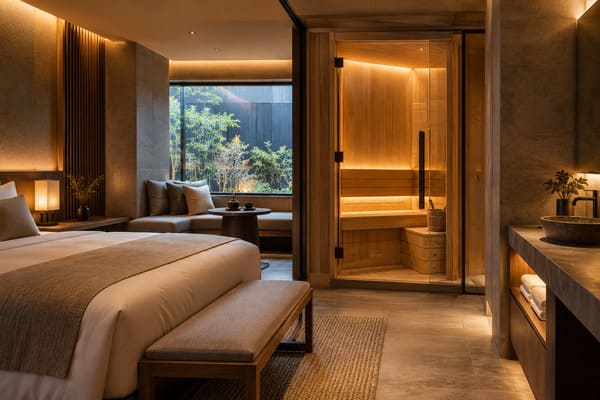
An outdoor sauna has become one of the most requested wellness amenities in hospitality. Guests want the ritual of heat and cold immersion in nature — a lakeside sauna at a resort, a wood-fired cabin at a glamping site, a sleek modern unit at a wellness retreat. For operators, it's a genuine revenue and differentiation driver: a well-placed resort sauna extends booking appeal into every season, commands premium rates, and photographs beautifully for marketing. Search interest in outdoor saunas has climbed sharply in recent years, and much of the new demand is commercial.
But a resort or glamping sauna is a very different project from a backyard one — and a different one again from an indoor hotel sauna. It runs for hours a day, serves dozens of guests, sits exposed to wind, rain, snow, and UV, and has to meet safety, power, and durability standards a home unit never faces. Get the planning right — siting, structure, power, weatherproofing, and equipment specification — and you have an asset that earns for a decade. Get it wrong and you have downtime, safety risk, and premature replacement. This guide focuses specifically on outdoor saunas for resorts, glamping sites, and wellness retreats; if you're planning an indoor hotel sauna, our hotel sauna planning guide covers capacity, guest flow, operating hours, and equipment instead.
A resort or glamping sauna is a commercial, all-weather project, not a scaled-up backyard unit or an indoor hotel sauna. Plan it in this order: choose a site with drainage, guest flow, and power access; build a proper foundation; specify weatherproof structure and durable, sauna-grade materials; bring in compliant electrical supply; and design for freeze protection, ventilation, and daily maintenance. Prefabricated or modular commercial units suit remote resort and glamping sites; site-built suits fixed premium projects. Specifying commercial-grade equipment upfront is what keeps an exposed, high-traffic sauna safe, reliable, and profitable.
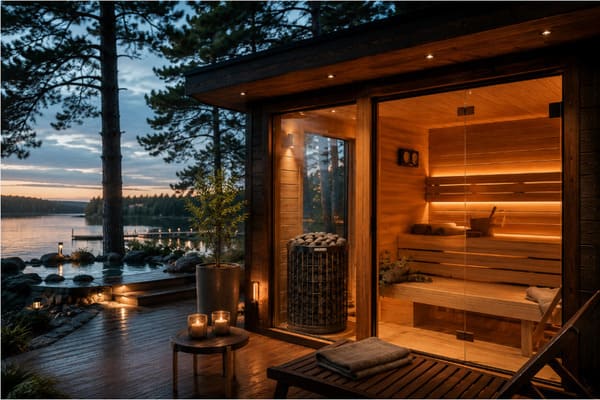
Why Resorts, Glamping Sites and Wellness Retreats Are Adding Saunas
Before the technical planning, it's worth being clear on the business case — because it shapes every decision that follows.
Resorts, glamping sites, and wellness retreats add outdoor saunas because they drive bookings, premium pricing, and year-round appeal. A sauna turns a summer-only glamping site into a four-season destination, gives a resort spa a signature nature-based experience, and anchors the growing wellness-tourism market. Guests increasingly seek authentic heat-and-cold rituals, and an outdoor sauna delivers exactly that while photographing well for marketing. For operators, it's a relatively contained capital investment with strong differentiation and revenue upside.
The wellness tourism sector has grown into one of travel's largest segments, and heat bathing is central to it.[^1] A resort sauna does three commercial jobs at once: it extends the season (a glamping site that was dead in winter becomes a cold-weather sauna destination), it justifies premium rates, and it generates marketing content — few amenities photograph as well as a lakeside or forest sauna at dusk. That's why everyone from luxury resorts to boutique glamping[^2] operators is investing. The key for operators is that the returns only materialise if the sauna is built to run reliably in commercial, all-weather conditions — which is where planning matters.
Choosing the Site: Drainage, Guest Flow and Access
Everything downstream depends on where the sauna sits. This is the first and most consequential decision.
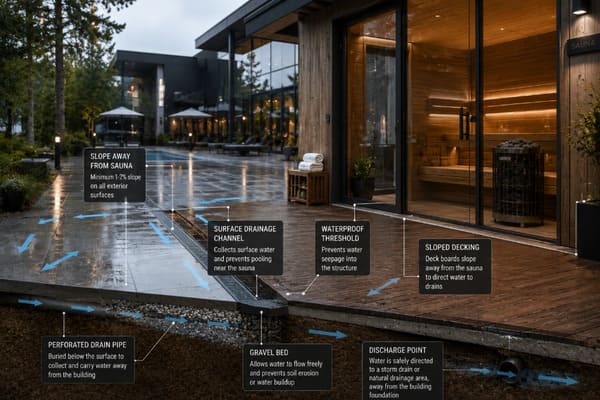
Site an outdoor sauna where it has good drainage, safe guest access, proximity to power, and a strong guest experience — ideally near water or a view for the cold-plunge ritual. Avoid low-lying spots that collect water, ensure a stable base free of flooding and frost heave, and plan a clear, well-lit, slip-safe path from guest areas. Consider privacy, prevailing wind for ventilation and smoke (for wood-fired units), and the distance electrical and water supply must run. In many regions an outdoor sauna also needs planning permission or a building permit.
Walk the candidate sites and weigh these factors:
- Drainage and ground. Avoid low, wet ground. The base must stay dry and stable to prevent rot and frost heave[^3], which can shift a poorly founded structure over winters.
- Guest flow and safety. Guests move between hot sauna and cold air (or plunge) often barefoot — the path must be short, well-lit, and slip-safe.
- Power and water distance. Every metre of trenching for electrical supply adds cost. Site with supply runs in mind.
- Experience. Proximity to a lake, river, or view massively increases the sauna's appeal and marketing value.
- Permits. Most jurisdictions require planning permission or a building permit[^4] for a permanent commercial outdoor structure — confirm before you build, not after.
Foundation and Groundwork
A commercial outdoor sauna needs a real foundation — this is where many DIY-minded projects underestimate the job.
An outdoor commercial sauna needs a stable, level, well-drained foundation: a concrete slab, concrete piers, or a properly engineered gravel-and-paver base depending on soil and climate. The foundation must keep the structure off wet ground, resist frost heave in cold climates, and carry the weight of the cabin, heater, stones, and occupants. Skipping proper groundwork causes rot, movement, door misalignment, and structural failure over time. For modular units, the supplier will specify the required base — follow it exactly.
The foundation is not the place to economise. It must do three things: keep the timber structure off the ground (moisture is the enemy of any sauna's timber), stay level so doors and benches align, and resist seasonal ground movement. A poured concrete slab is the most robust for a fixed commercial installation; engineered pier or gravel bases can work for modular units on stable ground. In cold regions, the base must extend below or be designed against the frost line. If you're installing a prefabricated or modular unit, the manufacturer will give you exact foundation requirements — treat them as non-negotiable.
Prefab vs Site-Built: Choosing the Right Structure
One of the biggest planning decisions is how the sauna is built — and for resort and glamping projects, this often favours prefab.
Choose a prefabricated or modular outdoor sauna for speed, predictable quality, and remote or multi-site rollouts — ideal for glamping sites and resorts adding several units. Choose site-built (custom) for fixed, high-end projects where architecture, size, or integration demand it. Prefab units ship as complete cabins or flat-pack kits, install fast with minimal on-site labour, and come with engineered structure and warranties. Site-built offers full design freedom but costs more, takes longer, and depends on local build quality. Many hospitality operators choose prefab commercial-grade units for reliability and rollout speed.
| Factor | Prefab / Modular | Site-Built |
|---|---|---|
| Speed | Fast — days to install | Slow — weeks of build |
| Quality control | Factory-controlled, consistent | Depends on local trades |
| Remote/multi-site | Ideal (ships in) | Difficult |
| Design freedom | Range of models | Full custom |
| Cost predictability | High | Variable |
| Best for | Glamping, resorts, rollouts | Fixed premium projects |
For most resort and glamping operators — especially those rolling out multiple units or building on remote sites where skilled trades are scarce — prefabricated commercial-grade units win on speed, consistency, and warranty. Barrel, cabin, and modern cube styles all ship as complete units or flat-pack kits. Site-built makes sense when a flagship project needs bespoke architecture. Whichever route, the deciding factor for commercial use is that the structure and equipment are rated for heavy, all-weather use — not home-grade.
Weatherproofing: Rain, Snow, Wind, Salt and UV
This is where outdoor commercial saunas live or die. Exposure is relentless, and materials must be specified for it.
Weatherproof an outdoor sauna with a durable, sloped, well-sealed roof; rot-resistant, sauna-grade exterior timber or cladding treated for UV and moisture; robust flashing and seals; and materials chosen for the specific climate. Coastal sites need salt-corrosion-resistant fixings and heaters; cold climates need freeze protection; sunny sites need UV-stable exterior finishes. The interior stays untreated sauna timber, but the exterior shell must be built to endure constant weather — this is the single biggest difference between an outdoor commercial sauna and an indoor one.
The exterior shell takes a beating that an indoor sauna never sees, so material selection is critical and climate-specific:
- Rain and snow: a properly sloped, sealed roof and quality flashing keep water out; snow load must be engineered for in cold regions.
- UV: exterior timber and finishes must be UV-stable[^5] or they grey, crack, and degrade.
- Salt (coastal): specify corrosion-resistant fixings, hardware, and heater components — salt air destroys standard steel fast.
- Wind: structure and anchoring must handle exposed-site wind loads.
Crucially, this is where material specification meets climate — a topic we cover in depth in our guide to commercial sauna materials for different environments. The interior remains untreated, breathable sauna timber (never varnished — it off-gasses when hot), while the exterior shell is engineered for endurance.
Power, Heating and Electrical Supply
Getting compliant power to an outdoor, often remote, sauna is a project in itself — and a safety-critical one.
An outdoor commercial sauna needs a compliant, professionally installed electrical supply sized for its heater — commercial electric heaters often require three-phase power and dedicated circuits. Wood-fired heaters suit off-grid resort and glamping sites but need safe flue installation and clearances. All outdoor electrical work must be weatherproof, properly earthed, RCD/GFCI-protected, and installed by a qualified electrician to local code. Plan supply routing and capacity early, because trenching power to a remote site is a major cost and constraint.
Two heating routes, chosen by site and experience:
- Electric heaters give precise, low-effort control ideal for busy resort spas — but a commercial sauna heater often needs three-phase supply, a dedicated circuit, and a suitable control unit with outdoor-rated placement. Getting compliant capacity to a remote site is often the biggest single constraint.
- Wood-fired heaters are perfect for off-grid glamping and rustic resort experiences and need no electrical supply for heat — but require safe flue[^6] installation, clearances from combustibles, and more guest supervision.
All outdoor electrical work must be weatherproof, earthed, and GFCI/RCD-protected[^7], installed to local code by a qualified electrician — non-negotiable for a public, wet, outdoor environment. Size and route the supply early: retrofitting capacity to a finished remote build is painful and expensive.
Freeze Protection, Ventilation and Cold-Climate Design
Cold-climate resorts get the biggest seasonal boost from a sauna — but only if it's designed to survive winter.
In cold climates, protect an outdoor sauna from freeze damage: drain or freeze-protect any plumbing, insulate the structure well, and ensure the heater can bring the room to temperature efficiently in low ambient conditions. Good ventilation is essential year-round to manage moisture, prevent mould, and keep air fresh for guests. Design intake and exhaust vents correctly, insulate walls and ceiling with a proper vapor barrier, and specify a heater sized for the coldest expected conditions, not average ones. Winter is often peak sauna season — the design must deliver then.
Winter is when a resort sauna earns most, so it must perform in the cold. Insulate the shell properly with a correct vapor barrier so the heater reaches temperature efficiently in low ambient conditions — an under-insulated outdoor sauna is slow, costly to run, and struggles in deep cold. Size the heater for the coldest expected day, not the average. Protect any water lines from freezing. And design ventilation carefully: outdoor saunas still need proper intake and exhaust airflow to manage moisture and keep air fresh — poor ventilation causes the same mould and odour problems it does indoors, covered in our commercial sauna cleaning and maintenance guide.
Specifying Durable, Commercial-Grade Equipment
For an exposed, high-traffic sauna, equipment quality isn't a luxury — it's what keeps the asset running and safe.
Specify commercial-grade equipment for an outdoor sauna: a heater rated for heavy, continuous, all-weather use with the right output for the room and climate; durable, rot-resistant sauna-grade timber and removable benches; quality sauna stones that resist crumbling; corrosion-resistant hardware (essential at coastal sites); and a reliable control system. Home-grade equipment fails fast under commercial outdoor conditions. Buying durable, correctly specified components upfront cuts downtime, maintenance labour, and replacement cost over the sauna's life — the largest part of its total cost of ownership.
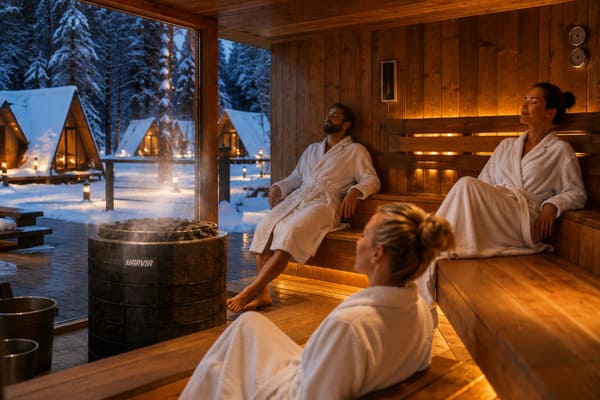
The difference between a resort sauna that runs trouble-free for a decade and one that becomes a maintenance headache is largely down to what you specify:
- Heater: a commercial sauna heater rated for continuous heavy use and sized for the room and the coldest ambient conditions. When an existing heater fails, our heater replacement guide covers the swap.
- Timber and benches: durable, rot-resistant sauna-grade timber, benches, and backrests, with removable benches for easy cleaning of an outdoor unit that collects more debris.
- Stones: quality sauna stones that resist the crumbling that chokes airflow.
- Controls and hardware: a reliable control unit and corrosion-resistant fixings — critical near the coast.
This is total cost of ownership[^8] thinking: the purchase price is small next to years of running, maintenance, and replacement, so durable specification pays for itself.
Daily Operation, Maintenance and Guest Safety
An outdoor commercial sauna is a public amenity, so operations and safety planning matter as much as the build.
Operate an outdoor resort sauna with a clear maintenance and safety routine: daily cleaning and ventilation, regular heater and stone checks, seasonal inspection of the exterior shell and foundation, and clear guest safety signage (time limits, hydration, cold-plunge guidance, wood-fire rules). Outdoor units collect more debris and face weather wear, so inspect roofing, seals, and timber each season. Assign responsibilities to staff and keep a checklist. Good operations protect guest safety, the sauna's lifespan, and your liability position.
Because it's public and outdoors, plan operations deliberately: daily cleaning and ventilation; regular checks of the heater, stones, and (for wood-fired) the flue; and seasonal inspection of the roof, seals, foundation, and exterior timber that an indoor unit never needs. Post clear guest guidance on session length, hydration, cold immersion, and — for wood-fired units — fire safety. Assign these tasks to named staff with a checklist so nothing is skipped. The full cleaning and upkeep routine is in our maintenance guide.
Common Mistakes in Outdoor Commercial Sauna Projects
Most failed projects repeat the same avoidable errors — nearly all rooted in treating a commercial project like a backyard one.
The most common mistakes are: using home-grade equipment and materials that fail under commercial all-weather use; skimping on the foundation, causing rot and movement; under-sizing the heater for cold climates; ignoring drainage and site selection; skipping permits; under-insulating so winter performance suffers; neglecting weatherproofing of the exterior shell; and having no maintenance or safety plan. Each turns a revenue asset into a liability. Specifying commercial-grade and planning properly upfront avoids nearly all of them.
| # | Mistake | Consequence |
|---|---|---|
| 1 | Home-grade equipment/materials | Fast failure under commercial outdoor use |
| 2 | Weak foundation | Rot, movement, misaligned doors |
| 3 | Under-sized heater | Poor winter performance, high running cost |
| 4 | Poor site/drainage | Flooding, frost heave, rot |
| 5 | Skipping permits | Legal and insurance problems |
| 6 | Under-insulation | Slow, costly, weak in cold |
| 7 | No maintenance/safety plan | Guest risk, short lifespan, liability |
How ROC Sauna-Solution Helps with Resort and Glamping Sauna Projects
An outdoor commercial sauna is only as reliable as the equipment inside it — and hospitality projects need a supplier who understands heavy, all-weather use.
ROC Sauna-Solution is a HARVIA-authorised agent and OEM/ODM manufacturer with 12+ years' experience, supplying commercial-grade equipment for outdoor saunas at resorts, glamping sites, and wellness retreats: heaters (electric and suited to demanding conditions), durable rot-resistant sauna timber and removable benches, quality stones, control systems, and corrosion-resistant components — all CE, RoHS, and REACH compliant. We help hotels, resorts, glamping operators, developers, and contractors specify durable, weather-ready outdoor saunas, and supply parts and consumables to keep them running. OEM/ODM custom builds and orders from 10+ units, shipped worldwide.
We work with SPA chains, hotel and resort projects, glamping operators, contractors, and distributors across 50+ countries, with our own production lines and an experienced QC team ensuring consistent batch quality. Whether you're planning a single flagship resort sauna, rolling out multiple modular units across a glamping site, or need commercial heaters, durable timber, benches, and stones, and control units specified for outdoor commercial use, we help you build an amenity that stays safe, reliable, and profitable — with stable bulk supply, OEM/ODM customisation, and dependable lead times.
Conclusion
A resort, glamping, or wellness-retreat sauna is a strong commercial asset — but only when it's planned as the all-weather, high-traffic, public installation it really is. Site it for drainage, access, and experience; build it on a proper foundation; weatherproof the shell for your climate; bring in compliant power; design for winter and ventilation; and specify durable, commercial-grade equipment throughout. Do that, and the sauna extends your season, commands premium rates, and earns for years. Treat it like a backyard unit, and it becomes downtime and liability. The single biggest lever is specification: commercial-grade, correctly sized, weather-ready equipment is what turns a good idea into a reliable, profitable amenity.
Planning an outdoor sauna for a resort, glamping site, or wellness retreat? Tell ROC Sauna-Solution about your project, and we'll help you specify durable, commercial-grade, weather-ready equipment — with OEM/ODM options and orders from 10+ units shipped worldwide. Start your enquiry here. You can also ask our AI assistant which setup suits your site and climate.
Frequently Asked Questions
Can a sauna be used commercially outdoors at a resort? Yes — outdoor saunas are increasingly popular at resorts, glamping sites, and wellness retreats. But a commercial outdoor sauna must be planned differently from a home unit: it needs a proper foundation, weatherproof structure, compliant electrical supply, freeze protection in cold climates, durable commercial-grade equipment rated for heavy all-weather use, and a maintenance and guest-safety plan. Built correctly, it becomes a strong revenue and differentiation asset that extends the season and commands premium rates.
Should a resort choose a prefab or site-built outdoor sauna? Prefabricated or modular units suit most resort and glamping projects — they install fast, offer factory-controlled quality and warranties, and are ideal for remote sites or rolling out multiple units. Site-built (custom) saunas offer full design freedom for fixed, high-end flagship projects but cost more, take longer, and depend on local build quality. Many hospitality operators choose commercial-grade prefab units for reliability and rollout speed. Whichever you choose, ensure the structure and equipment are rated for heavy, all-weather commercial use.
What power supply does an outdoor commercial sauna need? It depends on the heater. Commercial electric sauna heaters often require three-phase power, a dedicated circuit, and a suitable control unit, all installed weatherproof, earthed, and GFCI/RCD-protected to local code by a qualified electrician. Wood-fired heaters need no electrical supply for heat — ideal for off-grid glamping — but require safe flue installation and clearances. Plan supply capacity and routing early, because trenching compliant power to a remote site is often the biggest single cost and constraint of the project.
How do you protect an outdoor sauna from winter and freezing? Insulate the structure well with a proper vapor barrier so the heater reaches temperature efficiently in low ambient conditions, size the heater for the coldest expected day rather than the average, protect any plumbing from freezing, and build on a foundation designed against frost heave. Good ventilation is still essential to manage moisture. Winter is often peak sauna season for cold-climate resorts, so the design must perform in deep cold, not just mild conditions.
What equipment should you specify for a resort or glamping sauna? Specify commercial-grade components built for heavy, continuous, all-weather use: a heater rated for the room and the coldest local conditions, durable rot-resistant sauna-grade timber with removable benches, quality sauna stones that resist crumbling, a reliable control system, and corrosion-resistant hardware (essential at coastal sites). Home-grade equipment fails fast outdoors under commercial use. Specifying durable components upfront cuts downtime, maintenance, and replacement cost — the largest part of the sauna's total cost of ownership over its life.
Do you need planning permission for an outdoor commercial sauna? In most jurisdictions, yes — a permanent commercial outdoor structure typically requires planning permission or a building permit, and there may be additional requirements for electrical work, fire safety (for wood-fired units), and public-use facilities. Requirements vary by country and locality, so confirm with your local authority before building, not after. Skipping permits can cause legal, insurance, and operational problems that far outweigh the effort of getting approval upfront.
References
[^1]: Wikipedia — Wellness tourism. https://en.wikipedia.org/wiki/Wellness_tourism [^2]: Wikipedia — Glamping. https://en.wikipedia.org/wiki/Glamping [^3]: Wikipedia — Frost heaving. https://en.wikipedia.org/wiki/Frost_heaving [^4]: Wikipedia — Planning permission. https://en.wikipedia.org/wiki/Planning_permission [^5]: Wikipedia — Ultraviolet (degradation of materials). https://en.wikipedia.org/wiki/Ultraviolet#Degradation_of_polymers,_pigments_and_dyes [^6]: Wikipedia — Flue. https://en.wikipedia.org/wiki/Flue [^7]: Wikipedia — Residual-current device (RCD/GFCI). https://en.wikipedia.org/wiki/Residual-current_device [^8]: Wikipedia — Total cost of ownership. https://en.wikipedia.org/wiki/Total_cost_of_ownership