
The door is the one part of a sauna that never stops working. Every guest touches it, it opens and closes hundreds of times a day, and it sits at the exact boundary between a room held at 80–90°C and a cool changing area outside. That makes it the single biggest weak point for heat loss, the part most exposed to daily wear, and the element guests judge your sauna by before they've even sat down. Yet many projects treat the door as an afterthought — a piece of glass to fill the gap in the wall. It's far more than that. A good sauna door has to do four demanding jobs at once, and the choice that decides how well it does them is the frame material: glass, wood, or aluminum. This buyer's guide walks through all of it.
A sauna door has to seal heat in, survive constant heat and humidity, keep guests safe, and look right — and the frame material is what balances those four jobs. Frameless glass doors suit modern, open interiors; wooden-frame doors give the best heat retention and a traditional look; aluminum-frame doors are built for the wet, high-humidity conditions of steam rooms. All should use tempered safety glass, a full-perimeter seal, and outward opening. Choose the frame to match your room type, then confirm the glass, seal, size, and safety details.
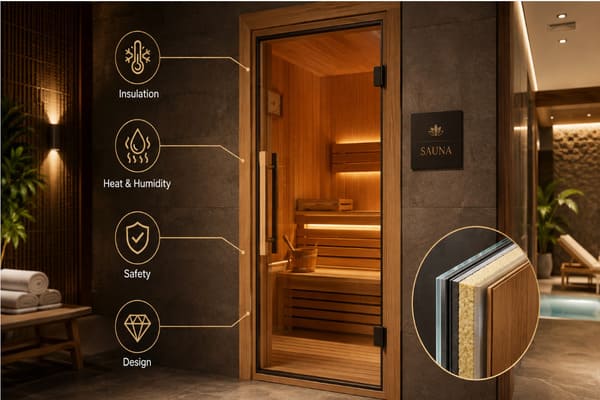
The Four Jobs Every Sauna Door Must Do
Before comparing frames, it helps to be clear on what you're actually asking a sauna door to do — because it's a lot, and the jobs pull against each other.
Every sauna door must do four things at once: seal heat and humidity inside so the room stays efficient, survive years of heat, moisture, and daily handling without warping or corroding, keep guests safe through tempered glass and outward opening, and look right for the interior. These four jobs compete — a bigger glass panel looks better but seals less well — so choosing a door is really about balancing them for your room.
Think of them as the four S's: Seal, Survive, Safety, Style. A door that seals perfectly but rusts in a year has failed. A beautiful door that leaks heat drives up your running costs every day it's open. The best sauna door isn't the one that maxes out a single job — it's the one that balances all four for the way your room is used. And the fastest way to strike that balance is the frame material, which is where most of these trade-offs are decided.
The Decision That Ties It Together: Frame Material
Frame material isn't a cosmetic choice — it's the decision that sets how a door seals, survives, and looks. Get this right and the rest falls into place.
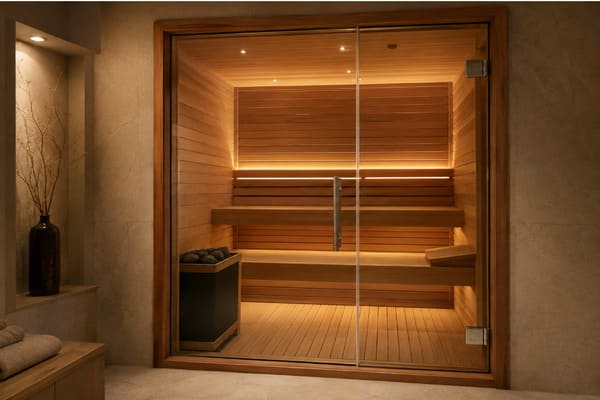
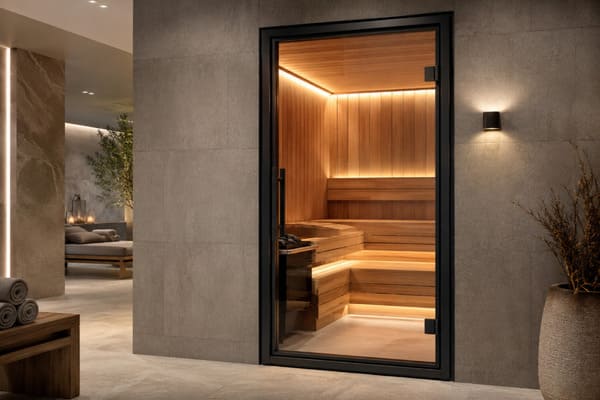
Sauna doors come in three main frame types: frameless glass, wooden frame, and aluminum frame. Frameless glass doors suit modern, minimalist interiors and maximise the sense of space; wooden-frame doors offer the best heat retention and a warm, traditional appearance; aluminum-frame doors are corrosion-resistant and built for the constant moisture of steam rooms and high-humidity wet areas. Match the frame to your room type first, then refine the details.
Here's how the three compare across the jobs that matter:
| Frame type | Best for | Heat retention | Moisture resistance | Look |
|---|---|---|---|---|
| Frameless glass | Modern dry saunas, open interiors | Good | High (all glass) | Sleek, minimal, spacious |
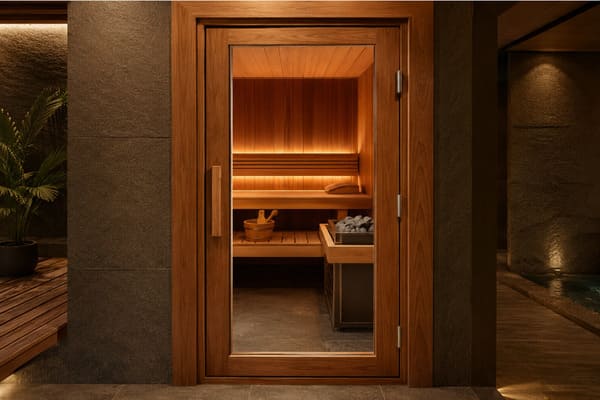
| Wooden frame | Traditional dry saunas | Best | Good (needs quality timber) | Warm, natural, classic |
| Aluminum frame | Steam rooms, wet / high-humidity areas | Good | Highest (won't rust or warp) | Clean, contemporary |
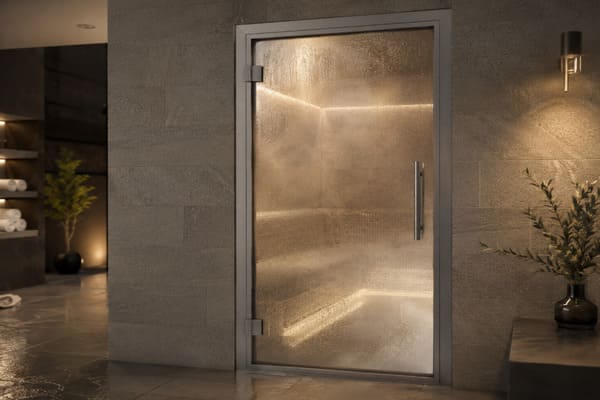
Each maps to a real product in a commercial range. A frameless-style glass sauna door with toughened, heat-resistant glass and precision hinges suits clean, modern cabins. A sauna door with a solid wooden frame — tempered glass set in natural, heat-resistant timber — is the classic choice that blends into a traditional interior and holds heat well. And a steam room door with a corrosion-resistant aluminum frame, sealed with a full silicone gasket, is purpose-built for the wet, high-humidity spaces where ordinary doors rust or warp. Pick the frame that matches your room, and the door is already doing three of its four jobs well.
The Glass: Why It Must Be Tempered
Whatever the frame, almost every sauna door is mostly glass — and that glass has to be the right kind, for safety as much as clarity.
Sauna door glass must be tempered (toughened) safety glass, typically 8mm thick. Tempering makes the glass far stronger and heat-resistant, and critically, if it ever breaks it shatters into small blunt pieces rather than sharp shards — essential in a hot room where people are barefoot and lightly dressed. Ordinary annealed glass should never be used in a sauna door.
The safety case for tempered glass[^1] is simple: it's roughly four times stronger than standard glass, handles thermal stress far better, and breaks safely. Look for glass that meets a recognised safety-glazing standard such as EN 12150[^2] or ANSI Z97.1, and for commercial projects, CE marking[^3] on the finished door. An 8mm tempered pane is the commercial norm — thick enough to feel solid and stay stable under repeated heating, while keeping the door light enough to swing easily on its hinges. This is one specification you should never compromise on, whichever frame you choose.
Sealing: Where Doors Quietly Waste Energy
A sauna door's seal decides how efficiently the room runs — and it's the job most often overlooked, because a poor seal isn't visible.
A sauna door needs a full-perimeter seal to keep heat and humidity inside. A silicone gasket around the door, plus a small controlled gap at the bottom for ventilation, lets the room heat up faster and hold temperature — cutting the heater's workload and your energy bill. A door that doesn't seal properly forces the heater to run harder all day, which is a real operating cost in a commercial sauna.
Sealing is where the door's efficiency lives or dies. A quality silicone gasket runs around the door edge so warm, humid air doesn't leak out through the gaps, while a deliberate small gap at the floor allows the fresh-air flow a sauna needs. This is also where the door connects to the wider building envelope: a well-sealed door only pays off if the walls around it are properly insulated too, which is covered in our sauna insulation and vapor barrier guide. In a steam room the sealing demands are even higher, because you're containing dense water vapour, not just hot air — which is exactly why aluminum-frame steam doors use a full silicone gasket as standard.
Safety: Outward Opening, Cool Handles, No Locks
A sauna is a hot, sometimes crowded room, so the door has genuine safety requirements that go beyond the glass.
A sauna door must open outward, never lock from the inside, and have a handle that stays cool to the touch. Outward opening means a guest who feels faint can fall against the door and it still opens; no internal lock means no one can ever be trapped inside; and a cool, heat-insulated handle prevents burns. Combined with tempered glass that breaks into blunt pieces, these features make the door safe in the one environment where safety really matters.
These aren't optional refinements — they're the difference between a safe amenity and a liability. The door should swing outward so it can never be blocked by someone who has collapsed against it, following the same logic as outward-opening egress doors[^4] in public buildings. It should have no inside lock at all, and its handle should be a low-conductivity material or design that won't burn a bare hand at sauna temperatures. For commercial operators, getting these three details right is both a duty of care and a straightforward liability question.
Getting the Size and Fit Right
Even a perfect door fails if it's the wrong size or badly fitted — so sizing and installation deserve their own attention.
Sauna doors come in standard sizes such as 1850×780mm and 2000×780mm, with custom sizes available via OEM for non-standard openings. The rough opening must be built to suit the door, the frame must be fitted plumb and square so it seals evenly, and the hinges must carry the glass without sagging. Order the door early so the opening is framed to match it — not the other way around.
Standard commercial door sizes cover most projects, but real buildings — especially renovations — often need a custom size, which is where OEM sizing matters. Whatever the size, the opening has to be framed accurately: a door that's out of square won't seal along its full length, undoing all the effort put into the gasket. The overall room dimensions and how the door fits the layout tie into wider sizing decisions, covered in our commercial sauna size guide. Plan the door dimension before the wall goes up, and fit it plumb — two simple steps that prevent most seal and sag problems.
Sauna Door vs Steam Room Door: Know the Difference
"Sauna door" and "steam room door" get used interchangeably, but they face different conditions — and choosing the wrong one causes problems.
A traditional sauna door handles hot, relatively dry air, so wooden and glass frames work well. A steam room door faces constant condensation and near-100% humidity, so it needs a corrosion-resistant aluminum frame and a full silicone gasket to seal dense vapour and resist rust. Using a standard sauna door on a steam room leads to frame corrosion and heat loss; matching the door to the room type avoids both.
| Dry Sauna Door | Steam Room Door | |
|---|---|---|
| Environment | 80–90°C, relatively dry | 40–50°C, near-100% humidity, constant condensation |
| Frame material | Glass or wooden frame | Corrosion-resistant aluminum frame |
| Seal | Silicone gasket | Heavier full-perimeter silicone gasket |
| Glass | 8mm tempered | 8mm tempered |
| Can they be swapped? | — | ❌ A dry-sauna door on a steam room will corrode and leak heat |
| Matching product | Sauna Door / Wooden-Frame Door | Steam Room Door (Silver/Gold) |
The environment is the deciding factor. A dry sauna's heat suits timber and glass, while a steam room's relentless moisture demands materials that simply won't corrode — which is why a purpose-built steam room door uses an aluminum frame and heavy silicone sealing. If your project includes a steam room, the door choice is tied to the steam system itself; our commercial steam generator guide covers that side. The rule is simple: match the door to the room's real conditions, not just its name.
What Buyers and Contractors Should Confirm
Whether you're specifying doors for a hotel group or fitting them on site, a short checklist prevents the common problems.
Before ordering a sauna door, confirm six things: the glass is tempered safety glass (typically 8mm), the frame material matches the room type, there's a full-perimeter seal, the door opens outward with no inside lock and a cool handle, the size fits the framed opening, and the door is certified (CE) for your market. These six cover safety, efficiency, and compliance in one pass.
| Checkpoint | What to confirm |
|---|---|
| Glass | Tempered / toughened, ~8mm, safety-rated |
| Frame | Matches room type (glass / wood / aluminum) |
| Seal | Full-perimeter silicone gasket |
| Safety | Outward opening, no inside lock, cool handle |
| Size & fit | Matches opening; plumb and square |
| Certification | CE certified; OEM option if custom size |
For wellness and health-resort renovation contractors, the door often has to fit a non-standard existing opening — so confirm early whether you need a standard size or a custom OEM door, and frame the opening accordingly. Ordering doors that suit the building, rather than forcing the building to suit stock doors, keeps a renovation on schedule.
Common Sauna Door Mistakes
Most sauna door problems trace back to the same handful of errors — all avoidable.
The most common mistakes are: using non-tempered glass, choosing the wrong frame for the room (a standard door on a steam room), a poor or missing seal, a door that opens inward or locks inside, ordering the wrong size, and buying an uncertified door. Each one shows up as a safety risk, wasted energy, or a failed inspection.
| # | Mistake | Consequence |
|---|---|---|
| 1 | Non-tempered glass | Dangerous shards if broken |
| 2 | Wrong frame for room type | Corrosion / heat loss |
| 3 | Poor or missing seal | Wasted energy, slow heat-up |
| 4 | Opens inward / locks inside | Guest can be trapped |
| 5 | Wrong size for opening | Won't seal, gaps, rework |
| 6 | Uncertified door | Fails commercial inspection |
Avoid these six and the door does all four of its jobs — seal, survive, safety, style — reliably for years.
How ROC Sauna-Solution Supports Your Door Choice
The easiest way to balance all four jobs is to choose from doors already built for commercial sauna and steam use — and matched to the rest of your equipment.
ROC Sauna-Solution supplies commercial sauna and steam room doors in glass, wooden, and aluminum frames — all with tempered safety glass, full-perimeter seals, outward opening, cool handles, and CE certification, in standard sizes or custom OEM dimensions. We help owners and contractors choose the frame that matches the room and specify a door that seals, survives, and stays safe.
We work with hotels, spas, resorts, gyms, project contractors, and wellness/health-resort renovation contractors across 50+ countries. Our range covers the modern glass sauna door, the traditional wooden-frame sauna door, and the moisture-proof aluminum steam room door — alongside genuine Harvia[^5] heaters, control units, timber, and accessories to complete the room. Tell us your room type and opening size, and we'll match the right door to your build.
Conclusion
A sauna door has four jobs — seal heat in, survive heat and moisture, keep guests safe, and look right — and the frame material is what balances them. Choose frameless glass for a modern dry sauna, a wooden frame for a traditional one, and an aluminum frame for a steam room or wet area. Then lock in the details that apply to every door: tempered 8mm glass, a full-perimeter seal, outward opening with no inside lock and a cool handle, the right size for the opening, and CE certification. Get the frame right and confirm those six details, and the door stops being an afterthought — and becomes the reliable, efficient, safe boundary a commercial sauna depends on.
Choosing a sauna or steam room door? Tell ROC Sauna-Solution your room type and opening size for a door matched to your build — tempered glass, sealed, certified, in glass, wooden, or aluminum frame. Start your project enquiry here. You can also ask our AI assistant which sauna door suits your project.
Frequently Asked Questions
What kind of glass is used in a sauna door? Sauna doors use tempered (toughened) safety glass, typically 8mm thick. Tempering makes the glass far stronger and heat-resistant, and if it ever breaks it shatters into small blunt pieces rather than sharp shards — essential in a hot room where people are barefoot and lightly dressed. Look for glass meeting a safety-glazing standard such as EN 12150 or ANSI Z97.1, and CE certification on the finished door.
Should a sauna door open in or out? A sauna door should always open outward. This means a guest who feels faint and falls against the door will still be able to push it open, and no one can be blocked inside. Sauna doors should also have no lock on the inside, so no one can ever be trapped, and a handle that stays cool to the touch to prevent burns.
What frame is best for a sauna door — glass, wood, or aluminum? It depends on the room. Frameless glass doors suit modern, open dry saunas; wooden-frame doors give the best heat retention and a traditional look; and aluminum-frame doors are corrosion-resistant and built for the constant moisture of steam rooms and wet areas. Match the frame to the room type first, then confirm the glass, seal, size, and certification.
What size are sauna doors? Common commercial sauna door sizes are 1850×780mm and 2000×780mm, with custom sizes available via OEM for non-standard openings. The rough opening should be framed to suit the door, and the frame fitted plumb and square so the seal works along its full length. For renovations with existing openings, a custom OEM size is often the better route.
What is the difference between a sauna door and a steam room door? A traditional sauna door handles hot, relatively dry air, so wooden and glass frames work well. A steam room door faces constant condensation and near-100% humidity, so it needs a corrosion-resistant aluminum frame and a full silicone gasket to seal dense vapour and resist rust. Using a standard sauna door on a steam room leads to frame corrosion and heat loss.
Why does a sauna door need a seal? A full-perimeter silicone gasket keeps heat and humidity inside the room, so it heats up faster and holds temperature — cutting the heater's workload and energy cost. A small controlled gap at the bottom still allows the ventilation a sauna needs. A door that doesn't seal properly forces the heater to run harder all day, which becomes a real operating cost in a commercial sauna.
About ROC Sauna-Solution
ROC Sauna-Solution is an official authorized Harvia distributor and commercial sauna sourcing partner based in China, with over 12 years of experience supplying sauna projects worldwide. We help hotels, spas, resorts, gyms, project contractors, and wellness/health-resort renovation contractors across 50+ countries build commercial saunas and steam rooms — supplying sauna and steam room doors in glass, wooden, and aluminum frames, plus genuine certified Harvia heaters, control units, steam generators, timber, stones, and accessories, with full technical documentation, CE/ETL/RoHS certification, OEM options, and technical and after-sales support.
[^1]: Tempered glass — Wikipedia. https://en.wikipedia.org/wiki/Tempered_glass [^2]: Safety glass (EN 12150 standard) — Wikipedia. https://en.wikipedia.org/wiki/Safety_glass [^3]: CE marking — Your Europe, European Commission. https://europa.eu/youreurope/business/product-requirements/labels-markings/ce-marking/index_en.htm [^4]: Fire door / egress door requirements — Wikipedia. https://en.wikipedia.org/wiki/Fire_door [^5]: Harvia — Official sauna heater manufacturer. https://www.harvia.com/en/