An aging sauna rarely needs to be torn out and rebuilt. The room's frame, benches, and shell often have years of life left — it's the "heart" of the sauna (the heater and its control unit) and the "skin" (the timber lining) that wear out first. The problem is knowing how far to go. Do you just swap a burned-out heating element? Replace the whole heater? Change the control unit too? Rewire for more power? Or reline the room? Go too small and the fault comes back; go too big and you spend money and downtime you didn't need to. This guide gives you a clear framework — repair, replace, or retrofit — and walks through each level of a commercial sauna renovation in order, so hotels, spas, gyms, and their contractors can make the right call.
When a sauna heater fails, work up through five levels only as far as the fault requires. Level 1: replace the heating element if only the element has burned out. Level 2: replace the whole heater if the body is corroded, underpowered, or beyond economical repair. Level 3: replace the control unit at the same time, because a new heater and an old controller are often incompatible[^1]. Level 4: rewire or upgrade the power supply if you're moving to a more powerful heater — a job for a licensed electrician. Level 5: replace the timber lining if it's darkened, cracked, or smells. Match the level to the actual fault, plan for compatibility and downtime, and you get a reliable sauna without over-spending.
Repair, Replace or Retrofit? The Decision Framework
Before ordering anything, work out which of three paths you're on. Most sauna problems fall cleanly into one.
Repair means fixing a single failed part — most often a heating element — while keeping the heater. Replace means fitting a new heater, usually because the old one is corroded, underpowered, or too old for spare parts. Retrofit means a fuller upgrade: heater plus control unit, often with rewiring and new timber. Choose repair for an isolated fault on an otherwise sound heater, replace when the heater itself is finished, and retrofit when you're modernising an old sauna or the whole system is dated.
Here's a quick way to place your situation:
| Symptom | Likely path | Level |
|---|---|---|
| One element glows, others don't; slow or partial heating | Repair — replace element(s) | 1 |
| Heater body rusted, corroded, or 10+ years old[^2] | Replace — new heater | 2 |
| New heater won't work with old controller / controller faulty | Retrofit — heater + controller | 3 |
| Upgrading to a bigger heater; breaker trips | Retrofit — rewire / power upgrade | 4 |
| Wood dark, cracked, or smells despite cleaning | Retrofit — new timber | 5 |
One caution before you start: if the heater simply won't switch on, heats unevenly, or trips the breaker, that may be a fault to diagnose rather than a part to replace — so rule out simple causes first. Our sauna heater repair and troubleshooting guide covers that; if the diagnosis points to a worn-out component, come back here to decide how far to go.
Level 1: Replacing the Heating Element
The most common — and cheapest — fix is the heating element, so start here before condemning a whole heater.
Sauna heating elements are the metal rods (often SCA, SAV, SAWO, JM, or H series in 1000–3000W ratings) that produce the heat. They're consumable parts: over years of heating and cooling, one will eventually burn out[^3], causing slow heat-up or uneven temperature. If the heater body is otherwise sound, replacing just the failed element (or the full set) restores full performance at a fraction of the cost of a new heater. Match the new element to the heater's model and wattage exactly.
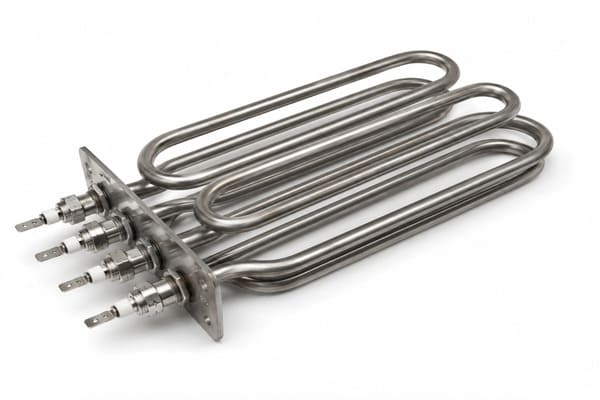
A sauna heating element works like any resistance heater: current passes through a coil that glows and radiates heat to the stones. When one element fails, the heater keeps running on the rest — so the room heats slowly, never reaches temperature, or heats unevenly. That's the classic sign to check the elements first.
The key to a successful element swap is an exact match on model and wattage. Fit a lower-wattage element and the heater underperforms; fit the wrong physical type and it won't seat correctly. This is where having the right parts on hand matters: we stock genuine sauna heating elements and replacement parts in SCA, SAV, SAWO, JM, and H series from 1000W to 3000W, compatible with the major heater brands — so you can replace a single burned-out element instead of scrapping a working heater. Because elements sit next to live wiring, the swap should be done with the power isolated and, in commercial settings, by a qualified person.
Level 2: Replacing the Whole Heater
When the heater body itself is finished, elements won't save it — it's time for a new heater.
Replace the entire sauna heater when the body is corroded or rusted through, when it's too old to source parts for, or when it no longer has the power (kW) to heat the room properly. Choosing a replacement is about matching heater output to room volume: as a rough guide, allow roughly 1 kW per cubic metre of sauna[^4], adjusting for glass area and insulation. Replacing an old heater is also the ideal moment to move to a more efficient, better-controlled modern unit.
If elements keep failing, the casing is rusting, or spare parts are discontinued, repeated repairs become false economy — a new heater is cheaper over its life. Sizing the replacement correctly is the main decision: an undersized heater never satisfies the room, an oversized one wastes energy and stresses the wiring[^5]. Match kW to the room's volume and account for how much glass and insulation it has. Our commercial sauna size guide covers the volume-to-kW relationship in detail. We supply a full range of certified commercial sauna heaters, including genuine Harvia units, sized for everything from a boutique cabin to a large hotel sauna.
Level 3: Replacing the Control Unit Too
Here's the trap that catches many renovations: a new heater often won't work with the old controller. Plan for both together.
When you replace a sauna heater above about 9 kW, it's controlled by a separate external control unit rather than built-in dials — and a new heater is frequently incompatible with an old controller. Different generations use different sensors, wiring, and communication, so pairing a new heater with a dated controller can leave it unreliable or inoperable. The safe approach is to replace the heater and control unit as a matched set, which also lets you add modern features like remote start, scheduling, and safety cut-offs.
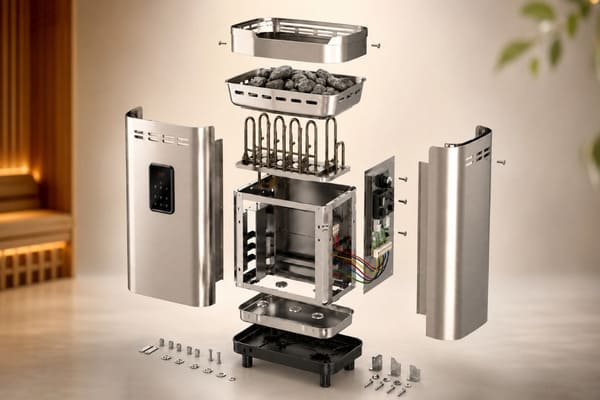
Think of the heater and controller as a pair, not two separate purchases. A modern heater expects a matching sensor and control logic; an old controller may not speak the same language, may lack the right safety cut-offs, or may simply not be rated for the new heater's load. Trying to save money by keeping the old controller is the most common reason a heater retrofit underperforms. Replacing both together — from a matched sauna control unit range — guarantees compatibility and unlocks scheduling, remote operation, and reliable over-temperature protection that older units often lack.
Level 4: Rewiring and Power Upgrades
If the retrofit involves a bigger heater, the existing wiring may not be enough — and this is strictly electrician territory.
Upgrading to a higher-kW heater often needs a heavier power supply than the old one used. Larger commercial heaters typically require a three-phase supply[^6] and a correctly sized cable and breaker; if the existing circuit trips or was sized for a smaller heater, it must be upgraded. All sauna wiring and power upgrades must be carried out by a licensed electrician to the local electrical code[^7], with proper earthing and residual-current protection. This is not a DIY step.
Sauna heaters draw serious current, and many commercial units need three-phase power. If you move from, say, a 6 kW to a 9 kW heater on a circuit sized for the old unit, the breaker will trip — or worse. A licensed electrician must confirm the supply, cable size, breaker rating, proper earthing, and a residual-current device for shock protection, all to the local code. Confirm the heater's electrical requirements before you buy, so the wiring work is scoped correctly. When you retrofit an old sauna, checking the power supply early prevents the nastiest surprise: a shiny new heater that can't be legally or safely connected.
Level 5: Replacing the Timber and Interior
The last level is the "skin." Even with a new heater, tired wood makes a sauna look and smell old.
Replace the interior timber when the wood has darkened, cracked, warped, or holds a musty smell that cleaning can't remove — usually a sign of years of moisture and heat. Relining with fresh, sauna-grade softwood (such as Nordic spruce or thermally treated wood[^8]) instantly modernises the room, improves hygiene, and pairs well with a new heater. It's also the moment to check the benches, backrests, and door, and to confirm the insulation and vapor barrier behind the lining are still sound[^9].
Timber is what guests see and smell, so new lining is the most visible part of a retrofit. If wood is stained black, splitting, or smells musty despite deep cleaning, it's past cleaning — reline it. While the old lining is off, it's the ideal time to inspect what's behind it: our sauna insulation and vapor barrier guide explains what a sound wall build-up should look like. It's also worth checking the door at this stage, since an old, leaky door undoes a new heater's efficiency — see our sauna door buyer's guide. We supply sauna-grade timber, benches, and interior materials to complete the refresh.
Retrofit-Specific Pitfalls: Compatibility and Fit
Renovations have traps a new build doesn't, because you're working around what's already there. These are the ones that derail projects.
The main retrofit pitfalls are compatibility and fit. Confirm that a new heater matches the existing control unit (or replace both), that the electrical supply can handle a bigger heater, that a new heater physically fits the old footprint and clearances, and that replacement elements match the exact model and wattage. Old and new Harvia generations, in particular, aren't always cross-compatible[^10] — always check the model before ordering parts.
| Pitfall | How to avoid it |
|---|---|
| New heater ↔ old controller mismatch | Replace as a matched set (Level 3) |
| Power supply too small for bigger heater | Electrician confirms supply before purchase |
| New heater doesn't fit old footprint / clearances | Check dimensions and safety clearances |
| Wrong element model or wattage | Match exact series (SCA/SAV/SAWO/JM/H) & kW |
| Old vs new brand generation incompatible | Confirm model with supplier before ordering |
The single best habit for a smooth retrofit: identify the exact make, model, and wattage of the existing equipment before you order anything. A photo of the heater's rating plate saves days.
Minimising Downtime
For a hotel or gym, a sauna out of service is lost revenue — so a retrofit is judged as much on downtime as on cost.
Minimise sauna downtime by ordering all parts before starting, scheduling the work in a single planned window, and doing electrical and lining work in parallel where possible. A simple element swap can take under an hour[^11]; a full heater-and-controller replacement, a day; a complete retrofit with rewiring and new timber, several days. Confirm parts availability and lead times up front — waiting for a back-ordered element is the most common cause of avoidable downtime.
The biggest downtime killer isn't the work itself — it's waiting for parts. Line up the heater, controller, elements, and timber before you shut the room, book the electrician for the same window, and the sauna is back in service fast. Keeping a spare heating element on the shelf is cheap insurance for a busy commercial sauna: a burned-out element becomes a one-hour fix instead of a week-long wait. If a fault reappears after the work, our sauna heater repair and troubleshooting guide helps your team diagnose it fast.
What Owners and Contractors Should Confirm
A short pre-order checklist prevents almost every retrofit problem.
Before a sauna heater replacement or retrofit, confirm six things: the exact model and wattage of the existing heater, whether the control unit needs replacing too, whether the electrical supply supports a bigger heater, that any new heater fits the existing footprint and clearances, that the timber and door are still sound (or budget to replace them), and that all new equipment is certified for your market.
| Checkpoint | What to confirm |
|---|---|
| Existing equipment | Exact make, model, wattage (photo the rating plate) |
| Control unit | Compatible with new heater, or replace as a set |
| Power supply | Rated for the new heater; electrician verified |
| Fit | New heater matches footprint and safety clearances |
| Timber & door | Sound, or budgeted for replacement |
| Certification | CE / relevant marking on all new equipment |
For CE-marked commercial equipment this checklist is also part of staying compliant — worth a final pass before the room reopens to guests.
Common Sauna Retrofit Mistakes
Most retrofit regrets come from the same handful of shortcuts.
The most common retrofit mistakes are: scrapping a whole heater when only an element had failed, keeping an incompatible old controller with a new heater, upgrading to a bigger heater without upgrading the wiring, ordering the wrong element model or wattage, and skipping the timber and door so a new heater still runs an inefficient, tired-looking room.
| # | Mistake | Consequence |
|---|---|---|
| 1 | Replacing the heater over one failed element | Unnecessary cost |
| 2 | New heater + old, incompatible controller | Unreliable or dead system |
| 3 | Bigger heater, same old wiring | Tripping breakers, unsafe |
| 4 | Wrong element model / wattage | Poor heating, won't fit |
| 5 | Ignoring old timber and door | Efficient heater, tired room |
Avoid these five and the retrofit lands where it should: the smallest fix that actually solves the problem.
How ROC Sauna-Solution Supports Your Retrofit
The simplest way to get a retrofit right is to source matched, certified parts from one supplier who can confirm compatibility for you.
ROC Sauna-Solution supplies everything a commercial sauna retrofit needs — genuine sauna heating elements in SCA, SAV, SAWO, JM, and H series (1000–3000W), full commercial heaters, matched control units, sauna-grade timber, stones, and accessories — all certified and matched to your existing setup. Send us the make, model, and wattage of your current heater, and we'll confirm the right elements or a compatible heater-and-controller set, with fast global shipping to minimise downtime.
We work with hotels, spas, resorts, gyms, project contractors, and wellness/health-resort renovation contractors across 50+ countries. Whether you need a single replacement heating element, a new commercial heater, a matched control unit, or a full re-line with fresh timber, we help you choose the smallest, safest fix that solves the problem — and ship it fast so your sauna is back earning.
Conclusion
A sauna heater failure is a decision, not a demolition. Work up the levels only as far as the fault requires: replace the heating element if that's all that's burned out, replace the heater when the body is finished, add a new control unit when compatibility demands it, upgrade the wiring only if you're going bigger (and only with a licensed electrician), and reline the timber when the room looks and smells its age. Identify your existing equipment exactly, plan for compatibility and downtime, and you'll spend on what fixes the problem — nothing more.
Planning a sauna heater replacement or retrofit? Send ROC Sauna-Solution the make, model, and wattage of your current heater, and we'll confirm the right heating element, heater, or matched heater-and-controller set — certified and shipped fast to minimise downtime. Start your enquiry here. You can also ask our AI assistant which parts fit your heater.
Frequently Asked Questions
Can you replace just the heating element in a sauna heater? Yes. If only an element has burned out and the heater body is otherwise sound, you can replace the single failed element (or the full set) instead of buying a new heater — at a fraction of the cost. The key is matching the new element to the heater's exact model and wattage, such as SCA, SAV, SAWO, JM, or H series in 1000–3000W. Because elements sit next to live wiring, isolate the power and, in commercial settings, have a qualified person do the swap.
When should you replace a sauna heater instead of repairing it? Replace the whole heater when the body is corroded or rusted through, when spare parts are no longer available for an old model, or when the heater no longer has enough power to heat the room properly. If elements keep failing repeatedly or the casing is rusting, ongoing repairs become false economy and a new, more efficient heater is cheaper over its life.
Do you need to replace the control unit when you replace the heater? Often, yes. Heaters above about 9 kW use a separate external control unit, and a new heater is frequently incompatible with an old controller because sensors, wiring, and control logic change between generations. Pairing a new heater with a dated controller can leave it unreliable or inoperable. The safe approach is to replace the heater and control unit as a matched set.
How long do sauna heaters last? A quality commercial sauna heater typically lasts many years, but the heating elements inside it are consumable parts that wear out sooner with heavy use — often the first thing to fail. Regular commercial use, water quality, and how well the room is maintained all affect lifespan. Replacing a burned-out element can extend a sound heater's service life significantly before a full replacement is needed.
Can I replace a sauna heater myself? Swapping a heating element with the power isolated can sometimes be done by a competent person, but replacing a whole heater, changing the control unit, or any wiring and power-supply work must be done by a licensed electrician to the local electrical code — with correct cable sizing, breaker rating, earthing, and residual-current protection. In commercial settings, electrical work should always be carried out by a qualified professional.
Are sauna heating elements universal or brand-specific? Elements are specific to the heater's model and wattage, not universal — but many are made in standard series (such as SCA, SAV, SAWO, JM, and H) that fit across several brands. Always match the exact series and wattage of your heater. Sending a photo of the heater's rating plate to your supplier is the easiest way to confirm the correct replacement element.
About ROC Sauna-Solution
ROC Sauna-Solution is an official authorized Harvia distributor and commercial sauna sourcing partner based in China, with over 12 years of experience supplying sauna projects worldwide. We help hotels, spas, resorts, gyms, project contractors, and wellness/health-resort renovation contractors across 50+ countries build, upgrade, and retrofit commercial saunas and steam rooms — supplying genuine sauna heating elements (SCA, SAV, SAWO, JM, H series, 1000–3000W), certified Harvia heaters, control units, steam generators, timber, stones, and accessories, with full technical documentation, CE/ETL/RoHS certification, OEM options, and technical and after-sales support.
[^1]: "How to Choose the Best Sauna Controller for Your Setup", https://finnmarksauna.com/en-us/blogs/sauna-how-to-guides/how-to-choose-a-controller-for-your-sauna. A technical guide could explain that incompatibility between new heaters and old controllers arises from differences in temperature sensors (e.g., thermistor vs. thermocouple), control logic, and communication protocols developed by manufacturers over time. Evidence role: mechanism; source type: other. Supports: The claim that new heaters and old controllers are often incompatible due to changes in technology.. Scope note: The source would likely provide a general explanation rather than a comprehensive compatibility list for specific models. [^2]: "Sauna Heater Lifespan: How Often Should You Replace ...", https://selectsaunas.com/blogs/sauna-education/sauna-heater-lifespan-how-often-should-you-replace-your-sauna-heater?srsltid=AfmBOorGNjhPOYthLocvPgPbHgjr-5s5l75yCWnq9jZkTFcdq61cPRMR. A source could confirm that commercial sauna heaters have a typical service life, after which replacement is often more economical than continued repair due to factors like corrosion, metal fatigue, and the discontinuation of spare parts. Evidence role: general_support; source type: institution. Supports: The claim that sauna heaters are often replaced after a certain number of years due to wear, corrosion, and parts availability.. Scope note: The source may provide a general lifespan range rather than a precise 10-year rule, as service life depends on usage, maintenance, and water quality. [^3]: "What Are Common Failure Modes Of Heating Elements? ...", https://kintekfurnace.com/faqs/what-are-common-failure-modes-of-heating-elements. A source could describe the mechanism of failure for resistance heating elements, explaining that repeated thermal expansion and contraction (thermal cycling) causes micro-fractures and eventual breakage or burnout of the resistive wire. Evidence role: mechanism; source type: encyclopedia. Supports: The claim that heating elements fail over time due to thermal cycling.. [^4]: "Sauna calculator", https://www.harvia.com/en-US/sauna/saunas/sauna-calculator/. A source could provide the standard industry formula for calculating the required power output of a sauna heater based on the room's volume, noting that adjustments are necessary for non-insulated surfaces like glass or stone. Evidence role: general_support; source type: education. Supports: The claim that heater power (kW) should be matched to room volume (m³), often using a ratio of approximately 1:1.. [^5]: "Inrush current", https://en.wikipedia.org/wiki/Inrush_current. A source on HVAC or electrical system design could explain that an oversized heater short-cycles, leading to energy inefficiency and increased wear on components like relays. While wiring is protected by a breaker, frequent high-current cycles contribute to the overall wear of the electrical system. Evidence role: mechanism; source type: paper. Supports: The claim that oversizing a heater can lead to inefficiency and potential electrical issues.. Scope note: The source would likely discuss general principles of HVAC or electrical heating systems, not saunas specifically. [^6]: "Single-Phase vs. Three-Phase Power: Differences & Uses", https://www.uti.edu/blog/electrical/single-vs-three-phase-power. An electrical engineering resource could explain that three-phase power is used for high-demand appliances like large heaters because it delivers power more efficiently and smoothly, allowing for smaller, more economical wiring and balancing the load on the electrical grid. Evidence role: mechanism; source type: encyclopedia. Supports: The claim that high-power heaters require a three-phase supply.. [^7]: "Sauna NEC Code Requirements 2026: Essential Guide for ...", https://peaksaunas.com/blogs/wellness/2023-nec-sauna-requirements?srsltid=AfmBOoo3AjQf_t_XCQM9aQ7wJWPDyfyOA_n30tEazcqvmAH8XvHWmiU_. A source such as a national electrical code or a safety standards body could be cited to show that saunas are classified as special locations (containing a heater and often moisture) requiring installation by qualified electricians according to specific regulations. Evidence role: expert_consensus; source type: government. Supports: The claim that sauna electrical work must be performed by a licensed professional according to code.. Scope note: The specific code (e.g., NEC in the US, BS 7671 in the UK) will vary by jurisdiction, so the source would be an example of such a regulation. [^8]: "Nordic Spruce Tongue & Groove Sauna Wood", https://saunasupplyco.com/nordic-spruce/. A research paper or forestry guide could detail the properties of woods suitable for saunas, noting that species like Nordic spruce have low resin content and that thermal modification processes increase wood's dimensional stability and resistance to decay. Evidence role: general_support; source type: research. Supports: The claim that certain woods like Nordic spruce and thermally treated wood are well-suited for saunas.. [^9]: "Humidity's Role in Heat-Related Health Outcomes - PMC - NIH", https://pmc.ncbi.nlm.nih.gov/articles/PMC10231239/. A building science resource could explain that a vapor barrier in a sauna wall is essential to prevent warm, moist air from penetrating the wall cavity, where it could condense and lead to rot, mold, and degradation of the building structure. Evidence role: mechanism; source type: education. Supports: The claim that a sound vapor barrier is a critical component of a sauna wall.. [^10]: "Electronic Control Devices Product Theory", https://isl.charlotte.edu/electronics/electronic-control-devices/electronic-control-devices-product-theory/. A technical article could explain that manufacturers of complex appliances frequently update electronic control boards, sensors, and software, often leading to a lack of backward compatibility between different product generations. Evidence role: general_support; source type: other. Supports: The claim that different generations of equipment from the same manufacturer can be incompatible.. Scope note: This source would provide a general explanation for this industry practice rather than confirming it for the specific brand mentioned. [^11]: "Why do sauna heater elements burn out and how to ...", https://www.facebook.com/groups/saunaloverscommunity/posts/1553157025433799/. A source from a trade association or a maintenance guide for facility managers could provide benchmark times for common repair and replacement tasks, supporting the relative difference in downtime between a minor component swap and a full system renovation. Evidence role: general_support; source type: other. Supports: The claim that repair times vary significantly, from under an hour for an element swap to several days for a full retrofit.. Scope note: The source would provide estimates, as actual times depend on technician skill, site conditions, and parts availability.