For a hotel, spa, or gym, a sauna that won't heat isn't just an annoyance — it's a room that's losing revenue every hour it stays closed. But before you call out a repair technician or, worse, order a whole new heater, it pays to understand what has actually failed. Many "faults" are simple resets or blocked vents that your own staff can check in minutes; others are genuine electrical problems that must go to a licensed electrician; and some mean a part has reached the end of its life and needs replacing. This guide is built for facility managers, maintenance teams, and sauna renovation contractors: a symptom-by-symptom diagnostic framework that tells you how serious a problem is, who should handle it, and when it's time to replace a part rather than repair it — so you keep downtime and cost to a minimum.
When a commercial sauna won't heat, diagnose before you dispatch. Start with the simple checks any trained staff member can do safely: the heater's reset button, the power supply, the door switch, and blocked vents or stones. If those are clear, match the symptom to its likely cause — no heat, slow heat, tripping breakers, uneven temperature, or an unresponsive control panel. Anything involving wiring, the control unit, or internal components must be handled by a licensed electrician. If diagnosis points to a burned-out heating element, corroded heater, or failed controller, the economical fix is usually to replace that part rather than keep repairing.
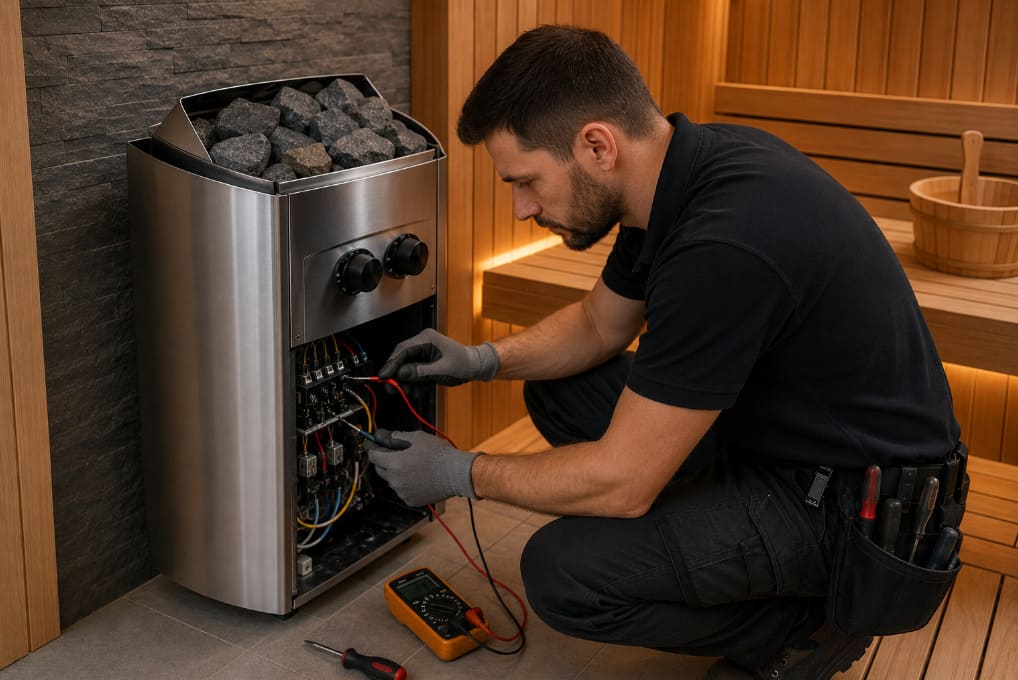
Safety First: What Staff Can Check vs What Needs an Electrician
In a commercial setting, the line between a safe staff check and a job for a professional isn't optional — it's a matter of liability and code compliance.
In a commercial sauna, trained staff may safely perform only no-contact, power-on checks: pressing the heater's external reset button, confirming the breaker is on, testing the door switch, and clearing blocked vents or badly stacked stones. Anything that requires opening the heater, touching wiring, testing components, or working inside the control unit must be carried out by a licensed electrician, in line with local electrical code. Sauna heaters run on high current and often three-phase power[^1], so unqualified electrical work is both dangerous and a compliance risk.
Set this rule with your team before anything goes wrong: if a fix requires a screwdriver on anything electrical, it stops and goes to a qualified professional. This isn't just safety — for a commercial operator it's about insurance, warranty, and liability. Throughout this guide, we flag which symptoms staff can triage and which must be escalated. When escalation points to a specific failed part, our sauna heater replacement and retrofit guide covers exactly what to change and how.
Start Here: The Simple Checks
Before diagnosing anything complex, rule out the quick, common causes. A surprising share of "dead" saunas are back in service in ten minutes.
Before assuming a serious fault, check four things in order: (1) the reset button — sauna heaters have a high-limit cut-off that trips and needs manually resetting; (2) the power supply — confirm the breaker hasn't tripped and the isolator switch is on; (3) the door — many commercial heaters have a door switch that stops heating if the door is open or the switch is faulty; and (4) obstructions — blocked air vents or overcrowded stones restrict airflow and cause overheating cut-outs. These four cover a large share of commercial sauna call-outs.
The reset button (the high-limit reset) is the single most common "it's dead" cause: the heater's safety cut-off has tripped, often after an overheat event, and simply needs resetting. If it trips again immediately, stop — that points to a real fault below. Check the breaker and isolator next, then the door switch, then airflow. Overcrowded or wrongly stacked stones are an underrated culprit: they choke airflow around the elements and trigger the overheat cut-out. Teach front-desk or maintenance staff this four-step triage and you'll resolve many faults without a call-out at all.
Symptom 1: The Sauna Won't Heat At All
If the room stays cold and the simple checks are clear, the fault is in the heater's power path or the elements themselves.
A commercial sauna that produces no heat at all — after the reset, power, and door checks are cleared — usually has one of three causes: a tripped or faulty high-limit cut-off, a failed contactor or wiring fault in the control circuit, or one or more burned-out heating elements. The reset is a staff check; the contactor, wiring, and control circuit must be tested by an electrician; and a confirmed burned-out element should be replaced. If the heater is old and elements keep failing, replacing the heater is often more economical than repeated repairs.
Work from simplest to most serious. If the reset holds but there's still no heat, an electrician should test the contactor (the switch that feeds power to the elements) and the control circuit. If those are sound, the elements themselves are the likely culprit — see Symptom 2 for how a failed element shows up. A "no heat at all" fault on an older heater is also the moment to weigh repair against replacement, which we cover below.
Symptom 2: Slow to Heat or Won't Reach Temperature
This is the most common complaint — and the most useful diagnostic, because a partially working heater points straight to the elements.
When a commercial sauna heats slowly or never reaches its set temperature, the most likely cause is one or more failed heating elements. A sauna heater has several elements; if one burns out, the others keep working, so the heater still produces some heat — just not enough, and not evenly. Other causes are an undersized heater for the room, poor insulation letting heat escape[^2], or blocked airflow. Check for a failed element first: if one element stays cold while others glow, replace the element set.
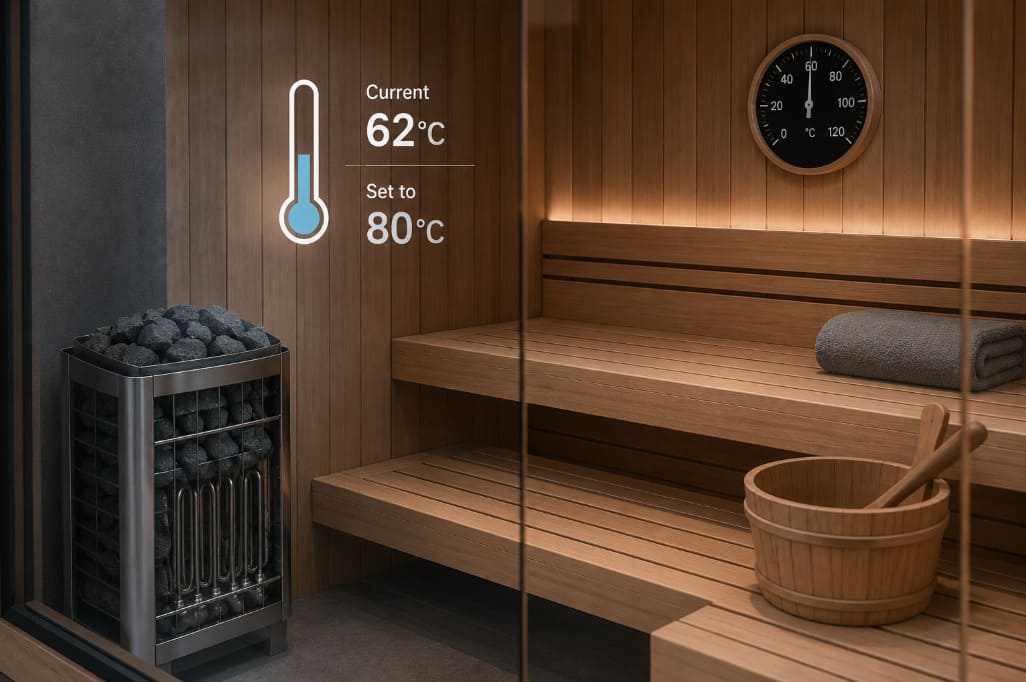
A heating element is a consumable part — in heavy commercial use, one will eventually burn out. The tell-tale sign is a heater that runs but underperforms: slow heat-up, never quite hitting temperature, or one side of the cabin cooler than the other. With the power isolated, a technician can see which element fails to glow. The fix is to replace the element — matched exactly to the heater's model and wattage. We stock genuine sauna heating elements in SCA, SAV, SAWO, JM, and H series from 1000W to 3000W, so a busy commercial sauna can be back at full output fast.
But rule out the alternatives before ordering: if all elements work yet the room won't heat, the heater may simply be underpowered for the space, or heat may be escaping through poor insulation or a leaky door. Our commercial sauna size guide explains the kW-to-volume match, and our sauna insulation and vapor barrier guide covers heat loss — both worth checking before you blame the heater.
Symptom 3: The Heater Keeps Tripping the Breaker
A heater that repeatedly trips the breaker is signalling an electrical fault — and this one goes straight to an electrician.
A commercial sauna heater that repeatedly trips the breaker or RCD/GFCI indicates an electrical fault — commonly a failing heating element that has developed an earth leak[^3], moisture in the wiring or connections, a deteriorating contactor, or a circuit that's undersized for the heater's load. This must be diagnosed by a licensed electrician; repeatedly resetting a tripping breaker is dangerous. If a leaking element is confirmed, replace the element; if the wiring or supply is inadequate, it must be brought up to code.
Do not keep resetting a breaker that trips — it's protecting people and property from a real fault. A common cause is an element that has broken down internally and is leaking current to earth, tripping the residual-current device. Moisture ingress at connections is another. Both are electrician territory. If the sauna was recently fitted with a larger heater on old wiring, the circuit itself may be undersized — a scenario we cover in the retrofit guide's section on power upgrades. For a commercial operator, a persistently tripping heater should mean the sauna stays closed until an electrician clears it.
Symptom 4: Uneven Temperature — Hot Head, Cold Feet
Complaints about uneven heat are usually design or airflow issues rather than a broken part — useful to know before dispatching a technician.
Uneven sauna temperature — hot at head height but cold at the feet[^4], or one side cooler than the other — is usually caused by poor air circulation, a partially failed heating element, blocked or badly positioned vents, or a heater that's undersized or wrongly placed. Check first for a failed element (which cools one zone) and for blocked intake and exhaust vents. If the elements and vents are sound, the cause is more likely ventilation design or heater sizing than a repairable fault.
Some temperature variation is normal — heat rises. But pronounced cold zones point to airflow. In a commercial sauna, the intake vent (low, near the heater) and exhaust vent (on the opposite wall) must both be clear and correctly sized to drive convection. A failed element also creates a persistent cold zone, so rule that out first. If the room was never comfortable from day one, the issue is likely design — heater position, size, or ventilation — rather than a fault that repair will fix.
Symptom 5: The Control Panel Is Unresponsive or Showing Errors
The control unit is the sauna's brain — and when it fails, the whole system stops, even with a perfectly good heater.
When a commercial sauna's control panel is blank, unresponsive, or displaying an error code, the cause is typically a blown fuse in the controller, a failed temperature sensor, loose or corroded sensor wiring, or a control unit that has reached the end of its life. Error codes usually indicate a sensor fault — check the sensor and its wiring first. If the controller itself has failed, it must be replaced; and because control units and heaters must be compatible, an old controller often can't simply be swapped for any new one.
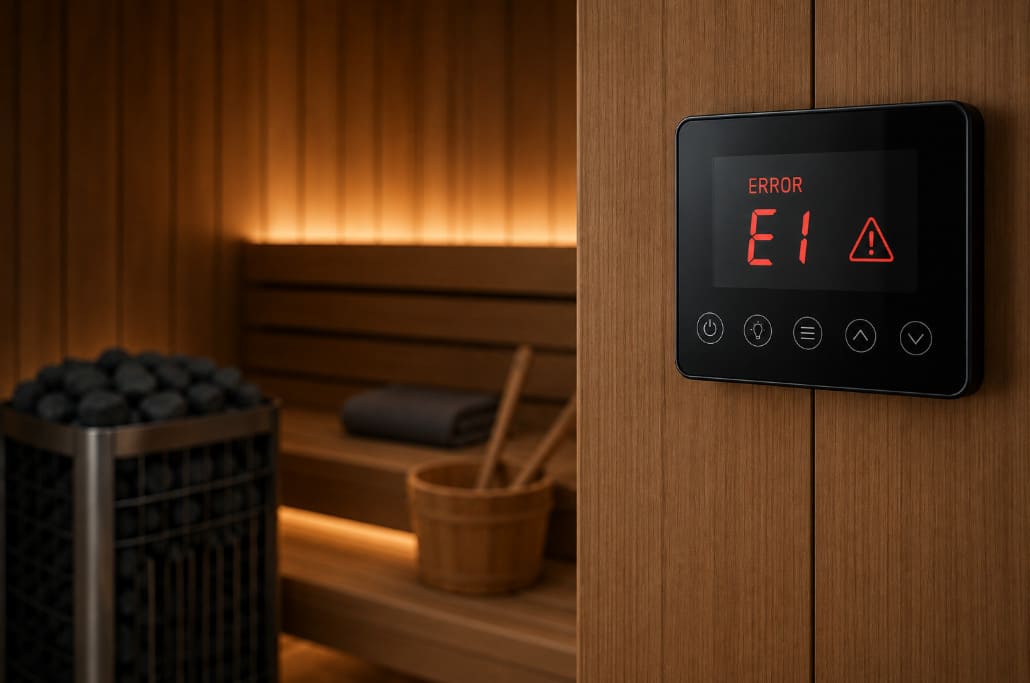
Most control-panel faults trace to the temperature sensor or its wiring — a cheap fix an electrician can confirm from the error code. But if the control unit itself has failed, replacement is the answer, and compatibility matters: a modern heater and an old controller don't always work together, and vice versa. This is where repair shades into retrofit. We supply matched sauna control units and can confirm which controller suits your heater — the retrofit guide explains why the heater and controller are best replaced as a matched set.
Repair or Replace? Making the Commercial Call
For a commercial operator, the decision isn't just "can it be fixed?" — it's "which option gets the room earning again, reliably, for the lowest total cost?"
Repair when a single part has failed on an otherwise sound heater — most often a heating element or a temperature sensor. Replace when the heater is old and elements fail repeatedly, when the body is corroded, when spare parts are discontinued, or when the control unit has failed and isn't compatible with modern replacements. For a commercial sauna, factor in downtime and reliability, not just part cost: a heater that keeps failing costs far more in lost revenue and repeat call-outs than a one-time replacement.
| Situation | Commercial call |
|---|---|
| One element failed, heater otherwise sound | Repair — replace element |
| Sensor fault, controller otherwise fine | Repair — replace sensor |
| Elements fail repeatedly / heater corroded | Replace — new heater |
| Spare parts discontinued for old model | Replace — new heater |
| Controller failed, not compatible with new parts | Replace — matched heater + controller |
The full decision framework — and how to minimise downtime during a swap — is in our sauna heater replacement and retrofit guide.
Downtime and Who Should Fix What
For a hotel or gym, the real cost of a sauna fault is the closed door — so managing who fixes what, and how fast, matters as much as the repair itself.
Minimise commercial sauna downtime by triaging faults by who can fix them: staff handle the simple checks (reset, power, door, vents) immediately; a licensed electrician handles all electrical faults; and stocked spare parts turn a multi-day wait into a same-day fix. The biggest avoidable downtime is waiting for parts — so a busy commercial sauna should keep a spare heating element and temperature sensor on the shelf. Confirm part compatibility and lead times before a fault occurs, not after.
Think of it as three response tiers:
| Tier | Who | Typical faults | Downtime |
|---|---|---|---|
| 1 | Trained staff | Reset, breaker, door, vents, stones | Minutes |
| 2 | Licensed electrician | Contactor, wiring, sensor, tripping | Hours–1 day |
| 3 | Part replacement | Element, sensor, controller, heater | Same day if stocked |
The lesson for operators: the fault you can't control is parts lead time. Keeping consumable spares — a matching heating element above all — on site is cheap insurance that keeps a revenue-generating sauna open. Regular sauna maintenance also prevents many faults before they start.
What Owners and Contractors Should Confirm
A short standing procedure turns sauna faults from a panic into a routine.
**For reliable commercial sauna operation, confirm five things up front: staff know the safe four-step triage (reset, power, door, vents); you have a named licensed electrician for electrical faults; the exact make, model, and wattage of your heater is recorded (photograph the rating plate); compatible spare elements and a sensor are stock
[^1]: "Electrical Requirements Of Electric Sauna Heaters - YouTube", https://www.youtube.com/watch?v=bqoBVNNz12E. Technical documentation and electrical references describe commercial electric sauna heaters as high-power resistive loads, with larger models commonly supplied by three-phase circuits. Evidence role: general_support; source type: institution. Supports: Commercial sauna heaters often draw high current and may use three-phase power.. Scope note: The source would support typical commercial heater configurations; smaller commercial or light-duty units may use single-phase supplies. [^2]: "Heat Loss in Building - an overview | ScienceDirect Topics", https://www.sciencedirect.com/topics/engineering/heat-loss-in-building. Building-physics and heat-transfer sources show that inadequate insulation increases conductive heat loss through walls and ceilings, raising the heating load required to maintain indoor temperature. Evidence role: mechanism; source type: education. Supports: Poor insulation can cause a sauna to lose heat and fail to reach or maintain set temperature even when the heater operates.. Scope note: The evidence would establish the heat-loss principle generally; sauna-specific losses depend on room construction, vapor barrier, door sealing, and operating temperature. [^3]: "[Fix Cartridge Heater Earth Leakage Causing RCD to Trip]", https://industrialmonitordirect.com/blogs/knowledgebase/cartridge-heater-rcd-tripping-at-800c-root-cause-and-solutions?srsltid=AfmBOoptO2ZtmhNtCvGd_zo8TebU-l6fwEQNtchBh6JLm0S0qn6D78Uh. Electrical testing literature explains that insulation deterioration in resistive heating elements can allow leakage current to flow to earth, which may trip residual-current protection. Evidence role: mechanism; source type: education. Supports: A deteriorating heating element can develop earth leakage and trip an RCD/GFCI.. Scope note: The evidence supports one recognized failure mode; moisture, wiring defects, or other insulation failures can produce similar symptoms. [^4]: "What makes heat rise?", https://wtamu.edu/~cbaird/sq/2014/07/10/what-makes-heat-rise/. Thermal convection references explain that warmer air is less dense and tends to rise, producing vertical temperature stratification unless airflow mixes the space. Evidence role: mechanism; source type: encyclopedia. Supports: Saunas can feel hotter at head height and cooler near the floor because warm air rises and stratifies without adequate circulation.. Scope note: The source supports the physical basis of temperature stratification; the degree of stratification in a sauna also depends on ventilation design, heater placement, and bench layout.