You want to launch your own infrared sauna range. Perhaps you already sell wellness products, bathroom equipment or traditional saunas and want to expand your product offering.
Should you develop a completely new cabin, modify an existing design or work with a manufacturer to create a private-label product?
For overseas importers, distributors and wellness brands, the answer depends on your target market, product requirements and budget.
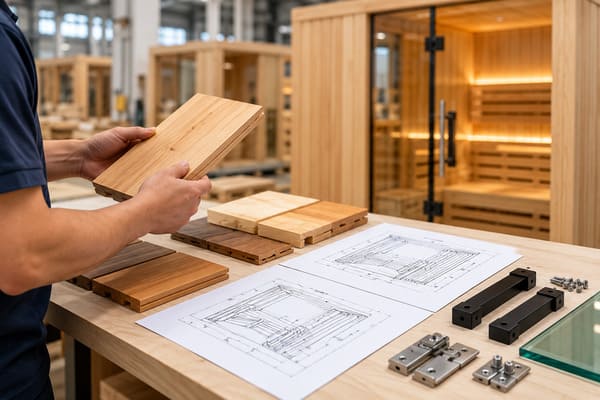
A custom infrared sauna involves more than adding your logo to a wooden cabin. The timber, dimensions, heating panels, controls, interior layout and packaging all contribute to the final product.
Understanding these options before approaching an infrared sauna manufacturer can help you avoid unnecessary development costs and make better purchasing decisions.
1. What Can You Customize in an Infrared Sauna?
Not every customization requires a completely new design.
Some changes involve appearance and branding, while others affect the cabin's structure, heating performance and electrical configuration.
Cabin Structure and Materials
Depending on the manufacturer's capabilities, customization may include:
- Dimensions: Adjusting the cabin to suit your target customers and available space.
- Wood species and finish: Selecting timber, colour and interior appearance.
- Bench layout: Configuring seating according to cabin dimensions and intended use.
- Glass and doors: Choosing suitable glazing, door dimensions and hardware.
- Lighting and accessories: Integrating compatible lighting and other approved features.
For example, a brand targeting compact residential properties may prioritize a smaller cabin footprint, while a wellness equipment distributor may prefer a larger model with more seating space.
Both can use infrared heating, but they serve different customer groups.
Heating Panels and Controls
Heating components deserve particular attention because they determine the technical configuration of the product.
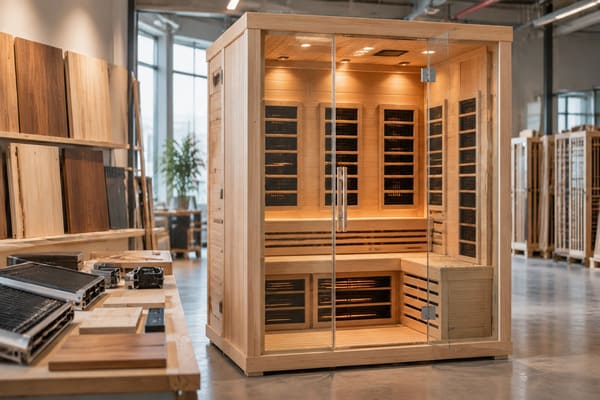
Depending on the design, an infrared sauna may use carbon-crystal panels or infrared tube emitters.
Their output, positioning, electrical requirements and control arrangements must be matched to the cabin design.
ROC's Infrared Heating Panels include carbon-crystal wall panels, infrared tube heaters and glass foot-warming panels in different sizes and power ratings.
For OEM projects, the panel arrangement can be evaluated according to the proposed cabin layout and seating positions.
The objective is not simply to install as many panels as possible. It is to select an appropriate configuration for the intended heating experience and electrical supply.
Before approving a custom design, confirm the complete heating specification, not just the appearance of the cabin.
2. Custom Infrared Sauna vs. Traditional Sauna: What Changes?
Both types of sauna can be customized in terms of dimensions, timber, benches, glass doors and branding.
The main difference is the heating technology, which affects how the cabin is designed and equipped.
| Design consideration | Infrared sauna | Traditional sauna |
|---|---|---|
| Heating system | Infrared panels or emitters | Electric heater with sauna stones |
| Main design focus | Panel positioning and radiant heating coverage | Heater location, stone capacity and safety clearances |
| Electrical planning | Based on infrared components and controls | Based on heater power and control requirements |
| Interior layout | Panels positioned around the intended seating area | Benches, heater position and ventilation planned together |
| Customization priorities | Panel layout, cabin dimensions and controls | Heater selection, bench levels and room structure |
Can You Convert a Traditional Sauna into an Infrared Sauna?
Potentially, but it should not be treated as a simple component replacement.
The cabin needs to be assessed for the intended infrared components, installation positions, electrical requirements and control system.
The same applies in reverse. Adding a traditional sauna heater to an infrared cabin requires a technical review of the structure, temperature limits, clearances and approved operating conditions.
Not every infrared panel is suitable for the high-temperature environment of a traditional sauna.
If both technologies are to be combined, the complete system must be specifically designed and assessed for that application. Simultaneous operation should never be assumed without manufacturer approval.
Harvia's official infrared product information provides examples of dedicated infrared cabins and hybrid designs combining infrared technology with traditional sauna heating.
For private-label buyers, the important distinction is:
Changing the heating technology may require a different product design, not simply a different parts list.
This should be decided before drawings and samples are approved.
3. How to Work with an Infrared Sauna Manufacturer
Once you understand the product requirements, you can choose between private label, OEM and ODM production.
Option A: Customize an Existing Design
This is often the practical starting point when an existing cabin structure already suits your market.
Depending on the manufacturer's capabilities, you may be able to adjust:
- Wood species and finish
- Cabin dimensions
- Infrared panel configuration
- Control system
- Logo and product labeling
- Packaging and user manuals
Starting with an existing design can reduce development work compared with creating a completely new product.
Option B: Develop a New Design Through ODM
ODM is more suitable when you have a specific product concept that cannot be achieved through simple modifications.
For example, you may want a different cabin shape, a new interior arrangement or a particular combination of heating components.
The process generally involves:
- Discussing the product concept and target market.
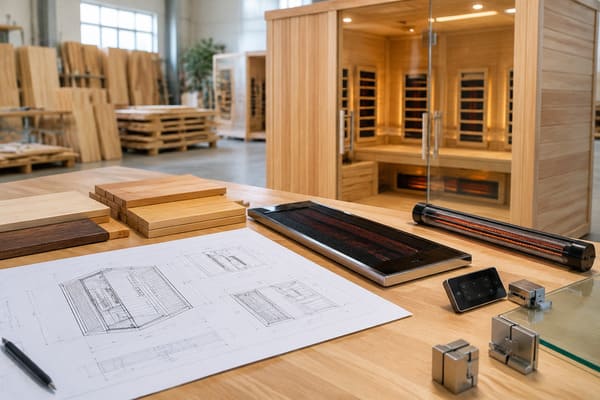
- Preparing drawings and technical specifications.
- Confirming materials and heating components.
- Developing a sample for review.
- Approving the final design before bulk production.
Development costs, technical responsibilities and production schedules should be agreed upon before work begins.
What Should You Send for an Initial Quotation?
An infrared sauna manufacturer can provide a more accurate proposal if you prepare:
| Information | Details |
|---|---|
| Target market | Country and customer group |
| Cabin dimensions | Internal and external measurements |
| Materials | Preferred wood species and finish |
| Heating system | Required infrared technology and panel configuration |
| Electrical supply | Destination voltage, frequency and phase |
| Branding | Logo, labels, manuals and packaging |
| Quantity | Initial order and estimated future demand |
You do not need to prepare every engineering detail yourself. Reference photographs, sketches and approximate dimensions are useful starting points.
At ROC Sauna-Solution, our OEM/ODM manufacturing service supports private-label products, OEM specifications and ODM development.
Our own-brand range includes infrared heating panels, sauna heaters, controllers, interiors and accessories. The available customization scope depends on the selected product and project requirements.
4. What Should Private-Label Buyers Confirm Before Ordering?
A product that looks good in a sample photograph is not necessarily ready for bulk production.
Before confirming an order, make sure the complete product specification is documented.
Branding and Packaging
Discuss where your logo will appear, how the product will be labeled and whether packaging and user manuals can carry your brand.
Also confirm which components can legally be supplied under your brand.
For example, genuine Harvia equipment retains its original Harvia branding. It can be supplied alongside your own-brand sauna interiors and accessories, but it cannot simply be relabeled as your private-label product.
Sample Approval and Production Consistency
Before bulk production, confirm:
- Approved cabin drawings and dimensions
- Wood species, finish and material specifications
- Infrared panel models and positioning
- Controller and electrical configuration
- Glass, hardware and accessories
- Packaging and product labels
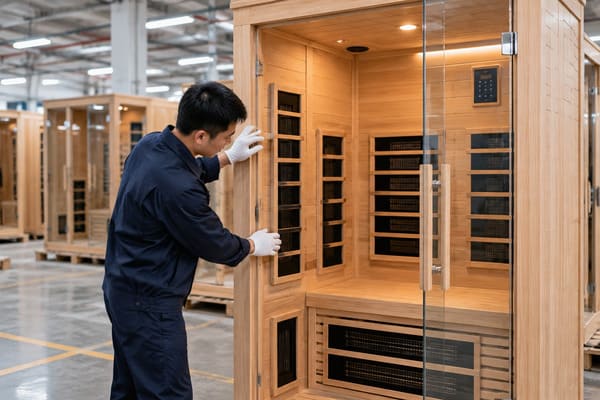
The approved sample should become the reference for production inspection.
Any proposed changes to materials, components or specifications should be reviewed and approved before being introduced into the production batch.
This helps reduce the risk of receiving products that differ from the original sample.
Market Requirements and Product Safety
Your target market should be considered before mass production begins.
For sauna and infrared cabin products, technical safety standards deserve particular attention.
The IEC 60335-2-53:2026 standard covers safety requirements for electric sauna heating appliances and infrared cabins. Its scope includes prefabricated saunas and prefabricated infrared cabins.
For the US market, buyers can refer to UL 60335-2-53, which addresses safety requirements for sauna heating appliances and infrared cabins, including applicable US national differences.
Independent testing organizations also play a role. TÜV Rheinland's wellness product testing services include sauna equipment among the product categories assessed for quality and safety.
The exact testing and certification requirements depend on the destination market, product configuration and applicable regulations.
A document covering one model should not automatically be assumed to cover a modified OEM product.
Before placing a bulk order, confirm the applicable standards, product configuration, technical documentation and certification responsibilities.
Compare Complete Quotations, Not Just Unit Prices
Two suppliers may quote different prices because they are offering different products.
One quotation may include the cabin, heating panels, controls, accessories, branding and export packaging. Another may cover only the cabin structure.
Before choosing a supplier, compare the complete specification and delivery scope.
A lower price is valuable only when the product meets the same requirements.
For private-label brands, consistent quality, reliable components and technical support are often more important than saving a small amount on the initial order.
Conclusion: Build the Right Product Before Building the Brand
A successful custom infrared sauna project starts with understanding your customers and defining the product you want to offer.
Some brands can begin with an existing cabin and customize its appearance. Others may need a different interior layout, new heating components or a more extensive ODM development process.
The important thing is to make these decisions in the right order:
Define the product → Confirm the technical specifications → Approve the sample → Verify production quality → Prepare for shipment.
Working with a China-based OEM manufacturer can make this process practical for overseas brands, particularly when several components and customization requirements need to be coordinated.
The advantage is not simply a lower purchasing price. It is the ability to develop a product that fits your market, with a clearly defined specification and an agreed supply scope.
The goal is not just to put your logo on a sauna.
It is to develop a product your business can sell with confidence.
Planning Your Own Infrared Sauna Range?
Sauna-Solution supplies ROC infrared heating panels, self-developed sauna equipment, controllers, custom timber interiors and related accessories for OEM/ODM projects.
We can also supply genuine Harvia equipment alongside your own-brand products where appropriate, retaining its original branding.
Tell us about your target market, preferred cabin dimensions, heating requirements, branding and expected order quantity.
Our team can discuss suitable customization options and prepare a project-specific proposal.
Contact Sauna-Solution About Your OEM/ODM Project
Frequently Asked Questions
1. Can I sell a custom infrared sauna under my own brand?
Yes, subject to the manufacturer's capabilities, the agreed branding scope and the requirements of your target market. Branding may include approved logos, packaging, manuals and product labels. If you market a product under your own name, confirm the applicable manufacturer and compliance responsibilities before placing an order.
2. Is customizing an infrared sauna different from customizing a traditional sauna?
Yes. Both can share customization options for timber, dimensions, benches and appearance, but the heating system changes the technical requirements. Infrared cabins require suitable panel placement and controls, while traditional saunas require appropriate heater sizing, stone capacity, clearances and ventilation planning.
3. Should I choose OEM or ODM for a new infrared sauna brand?
OEM may be suitable when you have a clear specification or want to modify an existing design. ODM is more appropriate when you need the supplier to develop a new product concept with you. The best route depends on how different your product needs to be, the available engineering resources and the budget for development.
4. What should I provide to receive an OEM quotation?
Provide your target market, dimensions, preferred timber, heating requirements, electrical supply, branding scope, estimated quantity and delivery destination. If you have reference photos or drawings, include them. The supplier can then identify technical questions, confirm the customization scope and propose the next steps.
References
-
Harvia — Infrared Sauna Solutions. Official manufacturer information on dedicated infrared cabins, heating components and hybrid sauna options.
-
IEC — IEC 60335-2-53:2026. International safety standard covering sauna heating appliances and infrared cabins.
-
UL Standards & Engagement — UL 60335-2-53. US standard covering safety requirements for sauna heating appliances and infrared cabins.
-
IEC 60335-2-53 Ed. 4.1 b:2017 — Sauna & Infrared Cabins (ANSI). Safety standard for sauna heating appliances and infrared cabins.