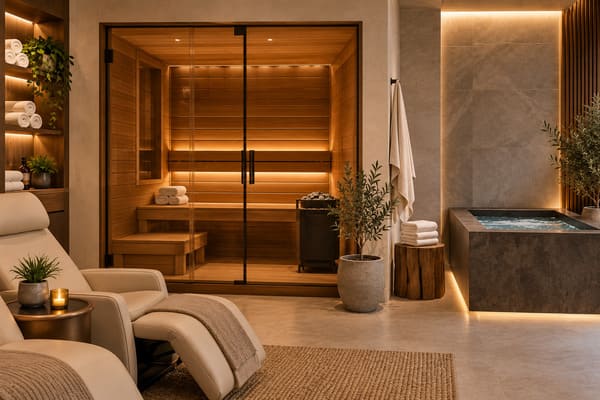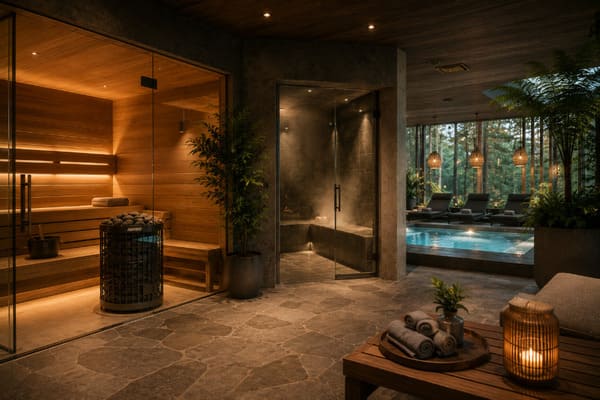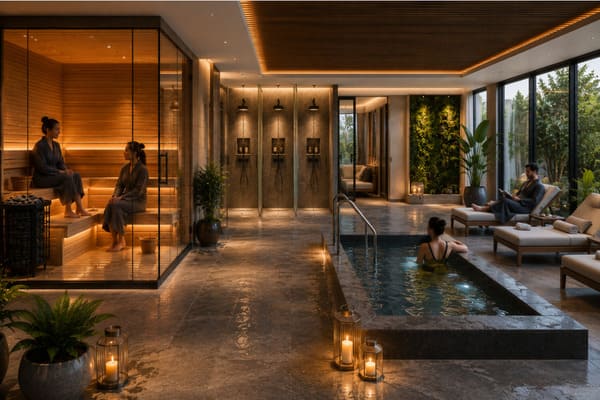
Why does heater selection start with room volume? Because a sauna heater is sized to the cubic volume of the room it must heat, not its floor area[^1]. If the heater is too small it will never reach or hold temperature; too large and it wastes energy and overheats the space. That is why every correct heater choice begins with one number — the room's volume in cubic metres (length × width × height) — and why getting this figure right, before anything else, is the foundation of a properly performing sauna.Picking a sauna heater? The biggest mistake is not the brand. It's the wrong power. Too small, it heats slow. Too big, it wastes energy.
To match sauna volume to heater power, use this rule: power (kW) ≈ room volume (m³) ÷ 1 to 1.3[^2][^1]. Each kilowatt heats about 1 to 1.3 cubic meters. Then adjust for glass, stone, and ceiling height.[^3]
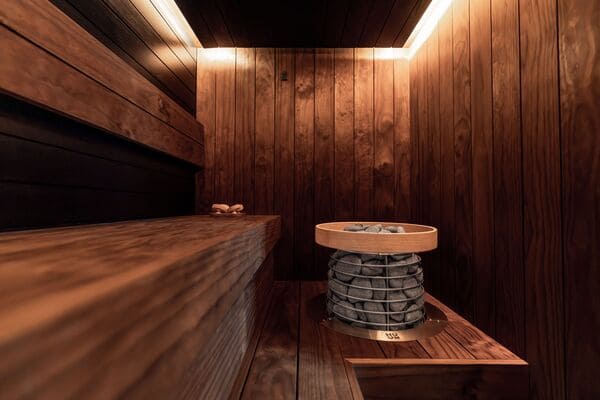
I have spent 12 years making heating products. I have seen buyers guess power and regret it. Below, I show you the simple math, a size chart, and the common errors. Let's start.
How Do You Calculate the Right Sauna Heater Power?
Wrong power means slow heat or wasted money. Many buyers just guess. That guess costs them later. Let me show the fix.
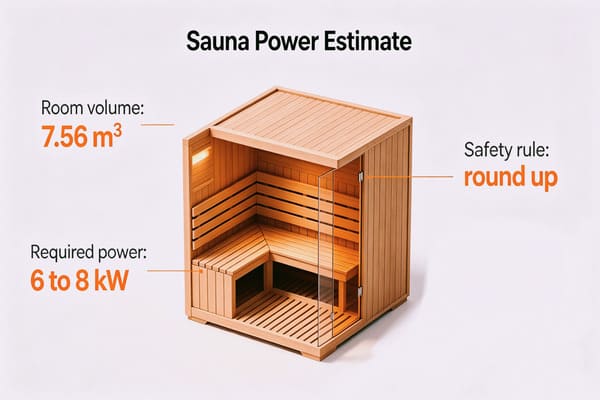
Calculate room volume first: length × width × height. Then divide by 1 to 1.3 to get the kilowatts. For a 7.56 m³ room, you need about 6 to 8 kW. Always round up for safety.
Step 1: Find the volume
Volume = length × width × height. Take a room of 2m × 1.8m × 2.1m. That gives 7.56 m³.
Step 2: Apply the formula
7.56 ÷ 1.3 ≈ 5.8 kW. 7.56 ÷ 1 ≈ 7.6 kW. So pick 6 to 8 kW. I always suggest the bigger value, like 8 kW, to keep some spare.
Step 3: Adjust for real conditions
The formula assumes good insulation. If not, add "effective volume":
| Condition | Adjustment |
|---|---|
| Glass door / glass wall | Add 1.2–1.5 m³ per 1 m² glass |
| Bare brick / stone / tile | Add 1–1.2 m³ per 1 m² |
| Ceiling over 2.3m | Move up one power level |
| Single-layer wood, no insulation | Multiply total volume × 1.5 |
Say the same 7.56 m³ room has a 1.8 m² glass door. Effective volume = 7.56 + 1.8 × 1.5 = 10.26 m³. Now pick 9 kW.
Which Heater Power Fits Your Room Size?
You did the math. But you still want a quick check. A chart saves time and stops doubt.
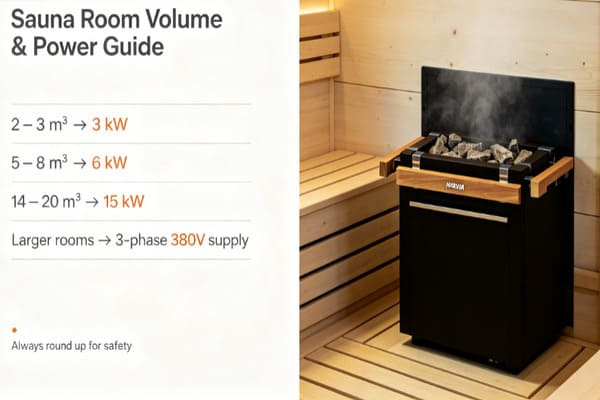
Use a size chart to match volume with power. A 2–3 m³ room needs 3 kW[^2]. A 5–8 m³ room needs 6 kW. A 14–20 m³ room needs 15 kW. Bigger rooms need three-phase 380V power.
Quick reference chart
| Room Volume | Power | Room Size | People | Power Supply |
|---|---|---|---|---|
| 2–3 m³ | 3 kW | 1.2×1.2×2.0m | 1 | 220V single |
| 3–4.5 m³ | 4.5 kW | 1.5×1.5×2.0m | 1–2 | 220V single |
| 5–8 m³ | 6 kW | 1.8×1.8×2.1m | 2–3 | 220V/380V |
| 7–12 m³ | 8–9 kW | 2.0×2.0×2.1m | 3–4 | 380V three |
| 10–15 m³ | 10.5–12 kW | 2.5×2.4×2.2m | 4–6 | 380V three |
| 14–20 m³ | 15 kW | 3.0×2.5×2.3m | 6–8 | 380V three |
| 18–30 m³ | 18–24 kW | Commercial | 8+ | 380V three |
Brands mark volume in different ways. Check the maker's manual before you buy. Most units over 6 kW need three-phase 380V[^3]. Confirm your wiring first.
What Common Mistakes Should You Avoid?
Buyers repeat the same errors. These errors waste money and ruin the sauna feel. I want you to skip them all.
The top mistakes: judging by floor area not volume, buying too small to "save power," ignoring glass heat loss, missing power supply needs, going too big, and forgetting sauna stone weight.

The six errors explained
Only floor area, not volume. Ceiling height matters a lot. A 2.0m and 2.4m ceiling differ by 20% in volume. Keep height near 1.9–2.1m.
Buying too small to save power. A weak heater runs full blast for a long time. It uses more power, not less.[^4] The stones never heat through.
Ignoring glass and stone heat loss. Glass loses heat fast. Each square meter of glass adds about 1.5 m³ of load[^4]. Recalculate for mixed designs.
Missing power supply limits. Under 4.5 kW runs on 220V. Over 6 kW needs 380V three-phase. Confirm this before you buy.
Going too big. Too much power spikes heat and trips the thermostat[^5]. You feel dry heat, not deep heat. Stones cannot store enough warmth.
Forgetting stone weight. Match stones to power. A 6–8 kW heater needs 20–25 kg of stones.
Conclusion
Calculate volume, adjust for glass and height, then match the chart. Round up one level, confirm your power supply, and your sauna will heat right every time.
[^1]: "Home Heating for the Hardy", https://dothemath.ucsd.edu/2012/03/home-heating-for-the-hardy/. A sauna design or building-services source can support that heater output is commonly selected by the sauna room’s volume because the full air volume and enclosing surfaces must be heated, rather than by floor area alone. Evidence role: general_support; source type: institution. Supports: Sauna heater selection should begin with room volume rather than floor area.. Scope note: This supports the sizing principle, but exact heater-capacity ranges still vary by manufacturer and construction details. [^2]: "The Most Accurate Sauna Heater Calculator & Sizing Guide", https://saunasupplyco.com/choosing-the-right-size-heater-for-your-sauna/. A sauna-construction guide or technical manual can document the commonly used rule of thumb linking electric sauna heater capacity in kilowatts to sauna room volume in cubic metres. Evidence role: general_support; source type: institution. Supports: A common sizing rule estimates sauna heater power by dividing room volume by roughly 1 to 1.3 cubic metres per kilowatt.. Scope note: This is a rule of thumb, not a universal standard; manufacturers may specify different ranges for specific heater designs. [^3]: "Sauna Heater Size Calculator: Find the Right kW", https://www.saunaplace.com/blogs/blogs/sauna-heater-size-calculator?srsltid=AfmBOoqsBM5yE272wXDcsg0IQ5HZ4uB0SujdqCj_lDmRb38QkVeAKT6h. Sauna design guidance can support that uninsulated or high-thermal-mass surfaces and larger room height increase the effective heating load used for heater selection. Evidence role: mechanism; source type: institution. Supports: Sauna heater sizing should be adjusted for glass, stone or masonry surfaces, and ceiling height.. Scope note: The source may support the need for adjustment without matching the article’s exact adjustment factors. [^4]: "Electricity consumption : r/Sauna - Reddit", https://www.reddit.com/r/Sauna/comments/17pr9xd/electricity_consumption/. Heating-system efficiency literature can support the principle that undersized heating equipment may operate continuously to meet a setpoint and can increase operating time, although total energy use also depends on insulation, thermostat settings, and heat losses. Evidence role: mechanism; source type: education. Supports: An undersized sauna heater may run longer at full output and fail to save energy.. Scope note: This provides contextual support for the mechanism but may not directly prove that an undersized sauna heater always consumes more energy than a correctly sized one. [^5]: "Thermostat Settings That Stop HVAC Short Cycling - Alternative Aire", https://alternativeaire.com/thermostat-settings-prevent-short-cycling/. Technical material on thermostat-controlled electric heating can support that oversized heating capacity can produce rapid temperature rise and frequent thermostat cycling or cutoffs. Evidence role: mechanism; source type: education. Supports: An oversized sauna heater can cause rapid temperature rise and frequent thermostat cycling.. Scope note: This supports the control mechanism generally; specific sauna comfort effects depend on heater design, stone mass, sensor placement, and ventilation.