If you're rolling out saunas across a hotel chain, fitting them into prefab buildings, or delivering multiple sites on a schedule, the biggest risk isn't the sauna itself — it's inconsistency, delays, and installation surprises multiplied across every location. A modular sauna is built to solve exactly that. This guide shows you how prefabricated construction actually works for a commercial buyer: how it keeps quality consistent from unit to unit, how it ships and installs on site, and why it's often the smarter choice when you're delivering more than one sauna. The goal is simple — help you decide whether a modular sauna fits your project, and what to demand from a manufacturer before you commit.
A modular sauna is a factory-built, pre-engineered sauna delivered as finished sections or a complete unit for quick assembly on site, rather than being built from raw materials in place. For commercial buyers — hotel chains, prefab builders, resort operators, and multi-site projects — this matters because factory production delivers consistent quality across every unit, predictable lead times, and far simpler site installation. Instead of relying on local builders to get each sauna right, you get the same specified result at every location. When buying, focus on how the units ship (complete or in sections), how they assemble on site, how consistent multiple units will be, and what local labour and access you'll need. For repeatable, multi-site delivery, a modular sauna is usually the lower-risk, more predictable choice.
What a Modular Sauna Actually Is
Start with a clear definition, because "modular," "prefab," and "kit" get used loosely and mean different things to a buyer.
A modular sauna is manufactured in a factory as pre-engineered, finished sections — typically walls, ceiling, benches, and integrated components — that are assembled into a complete sauna on site. A prefabricated sauna is the same idea: the sauna is built as a product in the factory rather than constructed from scratch on location. This differs from a stick-built sauna, which is framed and finished in place by local trades, and from a basic DIY kit aimed at home users. For a commercial buyer, the modular approach means the quality-critical work — precision, materials, and finish — happens under factory control, and the on-site work is reduced to assembly. That's what makes it predictable and repeatable across projects.
The distinction matters when you're buying:
- Modular / prefab sauna — factory-built to a specification, delivered as sections or a complete unit, assembled on site. Quality is controlled in the factory. This is the commercial buyer's tool.
- Stick-built sauna — framed and finished on site by local trades. Quality depends on whoever you hire at each location, which is exactly the risk that multiplies across multiple sites.
- DIY kit — a consumer product for a homeowner to self-install. Not built for the throughput, durability, or consistency a commercial facility needs.
For a commercial project — especially more than one — the modular route moves the make-or-break work into a controlled factory environment. That single shift is the reason it's the lower-risk choice, and everything else in this guide follows from it.

Consistency Across Sites: The Real Commercial Advantage
If you take one reason to consider modular, take this — it's the argument that matters most when you're delivering more than one sauna.
The biggest advantage of a modular sauna for commercial buyers is consistency. Because every unit is built to the same specification in the same factory, a sauna delivered to one hotel is the same as the one delivered to the next — same materials, same finish, same quality. For a chain or multi-site operator, this means a guest has the same experience at every location, and your brand standard is protected. With stick-built saunas, quality varies with whichever local builder does the work, so results are inconsistent site to site. Factory production removes that variable, which is why modular is the preferred approach for repeatable, brand-consistent rollouts.
Think about what "consistency" is worth to you specifically:
- Brand standard — a guest at your London property and your Dubai property should get the same sauna. Modular delivers that; local builds don't.
- Predictable quality — you approve one specification and one sample unit, and every subsequent unit matches it, rather than inspecting and correcting each site's work.
- Simpler procurement — you're buying a known product repeatedly, not commissioning a bespoke build each time.
- Easier maintenance — identical units mean identical parts, so servicing and replacements are simpler across the whole estate.
For a single one-off sauna, stick-built and modular can both work. The moment you're delivering more than one — and especially across different locations or on a rollout schedule — consistency becomes the deciding factor, and that's where the modular sauna earns its place in your specification.
How Modular Saunas Ship: Complete Unit vs Sections
Shipping is where modular gets practical, and it's the question that most affects cost and site access.
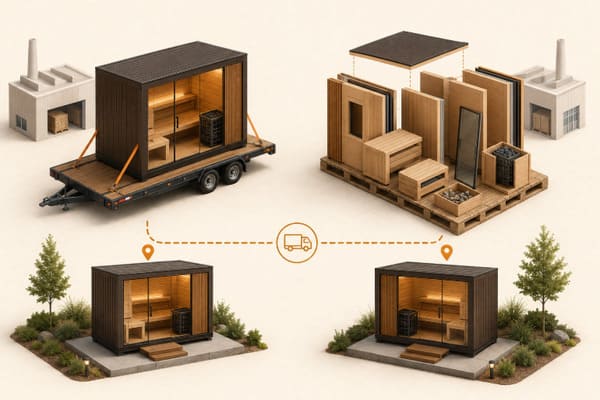
Modular saunas ship in one of two ways: as a complete pre-assembled unit, or broken down into flat-packed sections assembled on site. A complete unit is fastest to install but bulkier to transport and needs clear access — sometimes crane lifting — to place it. Flat-packed sections ship more efficiently, fit through standard doorways and into tight spaces, and suit sites with restricted access, at the cost of more on-site assembly. For a buyer, the right choice depends on your site access, how many units you're shipping, and your installation timeline. A good manufacturer will advise which format fits your project and destinations, and it directly affects both freight cost and installation effort.
The trade-off is straightforward once you frame it as a buyer:
| Shipping format | Best for | Trade-off |
|---|---|---|
| Complete unit | Easy-access sites, fast install | Bulkier freight; may need crane/lifting access |
| Flat-packed sections | Tight access, multiple units, efficient freight | More on-site assembly time |
Two things drive this decision: your site access (can a complete unit even get to where it's going?) and your freight economics (sections generally use container space far more efficiently, which matters a lot when you're shipping several units). For a multi-site rollout to varied locations, flat-packed sections often win on both flexibility and cost — but for a single, easy-access installation where speed matters, a complete unit can be the better call. This is exactly the kind of thing to work through with your manufacturer early, because it shapes your whole logistics plan.
Site Installation: What You'll Actually Need on the Ground
Beyond shipping, a buyer needs to know what happens when the sauna arrives — because that's where timelines and local costs live.
Installing a modular sauna on site typically involves positioning or assembling the sections, connecting the pre-wired electrical components to a power supply provided by a qualified local electrician, and final commissioning. The sauna itself is engineered for straightforward assembly, but you'll need to plan for local labour, suitable access to move sections into place, and a certified electrician for the power connection — high-temperature heaters require proper electrical work. For a complete unit, you may also need lifting equipment. Confirming these site requirements with your manufacturer in advance — access, labour, power, and lifting — prevents delays and unexpected costs when the units arrive.
Here's the honest picture for a buyer, so nothing surprises you on delivery day:
- Access — you need a route to move a complete unit or the sections to their final position. Measure doorways, corridors, and lifts against what's shipping.
- Assembly labour — modular units are designed for efficient assembly, but you still need people to do it; plan local labour or ask whether the manufacturer supports installation.
- Electrical connection — the heater and controls are heat-rated and often pre-wired, but connection to your power supply must be done by a qualified local electrician. This is non-negotiable for safety and compliance.
- Lifting — a complete pre-assembled unit may need a crane or lifting gear to place. Factor this into cost and scheduling.
None of this is difficult, but all of it needs planning. The manufacturers worth buying from will walk you through these requirements per destination — because a modular sauna's whole promise is a smooth, predictable installation, and that only holds if the site is ready when the units arrive.
Keeping It Consistent Across Multiple Units
For buyers ordering more than one, there's a layer beyond the single unit — making sure every unit in the project matches.
When ordering multiple modular saunas, consistency across units is the priority. Because they're factory-built to one specification, units in the same order should be identical in materials, dimensions, finish, and components — but a buyer should confirm this explicitly with the manufacturer, especially for larger projects or repeat orders over time. Ask how the manufacturer ensures unit-to-unit consistency, whether later reorders will match earlier ones, and how components and finishes are documented so your brand standard holds across every location and every phase. This documented consistency is what makes modular saunas ideal for phased rollouts and multi-site operators who need every property to match.
The practical questions to put to a manufacturer are:
- Within one order — will all units be identical in materials, finish, and dimensions?
- Across reorders — if you add sites next year, will the new units match the ones delivered this year?
- Documentation — are the specification, materials, and components recorded so your standard is repeatable over time?
This is where working with an established manufacturer pays off. Consistent unit-to-unit output — and the ability to reproduce it in a later phase — is a manufacturing capability, and it's exactly what protects a multi-site operator's brand standard as a rollout unfolds. It's the difference between "we bought some saunas" and "every property in our portfolio delivers the same experience."
How Volume Affects Your Planning
Buyers delivering several units naturally think about how scale changes things — here's the honest view.
As the number of units in a project increases, several things become more favourable and more important. Freight becomes more efficient when units are planned together rather than shipped piecemeal, and standardising on one specification simplifies procurement, installation, and maintenance across the whole project. At the same time, consistency and phased-delivery planning matter more. For a buyer, the key is to plan the full scope with your manufacturer from the start — total units, delivery phases, destinations, and site requirements — so shipping, consistency, and installation are all coordinated rather than handled unit by unit. Planning at project scale is what makes a multi-unit rollout smooth and cost-effective.
The efficiencies of scale are real, and worth planning around:
- Freight — coordinating shipments and using container space efficiently (a strong argument for flat-packed sections) lowers per-unit logistics cost.
- Standardisation — one specification across all units simplifies everything downstream: ordering, installing, training staff, stocking spare parts.
- Maintenance — identical units mean identical service procedures and interchangeable parts across your estate.
The takeaway for a buyer is to engage your manufacturer at project level, not unit level. Share your full scope — how many, where, and on what timeline — so freight, consistency, and installation can all be coordinated up front. A rollout planned as a whole is dramatically smoother than one assembled site by site, and that coordination is where a capable manufacturer proves its value.
How ROC Sauna-Solution Delivers Modular Saunas for Commercial Projects
For buyers delivering commercial and multi-site projects, the manufacturer behind the modular sauna is what makes the difference.
ROC Sauna-Solution is a HARVIA-authorised agent and OEM/ODM manufacturer with 12+ years' experience supplying commercial sauna equipment to hotels, resorts, spas, gyms, and wellness clubs worldwide. We produce modular and prefabricated saunas engineered for consistent, repeatable quality across every unit, with OEM/ODM options to match your brand specification, and we ship internationally in the format that suits your site access and project scope. Because we control production and QC in-house and hold recognised certifications (CE, RoHS, REACH), we can deliver the unit-to-unit consistency that multi-site operators and prefab builders depend on — the same specified sauna at every location, phase after phase. Talk to us about your project scope and we'll advise on shipping, installation, and consistency across your sites.
Because we manufacture to your specification and control quality in-house, we can answer the questions this guide raises with specifics — how units ship to your destinations, how they assemble on site, and how we hold consistency across a multi-unit, multi-phase rollout. For projects set in outdoor or resort environments, pair this with our guidance on choosing saunas for outdoor and resort settings. To specify the core equipment inside each unit, explore our sauna heaters, control systems, and accessories.
Conclusion
For a commercial project, the real risk in sauna delivery isn't the individual sauna — it's inconsistency, delays, and installation surprises multiplied across every site you're responsible for. A modular sauna is built precisely to remove that risk. Because the quality-critical work happens under factory control, you get the same specified result at every location, predictable lead times, and a site installation reduced to assembly and a certified power connection. Decide how your units should ship for your access and freight, confirm unit-to-unit consistency for your rollout and any future phases, and plan the whole project — not each unit — with your manufacturer from the start. Do that, and delivering saunas across a chain, a prefab build, or a multi-site portfolio becomes a controlled, repeatable process instead of a series of one-off gambles.
Delivering modular saunas across a hotel chain, prefab build, or multi-site project and want consistent, factory-built quality at every location — shipped and installed to suit each site? Talk to ROC Sauna-Solution about your project scope, and we'll advise on specification, shipping, installation, and unit-to-unit consistency. Start your enquiry here. You can also ask our AI assistant your modular sauna questions.
Frequently Asked Questions
What is a modular sauna? A modular sauna is a factory-built, pre-engineered sauna delivered as finished sections or a complete unit and assembled on site, rather than constructed from raw materials in place. The quality-critical work — precision, materials, and finish — happens under factory control, so the on-site work is reduced mainly to assembly and connection. A prefabricated sauna means the same thing. This differs from a stick-built sauna, which is framed and finished on location by local trades, and from a basic DIY kit aimed at homeowners. For commercial buyers, the modular approach delivers consistent, predictable quality that's ideal for hotels, resorts, and multi-site projects.
Why choose a modular sauna for a commercial project? The main reason is consistency. Because every unit is built to the same specification in the same factory, a sauna delivered to one location matches the one delivered to the next — same materials, finish, and quality. For a chain or multi-site operator, this protects your brand standard and gives guests the same experience everywhere. Modular also offers predictable lead times, simpler procurement of a known product, and easier maintenance from identical units and parts. With stick-built saunas, quality depends on whichever local builder does the work, so results vary site to site. Factory production removes that variable, which is why modular suits repeatable rollouts.
How does a modular sauna ship and install? Modular saunas ship either as a complete pre-assembled unit or as flat-packed sections assembled on site. A complete unit installs fastest but is bulkier to transport and may need clear access or crane lifting to place. Flat-packed sections ship more efficiently, fit through standard doorways and tight spaces, and suit restricted-access sites, with more on-site assembly. Installation involves positioning or assembling the sections, connecting the pre-wired components to a power supply via a qualified local electrician, and commissioning. Plan for site access, local assembly labour, certified electrical work, and lifting if needed. A good manufacturer advises which format fits each destination.
Will multiple modular saunas be identical across sites? They should be, because they're factory-built to one specification, but a buyer should confirm this explicitly — especially for larger projects or reorders placed over time. Ask the manufacturer how they ensure unit-to-unit consistency in materials, dimensions, finish, and components, whether later phases will match earlier ones, and how the specification is documented so your standard holds. This documented consistency is what makes modular saunas ideal for phased rollouts and multi-site operators who need every property to match. Working with an established manufacturer that controls its own production is the best way to guarantee it.
Does ordering more units change the planning? Yes, in helpful ways. As unit numbers rise, freight becomes more efficient when shipments are coordinated rather than sent piecemeal, and standardising on one specification simplifies procurement, installation, maintenance, and spare parts across the whole project. At the same time, consistency and phased-delivery planning become more important. The key for a buyer is to plan the full scope with the manufacturer from the start — total units, delivery phases, destinations, and site requirements — so shipping, consistency, and installation are coordinated at project level rather than handled unit by unit. Planning at scale is what makes a multi-unit rollout smooth and cost-effective.
References
[^1]: Wikipedia — Sauna. https://en.wikipedia.org/wiki/Sauna [^2]: Wikipedia — Prefabrication. https://en.wikipedia.org/wiki/Prefabrication [^3]: Wikipedia — Modular building. https://en.wikipedia.org/wiki/Modular_building [^4]: Wikipedia — Intermodal container. https://en.wikipedia.org/wiki/Intermodal_container [^5]: Wikipedia — Prefabricated building. https://en.wikipedia.org/wiki/Prefabricated_building