
Here is a fact that catches many commercial buyers off guard: under the EU's new packaging rules, the box your imported sauna heater arrives in can become your legal responsibility — not the factory's. The Packaging and Packaging Waste Regulation (PPWR), formally Regulation (EU) 2025/40, was adopted on 19 December 2024 and its main provisions apply from 12 August 2026.[^1] Because it is a regulation rather than a directive, it applies directly and uniformly across every EU member state — there is no national version to soften or delay it. For hotels, spas, gyms, resorts, and contractors bringing sauna equipment into the EU, PPWR is no longer an environmental headline for someone else to worry about. It is a compliance and cost factor that increasingly lands where the purchasing decision is made.
This guide is written for the people making those decisions — the buyers and specifiers — not for the packing line. It explains what PPWR is, why the responsibility can fall on you, how to gauge your own exposure, where the cost shows up, and exactly what to ask a supplier before your next EU-bound order.
PPWR (Regulation EU 2025/40) is a directly applicable EU regulation, effective for most provisions from 12 August 2026, that tightens rules on packaging recyclability, excess packaging, and documentation for all goods placed on the EU market — including imported sauna equipment. The critical point for buyers is that legal responsibility for compliant packaging often rests with the party placing the goods on the EU market, which is frequently the EU-based buyer or importer rather than the overseas factory. In practice, your supplier's packaging choices become your compliance and cost exposure. The smart response is not to memorise the regulation, but to assess your own risk, choose a supplier who takes packaging seriously, and price compliance in before it surprises you. This article is general information, not legal advice — verify specifics against the official regulation and a qualified advisor.
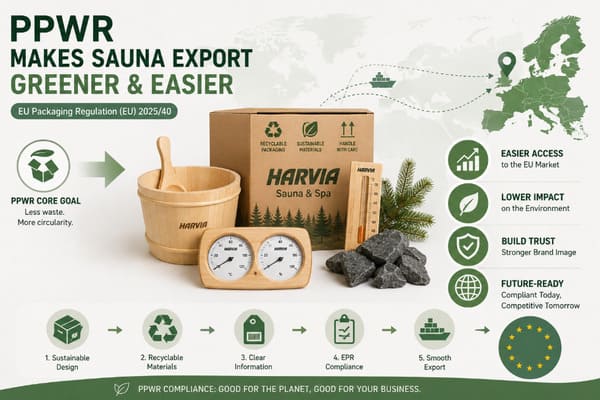
The Shift That Catches Buyers Out: The Box Is Now Your Problem
For years, packaging was invisible to buyers. It was the supplier's carton, the supplier's concern. PPWR quietly ends that arrangement, and the reason is worth understanding clearly.
PPWR assigns obligations to the economic operators who place packaging on the EU market — a definition that frequently captures the EU-based buyer or importer, not the non-EU manufacturer who physically packed the goods. When you bring sauna equipment into the EU from an overseas supplier, you may become the responsible party, which means non-compliant packaging is your exposure even though a factory abroad chose it. This is the single most important idea in this article: PPWR converts your supplier's packaging decisions into your legal and commercial risk. Once you see it that way, packaging stops being a detail and becomes part of responsible sourcing.
Two features of PPWR make this matter more than the rules it replaces:
- Direct applicability. As a regulation, it takes effect the same way in every member state from the application date — removing the national patchwork buyers used to lean on.
- Operator responsibility. Duties fall on those who place packaging on the market, a status that regularly attaches to the importer or buyer rather than the foreign manufacturer.[^2]
Put bluntly: if the packaging around your imported equipment doesn't meet the rules, "the factory packed it that way" is unlikely to protect you. That is why, from 2026 onward, packaging belongs in your supplier evaluation right next to price, quality, and lead time.
How Big Is Your PPWR Exposure? A Quick Self-Assessment
Not every buyer carries the same risk. Before you do anything else, it helps to place yourself on the spectrum — this is the practical starting point most PPWR coverage skips.
Your PPWR exposure is generally higher the more directly you act as the importer of record and the more packaging-intensive your shipments are. A buyer importing sauna equipment directly from a non-EU factory, in volume, with mixed materials (timber, glass, electronics), sits at the higher-risk end. A buyer sourcing through an EU-based intermediary who already assumes market-placement responsibility sits lower. Ask yourself three questions: Am I the party placing these goods on the EU market? How packaging-heavy are my shipments? Does my supplier already engage with EU packaging compliance? Your answers tell you how much attention PPWR deserves in your sourcing — and where to focus it.
Think of it as three broad positions:
- Higher exposure — you import directly from a non-EU factory, you're the party placing goods on the market, and shipments mix timber, glass, and electronics. PPWR should be an active part of your sourcing conversation.
- Moderate exposure — you import but share responsibility with a supplier who already addresses EU compliance. You still verify; you carry less of the burden alone.
- Lower exposure — you buy through a party that clearly assumes market-placement responsibility. You confirm this is documented rather than assumed.
The value of locating yourself here is focus: it tells you whether PPWR is a headline item in your next negotiation or a box to confirm. Where responsibility sits in your specific arrangement is exactly the kind of point to verify with a compliance professional, because it depends on your role and market.
What PPWR Actually Regulates — Without the Legal Fog
You don't need the full text to have an informed conversation. A handful of themes drive everything relevant to imported equipment.
PPWR's provisions most relevant to imported goods revolve around three ideas: packaging should be designed to be recyclable; packaging should not be excessive (limits on empty space and unnecessary layers); and packaging must carry required information and be backed by documentation showing it conforms. There are also restrictions on certain substances. For a buyer, the takeaway isn't the legal detail — it's that the packaging you receive must be defensible on these grounds, and you may need to demonstrate it. Exact thresholds and phase-in dates vary by provision and belong to the official text, not a supplier's summary.
In plain terms, the areas worth knowing are:
- Recyclability by design — packaging built to fit real recycling streams.
- Minimisation and empty space — less unnecessary packaging, less void volume.
- Information and marking — labelling that lets packaging be sorted and handled correctly.
- Substance restrictions — limits on certain materials of concern.
- Documentation of conformity — the ability to show, on request, that packaging meets the rules.
I'm deliberately not quoting specific percentages or per-provision dates. PPWR phases requirements in over different timelines, and those precise figures are exactly what should come from the official regulation[^1] or a qualified advisor. What matters here is that you recognise the shape of the obligations — enough to know what to ask about.
Why Sauna Equipment Is a Harder Case Than Most
This is where sauna buyers face something a buyer of, say, a single-material product does not — and it's a genuine reason to choose your supplier carefully.
A single sauna order can combine radically different packaging challenges: cartoned heaters and control units, bundled or crated timber, glass doors needing rigid protection, and boxed accessories, usually consolidated on pallets for freight. Each material stream interacts with the rules differently, and wooden packaging additionally triggers separate international standards — such as ISPM 15 for wood packaging material — that sit alongside PPWR rather than inside it. For buyers this means "is our packaging compliant?" is not one question but several, and a supplier who can speak confidently to each stream is worth far more than one who cannot.
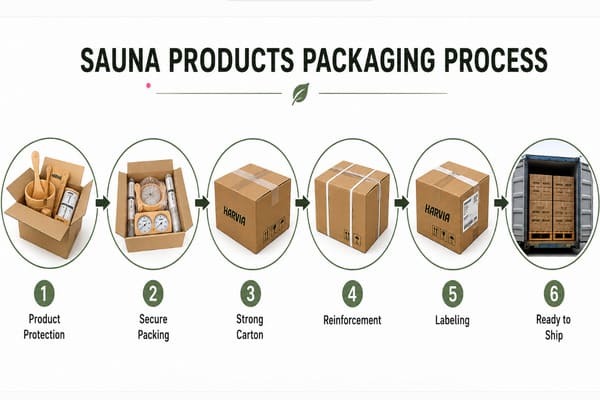
A heater in a printed carton, a control unit in protective inner packaging, a stack of cladding timber, and a fragile glass door each raise different recyclability, protection, and documentation questions. Timber is a particular flag: wood used as packaging or dunnage in international freight is governed by phytosanitary standards like ISPM 15[^3], which require treatment and marking — a completely separate regime from PPWR that nonetheless rides on the same shipment. The lesson for a buyer is simple: treat sauna packaging compliance as multi-layered, and treat a supplier who understands all the layers as an asset, not a commodity.
The Cost Conversation — Have It Early, Not on the Invoice
Compliance rarely arrives free, and pretending otherwise leads to disputes and margin surprises.
PPWR can move landed cost in several directions: recyclable or redesigned materials, protective-packaging changes that shift freight volume, documentation and administrative effort, and possible fees under extended producer responsibility schemes in the destination market. For buyers, the real danger isn't the cost itself — it's unexpected cost, arriving when a shipment is held, reworked, or repriced late. The disciplined move is to raise packaging compliance early in negotiation, ask how it affects unit and freight cost, and treat a clear answer as a sign of a capable partner. Packaging that's cheap but non-compliant isn't a saving; it's a deferred liability with your name on it.
Separate the cost vectors in your own planning so none of them surprise you:
- Materials — compliant or reduced packaging may price differently from legacy packaging.
- Freight and volume — void reduction and protective changes can shift cubic volume, and cost, either way.
- Administration — documentation, marking, and record-keeping carry overhead.
- Downstream fees — extended producer responsibility[^4] and national reporting in the destination country may apply to what you place on the market.
The buyers who handle PPWR best don't discover these on the commercial invoice. They put them on the table during sourcing.
Five Questions to Ask Your Sauna Supplier — and What a Good Answer Sounds Like
This is where the regulation becomes an action list. Each question below matters less for the "yes" than for the quality of the answer — that's your real signal.
Ask your supplier: (1) Are you aware of PPWR and designing packaging with it in mind? A good answer references specific materials and recyclability, not a vague "yes." (2) What do you use to pack heaters, controls, timber, glass, and accessories, and is it recyclable? A good answer addresses each stream separately. (3) Can you provide documentation showing packaging conformity on request? A good answer is an unqualified yes with an example. (4) How is wooden packaging treated and marked for international freight? A good answer names ISPM 15 without prompting. (5) How does compliant packaging affect our unit and freight cost? A good answer is specific and volunteered, not extracted. A supplier who answers these clearly is protecting you; one who deflects is quietly transferring risk onto your side of the deal.
Notice what this list is not: it is not a manual for running a packing line — that's the manufacturer's job. Your job as the buyer is to verify that the party you rely on understands the regime and can evidence it. The quality of these answers is, in itself, a reliable read on whether a supplier is equipped to serve the EU market in 2026 — the same way you'd weigh their product certifications[^5] or delivery record.
Timeline: Treat August 2026 as "Live," Then Check the Detail
Dates matter here, so handle them precisely.
The headline date is 12 August 2026, when PPWR's main provisions become applicable across the EU. But PPWR also phases specific requirements in on later dates, so "PPWR applies from August 2026" is true as a general statement without being the full picture for every provision. Don't assume a single cutoff makes everything mandatory at once, and don't assume later-dated provisions can be ignored today. For planning, treat 12 August 2026 as the point from which the regime is live, and confirm the timing of any specific requirement against the official record.
Because different articles carry different application dates, plan around the live-from date while checking specifics against the official EUR-Lex record for Regulation (EU) 2025/40[^1] and the European Commission's packaging pages[^6] — the authoritative references for exact dates.
How ROC Sauna-Solution Works With EU-Bound Buyers
Working with a supplier who already thinks in these terms removes much of the risk before it reaches you.
ROC Sauna-Solution is a HARVIA-authorised agent and OEM/ODM manufacturer with 12+ years' experience supplying sauna equipment — heaters, control systems, timber, glass doors, and accessories — to hotels, spas, gyms, resorts, wellness centres, and contractors across 50+ countries, including the EU market. We work with our customers on packaging suited to international freight and destination-market expectations, provide the product documentation our buyers need, and treat our clients' compliance as part of a long-term partnership rather than a form to hand back. For EU-bound buyers facing PPWR, that means a supplier who engages with your packaging and documentation questions instead of leaving them at your door.
We supply commercial projects worldwide, backed by our own production lines and QC team, with products carrying recognised certifications (CE, RoHS, REACH). As PPWR moves from headline to daily reality, our aim is simple: to be the kind of partner whose answers to the five questions above are clear, specific, and on your side — so packaging compliance becomes one less thing you carry alone.
Important Disclaimer
This article is general information for commercial buyers and is not legal, regulatory, or compliance advice. PPWR (Regulation EU 2025/40) is detailed and phases requirements over multiple dates; specific obligations, thresholds, and deadlines must be verified against the official regulation text on EUR-Lex and, where appropriate, with a qualified legal or trade-compliance professional. Requirements may interact with national implementing measures and other regimes (such as ISPM 15 for wood packaging). ROC Sauna-Solution provides this overview to help buyers ask informed questions and does not warrant it as a substitute for professional advice.
Conclusion
Packaging used to be something buyers never thought about — the supplier's box, the supplier's problem. PPWR ends that quiet arrangement. As a directly applicable EU regulation live from 12 August 2026, it puts recyclability, minimisation, and documentation on the agenda for everything placed on the EU market, and it frequently makes the buyer the responsible party. For sauna equipment — a mix of cartoned electronics, bundled timber, and fragile glass — that makes packaging compliance a real part of sourcing strategy, not an afterthought. The buyers who come out ahead won't be the ones who read every article of the regulation. They'll be the ones who know their own exposure, ask the right questions early, choose a supplier who engages seriously with the answers, and price compliance in rather than being caught out by it.
Importing sauna equipment into the EU and want a supplier who takes packaging and documentation as seriously as you do? Talk to ROC Sauna-Solution about your EU-bound orders — heaters, controls, timber, glass, and accessories, shipped worldwide with OEM/ODM options. Start your enquiry here. You can also ask our AI assistant your PPWR-related sourcing questions.
Frequently Asked Questions
What is PPWR and when does it apply? PPWR is the EU Packaging and Packaging Waste Regulation, formally Regulation (EU) 2025/40, adopted on 19 December 2024, with its main provisions applying from 12 August 2026. As a regulation, it applies directly and uniformly across all EU member states without national transposition. It tightens rules on packaging recyclability, excess packaging, marking, and documentation for goods placed on the EU market. Because different provisions phase in on different dates, buyers should confirm specific requirements and deadlines against the official EUR-Lex text rather than assuming a single cutoff.
Does PPWR affect me as a buyer, or only the overseas manufacturer? It can very much affect you. PPWR places obligations on the economic operators who place packaging on the EU market, a definition that frequently captures the EU-based buyer or importer rather than the non-EU manufacturer. In practice this means responsibility for compliant packaging can rest with you, so a supplier's packaging choices become your compliance and cost exposure. This is why packaging due diligence now belongs in supplier evaluation. Confirm your specific responsibilities with a compliance professional, as they depend on your role and destination market.
How can I tell how much PPWR exposure I have? Your exposure is generally higher the more directly you act as the importer placing goods on the EU market, and the more packaging-intensive your shipments are. A buyer importing sauna equipment directly from a non-EU factory, in volume, with mixed materials like timber, glass, and electronics, sits at the higher-risk end. A buyer sourcing through a party that already assumes market-placement responsibility sits lower. Ask whether you are the party placing goods on the market, how packaging-heavy your shipments are, and whether your supplier engages with EU packaging compliance — then verify specifics with a professional.
What about wooden packaging in sauna shipments? Wooden packaging and dunnage used in international freight is governed by phytosanitary standards such as ISPM 15, which require treatment and marking to prevent pest spread. This is a separate regime that sits alongside PPWR, not inside it, but it appears on the same sauna shipment because timber is common in sauna packaging. Buyers should confirm their supplier treats and marks wooden packaging correctly for international transport, in addition to addressing PPWR's requirements for other materials like cartons and protective inner packaging.
What should I ask my sauna supplier about PPWR? Ask whether they are aware of PPWR and designing packaging with it in mind; what materials they use for heaters, controls, timber, glass, and accessories and whether they are recyclable; whether they can provide documentation demonstrating conformity on request; how wooden packaging is treated and marked for international freight; and how compliant packaging affects your unit and freight cost. Judge them less on the "yes" than on how specific and volunteered the answers are — clear, detailed responses indicate a supplier equipped for the EU market, while deflection suggests risk is being shifted onto you.
References
[^1]: EUR-Lex — Regulation (EU) 2025/40 (PPWR). https://eur-lex.europa.eu/eli/reg/2025/40/oj [^2]: EUR-Lex — Access to European Union law. https://eur-lex.europa.eu/ [^3]: Wikipedia — ISPM 15 (wood packaging material). https://en.wikipedia.org/wiki/ISPM_15 [^4]: Wikipedia — Extended producer responsibility. https://en.wikipedia.org/wiki/Extended_producer_responsibility [^5]: Wikipedia — CE marking. https://en.wikipedia.org/wiki/CE_marking [^6]: European Commission — Packaging waste (Environment). https://environment.ec.europa.eu/topics/waste-and-recycling/packaging-waste_en