A commercial sauna project is rarely completed by simply selecting a heater and installing a wooden room.
For hotels, spas, gyms and wellness facilities, the success of a sauna installation depends on how different systems work together: room design, electrical supply, ventilation, heater selection, control systems and long-term maintenance.
Many problems in commercial sauna projects are not caused by choosing the wrong heater. They happen because important decisions are made too late.
A room may not have enough electrical capacity for the selected equipment. A beautiful sauna layout may leave insufficient space for maintenance. A high-power heater may not perform as expected if the room design does not match its requirements.
A successful commercial sauna installation starts before the equipment is ordered.
This guide explains the key factors that hotels, spa operators and project contractors should consider before building or upgrading a commercial sauna facility.
1. Plan the Sauna Room Before Selecting Equipment
One of the most common mistakes in commercial sauna projects is choosing the heater first and designing the room around it afterwards.
The correct approach is the opposite:
First define the sauna environment, then select the equipment that matches it.
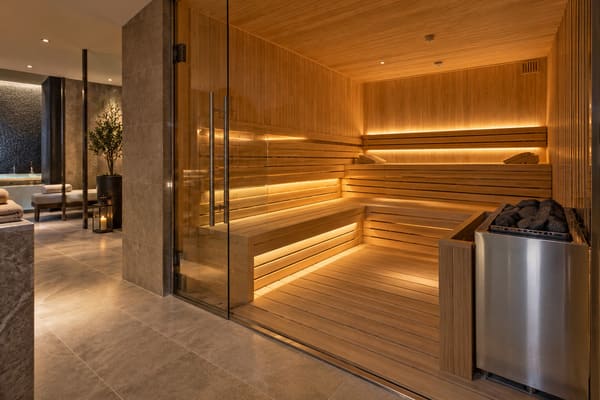
A commercial sauna design should consider:
- Room dimensions
- Ceiling height
- Bench layout
- Door location
- Heater position
- Ventilation strategy
- Maintenance access
These factors influence both guest experience and equipment performance.
Sauna Room Requirements Are More Than Just Size
The size of a sauna room affects heater selection, but volume alone is not the only consideration.
A room with large glass panels, stone surfaces or other heat-absorbing materials may require additional heating capacity compared with a fully insulated timber room of the same dimensions.
Harvia explains that sauna heater selection should consider room volume together with surfaces that increase heating demand, such as glass and stone areas.
You can read more about heater sizing principles in our Sauna Heater Size Guide.
For example:
A commercial sauna measuring:
- Length: 4 m
- Width: 3 m
- Height: 2.4 m
has a basic volume of:
4 × 3 × 2.4 = 28.8 m³
However, if the sauna includes a large glass wall, the effective heating requirement may be higher.
This is why professional projects should not select equipment only according to the number of seats or room dimensions.
Bench Layout Affects Both Comfort and Capacity
In commercial facilities, seating design is not only about fitting more people inside.
The layout should consider:
- Comfortable sitting positions
- Upper and lower bench temperatures
- Guest movement
- Cleaning access
- Heater safety distance
A crowded sauna may technically increase capacity but reduce the guest experience.
For hotels and wellness centres, the goal is usually not maximum occupancy. It is creating a comfortable environment that guests want to use repeatedly.
For more detailed planning considerations, see our guide on Commercial Sauna Size and Layout Planning.
Design the Maintenance Space Before Closing the Walls
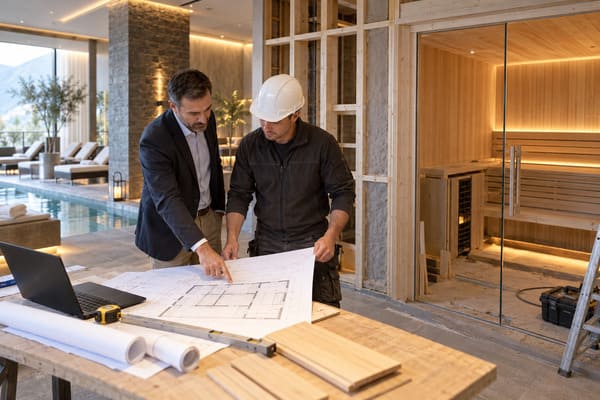
A commercial sauna should also be designed for future service.
Before construction is completed, confirm:
- Where technicians will access the heater
- How heating elements can be replaced
- Whether benches need to be removed for repairs
- Whether electrical components remain accessible
A heater that fits perfectly into a drawing may become difficult to maintain once the surrounding woodwork is installed.
Professional sauna planning should consider the entire lifecycle of the facility, not only the first day of operation.
2. Electrical Requirements: The Part Many Projects Underestimate
For commercial sauna projects, electrical planning is often one of the most overlooked stages.
A customer may request:
"We need a 15 kW or 20 kW sauna heater."
But the real question is:
Can the building safely support the complete heating system?
Before ordering equipment, confirm:
- Available voltage
- Electrical phase
- Maximum power capacity
- Dedicated circuits
- Cable requirements
- Controller compatibility
The electrical supply should be reviewed together with the selected heater and control system.
The IEC 60335-2-53 safety standard provides requirements related to safety aspects of electric sauna heaters and related equipment.
Local electrical regulations may differ, so final installation should always be completed by qualified professionals familiar with the project location.
The Heater and Controller Should Be Selected Together
A commercial sauna heater is rarely a standalone product.
Many high-power heaters require:
- External controller
- Power unit
- Temperature sensors
- Safety devices
This is especially important for larger installations.
For example, high-output Harvia heaters are commonly paired with compatible control systems rather than operating independently.
You can learn more about commercial sauna control solutions in our Commercial Sauna Control Units Guide.
The same principle applies to ROC commercial heaters. The heater output, electrical configuration and controller must be considered as one complete system.
A common purchasing mistake is:
- Select the heater.
- Place the order.
- Discover later that the available controller or electrical supply is unsuitable.
A better approach is:
- Confirm room requirements.
- Select heater capacity.
- Match the controller and electrical system.
- Finalize installation details.
This reduces unexpected changes during construction.
3. Selecting the Right Commercial Sauna Heater
The largest heater is not always the best heater.
Commercial sauna heater selection should balance:
- Room volume
- Glass and material factors
- Expected usage frequency
- Heating recovery requirements
- Installation space
- Maintenance requirements
A hotel sauna operating several hours every day may have different requirements from a private wellness room used occasionally.
Power Rating Is Only One Part of the Decision
A 20 kW heater does not automatically perform better than a 15 kW heater.
The actual question is:
Is the heater correctly matched to the sauna environment?
For example, a larger stone-capacity heater may provide different heat characteristics compared with a compact high-power unit.
Commercial operators should evaluate:
- Rated room volume
- Stone capacity
- Heating element design
- Control options
- Service accessibility
Our article on Large Sauna Heater Selection: Power, Configuration and Costs explains why commercial buyers should look beyond kilowatt ratings.
Consider the Complete Heating System
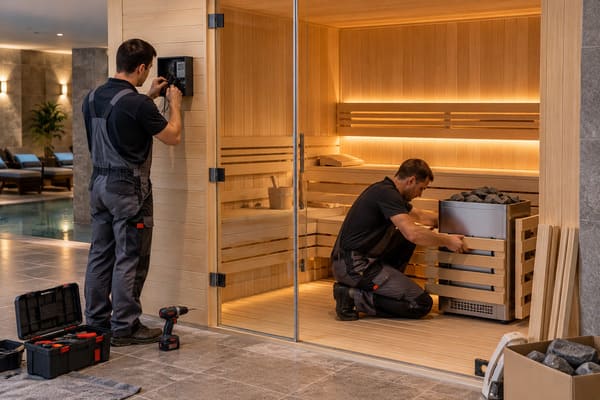
A commercial sauna heater installation normally includes more than the heater body.
Depending on the project, the complete system may include:
- Heater
- Sauna stones
- Controller
- Power unit
- Temperature sensors
- Protective accessories
For example, the Harvia Cilindro Pro range provides different power options for larger sauna environments, while the ROC SAV commercial sauna heater range offers high-output floor-standing solutions for project applications.
The correct choice depends on the specific room and operating requirements, not simply the highest available output.
4. Safety Design: Doors, Temperature Monitoring and Emergency Planning
Safety should be considered during the design stage, not added after installation.
Recent discussions around sauna safety regulations, including updates in some Japanese regions, highlight a broader issue:
Commercial sauna facilities need clear emergency procedures and practical safety design.
Although requirements vary between countries, many safety principles are similar.
Sauna Door Design
Commercial sauna doors should allow users to exit easily and should not create unnecessary barriers during an emergency.
Important considerations include:
- Easy opening from inside
- Appropriate door construction
- Visibility where required
- Correct installation according to local regulations
Door design is often overlooked because it appears simple, but it directly affects user safety.
Temperature Monitoring and Control
Commercial facilities also need reliable temperature monitoring.
Compared with residential saunas, commercial environments often experience:
- More users
- Longer operating hours
- More frequent door opening
A suitable control system helps operators maintain consistent conditions and manage operation more effectively.
The Narvi guide on commercial sauna heater control systems explains why control solutions are an important part of commercial sauna operation.
Emergency Planning
A commercial sauna project should consider:
- Staff awareness
- Emergency access
- Operating procedures
- Regular equipment inspection
Safety is not only about equipment selection. It is about creating a system that can be operated reliably every day.
5. Ventilation, Moisture and Material Requirements
A commercial sauna is a controlled heat environment, not simply a wooden room with a heater.
While the heater provides the heat source, the surrounding construction determines whether the room can maintain comfortable conditions over years of operation.
Three areas deserve particular attention:
- Ventilation
- Moisture protection
- Material selection
Ventilation: Balancing Heat and Air Quality
A commercial sauna requires sufficient air movement to maintain a comfortable bathing environment.
Poor ventilation can lead to:
- Uneven temperatures
- Excessive humidity
- Reduced comfort
- Unnecessary stress on equipment
Ventilation design should consider:
- Air intake location
- Exhaust position
- Heater placement
- Room volume
- Expected occupancy
The ventilation approach may vary depending on the building design and local requirements.
A small private sauna inside a hotel suite and a large public sauna serving dozens of guests should not necessarily use the same ventilation strategy.
Moisture Protection Is Critical
Although traditional saunas operate at lower humidity than steam rooms, moisture management is still an important part of commercial sauna installation.
Repeated operation introduces:
- Heat cycling
- Condensation changes
- Humidity fluctuations
- Cleaning moisture
The construction should consider:
- Proper insulation
- Vapour barriers
- Suitable wall and ceiling assemblies
- Correct sealing around penetrations
This is especially important when integrating a sauna into an existing hotel building.
A room that previously functioned as a storage area, bathroom or relaxation space may require significant upgrades before becoming suitable for commercial sauna use.
Choose Materials for Long-Term Operation
Commercial facilities experience more frequent use than residential saunas.
Materials should therefore be selected not only for appearance but also for durability.
Common considerations include:
- Heat resistance
- Moisture tolerance
- Cleaning requirements
- Guest comfort
Wood selection, bench design and interior finishes all affect the user experience.
For hotels and wellness centres, the best sauna design usually balances visual quality with practical maintenance.
6. Commercial Sauna Installation Cost: What Should Be Included?
One of the biggest mistakes in commercial sauna projects is comparing quotations based only on the heater price.
A complete installation includes much more than the heating unit.
A professional quotation should clearly identify:
| Project Component | What Should Be Confirmed |
|---|---|
| Sauna room construction | Materials, insulation, benches and finishes |
| Sauna heater | Exact model, power rating and room suitability |
| Control system | Controller, sensors and required power units |
| Electrical work | Local supply requirements and installation scope |
| Ventilation | Design responsibility and connection requirements |
| Accessories | Sauna stones, guards and additional equipment |
| Commissioning | Testing and handover process |
| Maintenance support | Spare parts and after-sales service |
This approach makes supplier comparisons much easier.
A cheaper quotation may simply exclude components that another supplier has already included.
Heater Price Is Only One Part of the Investment
For example, two suppliers may quote different prices for a similar power sauna heater.
However:
Supplier A:
- Heater only
Supplier B:
- Heater
- Compatible controller
- Sauna stones
- Sensors
- Technical documentation
The second quotation may appear more expensive initially, but it may represent a more complete solution.
For commercial projects, buyers should compare the total installed system rather than the individual equipment price.
Consider Long-Term Operating Costs
A commercial sauna is a long-term facility investment.
Besides initial installation costs, operators should consider:
- Electricity consumption
- Maintenance frequency
- Replacement parts
- Equipment downtime
- Local service availability
A slightly higher initial investment may be justified if it reduces operational difficulties over the facility's lifetime.
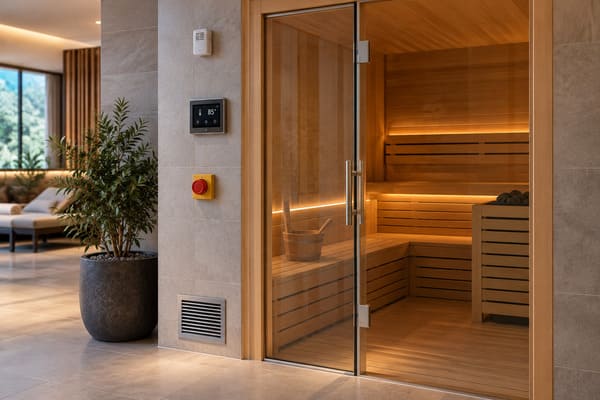
The Aviva Sauna Safety Guide highlights the importance of regular inspection, safe operation and maintenance practices for sauna facilities.
7. Commercial Sauna Installation Checklist
Before construction begins, confirm the following:
Room Planning
☐ Sauna size and capacity confirmed
☐ Bench layout finalized
☐ Heater position approved
☐ Door access reviewed
☐ Maintenance space reserved
Electrical Planning
☐ Voltage and phase confirmed
☐ Electrical capacity checked
☐ Heater and controller compatibility verified
☐ Safety protection requirements reviewed
Equipment Selection
☐ Heater model selected according to room requirements
☐ Controller included or confirmed
☐ Sauna stones specified
☐ Replacement parts availability checked
Construction Requirements
☐ Insulation completed correctly
☐ Vapour protection considered
☐ Ventilation planned
☐ Suitable materials selected
Final Commissioning
☐ Equipment tested
☐ Temperature control verified
☐ Staff training completed
☐ Maintenance procedures prepared
This checklist helps prevent common installation problems and ensures that the sauna is designed as a complete operating system rather than a collection of separate products.
Conclusion: Successful Commercial Sauna Installation Starts Before Equipment Purchase
A successful commercial sauna installation is not defined only by the heater selected.
The best projects combine:
- Correct room planning
- Suitable electrical infrastructure
- Proper heater sizing
- Compatible control systems
- Effective ventilation
- Long-term maintenance planning
For hotels, spas and wellness facilities, the goal is not simply to install a sauna room.
The goal is to create a reliable facility that guests enjoy and operators can manage efficiently for years.
Choosing equipment early without considering the surrounding requirements can create unnecessary costs later.
A better approach is to plan the entire system first, then select the heater, controls and accessories that match the project's actual needs.
Planning a Commercial Sauna Installation?
At Sauna-Solution, we provide commercial sauna equipment solutions including Harvia sauna heaters, ROC commercial sauna heaters, control systems and related accessories for hotel, spa and wellness projects.
Whether you are developing a new wellness facility or upgrading an existing sauna area, share your project information with our team:
- Project location
- Sauna room dimensions
- Expected users
- Electrical supply
- Operating schedule
We can help evaluate suitable equipment options and prepare a complete supply proposal based on your project requirements.
Contact Sauna-Solution for a Commercial Sauna Project Consultation
Frequently Asked Questions
What information should I provide before requesting a commercial sauna installation quotation?
A useful project brief should include the sauna room dimensions, location, electrical supply, expected number of users, operating hours and whether the sauna is part of a hotel, spa, gym or private wellness facility.
Providing these details allows suppliers to recommend suitable heater capacity, controls and supporting equipment instead of quoting based only on room size.
Can an existing room be converted into a commercial sauna?
Yes, but the existing space must be evaluated before installation.
Important factors include insulation, vapour protection, ventilation, electrical capacity, heater clearances and maintenance access.
A room that appears suitable from a layout perspective may still require significant upgrades before it can safely operate as a commercial sauna.
Why is the control system important for a commercial sauna heater?
The control system manages how the sauna operates and ensures compatibility between the heater, electrical supply and safety functions.
For commercial facilities, a suitable controller can also help operators manage operating schedules, temperature settings and daily use more effectively.
The heater and controller should therefore be selected as a complete system rather than purchased separately without compatibility checks.