A commercial sauna installation is not simply about choosing a heater and building a wooden room.
Once a sauna operates in an unusual environment — especially a high-traffic commercial facility — power supply, ventilation, heat distribution and maintenance can become more important than the cabin itself.
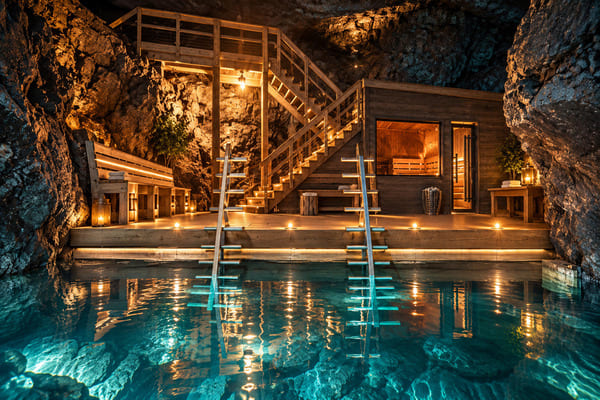
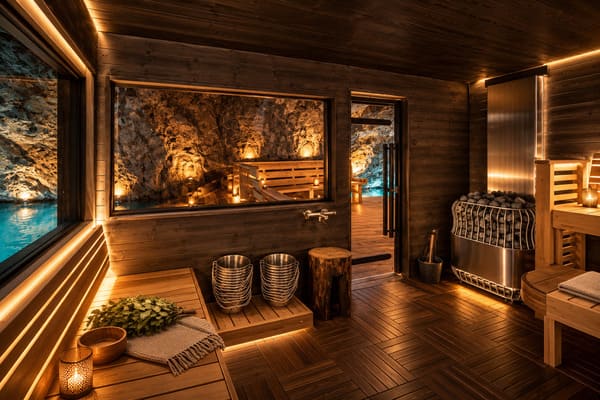
A good example is the underground sauna at Adventuremine in Tuna Hästberg, Sweden.
The sauna is located approximately 80 metres underground, beside an underground lake and around half a kilometre inside the former mine. The operator has turned the unusual location into a commercial sauna experience rather than simply installing a conventional sauna underground.
That makes this project worth studying.
1. The Project: A Sauna 80 Metres Underground
Adventuremine operates guided sauna rituals deep inside a former iron-ore mine.
According to the operator, the mine remains around 4°C year-round, while the sauna is positioned close to the underground lake. Guests descend through the historic mine before reaching the sauna and alternating between sauna sessions and cold-water bathing.
This immediately creates several engineering challenges that would not normally appear in a hotel or gym sauna.
The project had to solve:
- Long-distance power supply
- High heating demand
- Heat distribution inside a difficult environment
- Mechanical ventilation
- Moisture and drying
- Remote equipment control
- Maintenance in a hard-to-access location
The important lesson is that the environment became part of the technical specification.
2. Why a 23 kW Heater Makes Sense Here
The project uses a 23 kW Saunum Luxury heater, according to the project interview published by SaunaNews.
At first glance, 23 kW may look excessive compared with a typical private sauna.
But commercial heater selection should not start with the number of people alone.
Room volume, insulation, glass surfaces, ventilation, ambient temperature and expected operating frequency all affect the required heating capacity.
For commercial projects, our sauna heater sizing guide explains why heater power should be calculated from the room and then adjusted for the actual installation conditions.
The lesson for other projects
Do not copy the 23 kW number. Copy the decision-making process.
A 23 kW heater may be appropriate for one large or demanding sauna, while a much smaller hotel sauna may need only 8–12 kW.
The correct question is:
What heating capacity does this specific room and operating environment require?
For a commercial sauna, oversizing or undersizing the heater can both create unnecessary operating problems.
3. The Power Supply Was Part of the Design
One of the most interesting details of this project is the power infrastructure.
SaunaNews reports that the sauna receives power through a cable running approximately 500 metres from the surface.
That changes the way the installation has to be planned.
A high-power commercial heater already places a significant electrical load on a building. A very long cable run introduces additional design considerations such as voltage drop, cable sizing, protection and installation conditions.
This is why electrical planning should happen before the heater is ordered, not after the equipment arrives.
For international projects, the exact requirements must always be checked against the heater's installation manual and local electrical regulations. IEC 60364-7-703 specifically covers electrical installations in rooms and cabins containing sauna heaters.
Our guide to commercial sauna electrical requirements covers the main points buyers should confirm with their electrician.
The lesson for other projects
Before approving a commercial sauna heater, confirm:
- Available voltage and phase
- Building power capacity
- Cable route and cable length
- Required cable size
- Circuit protection
- Control-system wiring
- Local inspection requirements
The heater specification and the building's electrical infrastructure must be designed as one system.
4. Ventilation Is Not Optional
A sauna deep inside a mine presents an obvious problem: heat and humidity have to be managed without relying on ordinary room ventilation.
The Adventuremine project uses mechanical ventilation, according to the project interview.
This is particularly relevant for commercial facilities.
A sauna used repeatedly throughout the day needs fresh air for occupants, while the room also needs a reliable way to manage moisture and heat after use.
Harvia's current ventilation guidance recommends designing sauna air exchange according to the heater and ventilation system, with the company stating that an electric-heated sauna should have approximately six air changes per hour.
The exact arrangement depends on the room, heater and ventilation strategy.
The lesson for other projects
Don't treat ventilation as a final construction detail.
During the design stage, decide:
air intake → air movement → exhaust → drying
This is especially important for:
- Hotel saunas
- Gym saunas
- Spa facilities
- Underground or enclosed rooms
- High-use commercial saunas
Our guide to commercial sauna ventilation provides more detail on airflow planning.
5. Maintenance Was Designed Into the Project
Perhaps the most useful lesson from this case is not the heater.
It is maintenance.
Imagine having to replace a component in a sauna that is 80 metres underground and approximately 500 metres inside a mountain.
A maintenance problem that takes an hour in a hotel could become a major logistical operation in this environment.
The project therefore incorporated measures to help manage the sauna after each session. SaunaNews reports that the facility uses underfloor heating and mechanical ventilation, while the sauna stones also help retain heat and support drying after operation.
This demonstrates an important principle for commercial sauna design:
The best installation is not necessarily the one that looks best on opening day. It is the one that remains practical to operate years later.
For a normal hotel or spa, this means thinking about:
- Access to the heater
- Replacement of heating elements
- Sauna stones
- Sensors
- Control systems
- Ventilation components
- Cleaning
- Drying
- Spare parts
6. Remote Control Becomes More Valuable in Difficult Locations
The Adventuremine project also uses a fiber-optic connection for remote heater control, according to the project interview.
Remote control is not necessarily essential for every commercial sauna.
But when equipment is located far away from the operator — underground, inside a large resort or in another difficult-to-access area — remote monitoring and control can become much more valuable.
Modern control systems can also integrate functions such as lighting, ventilation and safety features. For example, HUUM's UKU control system supports remote control through its mobile app, while its safety functions include overheating protection and a door sensor.
For commercial facilities, the question should therefore not simply be:
"Do we need Wi-Fi?"
Instead ask:
"How much time and operational effort could remote control save our staff?"
7. What Other Commercial Sauna Projects Can Learn
The Adventuremine project is extreme, but the lessons are surprisingly practical.
| Project Challenge | Lesson for a Commercial Sauna |
|---|---|
| 80 m underground | Consider the complete installation environment |
| 23 kW heating system | Size the heater from room conditions, not guest count alone |
| ~500 m power route | Confirm electrical infrastructure before ordering |
| Underground cold environment | Design heating and ventilation together |
| High humidity | Plan drying and moisture management |
| Difficult maintenance access | Select equipment with long-term serviceability in mind |
| Remote location | Consider remote control and monitoring |
The key takeaway is simple:
A commercial sauna should be designed as a complete operating system — not as a room plus a heater.
That principle applies whether the sauna is inside a mine, a hotel, a gym, a resort or a private wellness facility.
8. What to Confirm Before Starting a Commercial Sauna Installation
Before purchasing equipment, a project owner or contractor should have clear answers to these questions:
Room
- What is the internal room volume?
- How much glass or other uninsulated surface is included?
- What is the expected occupancy?
- How many hours per day will the sauna operate?
Equipment
- What heater power is actually required?
- Is the heater suitable for commercial use?
- What control system and sensors are required?
- How will stones and heating elements be maintained?
Infrastructure
- What voltage and phase are available?
- Is the building's electrical capacity sufficient?
- Where will the ventilation system connect?
- Is there a practical route for maintenance?
Operation
- Who will operate the sauna?
- How often will it be cleaned and dried?
- What happens if the heater or control system fails?
- Are replacement parts readily available?
These questions are often more important than simply comparing two heater prices.
Frequently Asked Questions
Can a residential sauna heater be used in a commercial project?
Not automatically. Commercial use usually means higher operating frequency and greater demand on the equipment. The heater should be selected according to the manufacturer's intended application, room conditions and local requirements rather than simply its kW rating.
Does a larger sauna always need a higher-power heater?
Generally, larger room volume requires more heating capacity, but volume is not the only factor. Glass, stone, insulation, ventilation and the surrounding environment can all affect the final specification. The heater should therefore be sized from the complete room design.
What information should I give a supplier before asking for a commercial sauna quotation?
At minimum, provide the sauna's length, width, height, estimated occupancy, glass area, installation location, available voltage/phase and expected operating frequency.
For a serious project, also provide the floor plan and information about ventilation and electrical infrastructure. This allows the supplier to recommend a complete configuration instead of quoting a heater based only on room size.
Conclusion
The Adventuremine underground sauna is an unusual project, but that is exactly why it is useful.
Its biggest lesson is not that every commercial sauna needs a 23 kW heater, remote control or complex infrastructure.
It is that the installation environment should determine the equipment and engineering decisions.
For a hotel, gym or spa project, the same principle applies on a smaller scale:
Room → Usage → Heater → Electrical Supply → Ventilation → Control → Maintenance
Get these decisions aligned before construction begins, and the sauna is far more likely to perform reliably after the project is handed over.
If you are planning a commercial sauna project and need help selecting the sauna room, heater, controls and accessories, ROC Sauna Solution can provide equipment sourcing and project-oriented configuration support for hotels, spas, gyms and wellness facilities.