A commercial steam room is more than an enclosed space with a steam generator. In hotels, fitness clubs and wellness centres, the complete system must work together: steam production, temperature control, water supply, drainage, waterproofing and ventilation.
For project developers and equipment buyers, overlooking any of these elements can lead to additional installation costs, equipment compatibility problems or maintenance difficulties.
So, what does a complete commercial steam room actually require?
This article breaks down the essential equipment, room construction considerations and purchasing costs to help buyers plan a more reliable commercial steam room project.
1. What Equipment Does a Commercial Steam Room Need?
A commercial steam room typically consists of several connected components. The generator is the main equipment, but it cannot operate as a complete system on its own.
| Equipment | Main Function |
|---|---|
| Steam Generator | Produces steam for the room |
| Control Panel | Sets and manages operating conditions |
| Temperature Sensor | Monitors room temperature |
| Steam Head / Outlet | Distributes steam into the room |
| Steam Solenoid | Controls steam delivery in compatible systems |
| Automatic Drain / Blowdown | Removes accumulated water and sediment |
| Aroma System (Optional) | Introduces approved fragrances into the steam |
| Safety Devices | Provides required temperature and system protection |
For example, MrSteam's commercial steam system documentation identifies generator, control package, temperature sensor, steam solenoid, steam head and automatic blowdown equipment as important system components.
Not every project needs every optional accessory. The final configuration depends on the selected generator, room design and operating requirements.
The Steam Generator Is Only the Starting Point
The generator must be selected according to the room's effective volume, construction materials and expected operating schedule.
A small hotel spa with limited daily usage may have different requirements from a fitness club operating its steam room for extended hours.
Commercial generators are also available in different configurations and capacities.
Before ordering, confirm:
- Rated power and steam output.
- Recommended room volume.
- Electrical supply and phase.
- Required controller and sensors.
- Water supply and drainage connections.
- Manufacturer requirements for continuous operation.
Our Commercial Steam Generator Selection article covers generator selection and Harvia system options in greater detail.
2. How Should the Steam Room Be Designed?
Equipment selection and room construction should be coordinated from the beginning.
A steam room operates in a high-humidity environment. Materials and construction methods suitable for a conventional dry room are not automatically suitable for continuous steam exposure.
Three areas deserve particular attention.
Waterproofing and Wall Construction
The walls, floor and ceiling need a continuous waterproofing and vapour-control system appropriate for steam-room applications.
Tile and stone are common finishes, but the waterproofing layer behind them is just as important.
The design should account for:
- Compatible waterproofing and vapour-retarder membranes.
- Properly sealed joints and penetrations.
- Moisture-resistant substrates.
- Compatible adhesives and grout.
- Suitable expansion and movement joints.
LATICRETE's Steam Room Technical Design Manual explains how incorrect vapour-control detailing can allow moisture to enter wall cavities and adjacent building areas.
Ceiling, Benches and Drainage
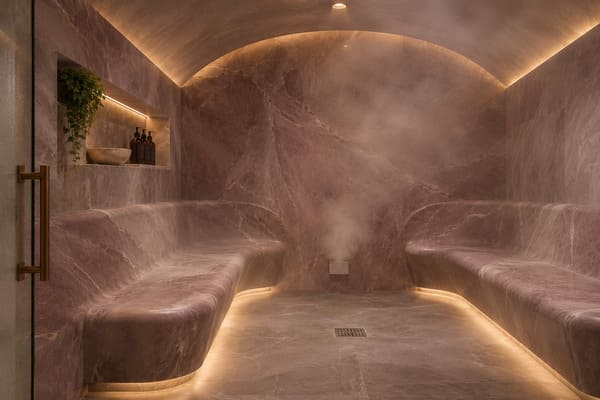
Condensation is unavoidable in a steam room.
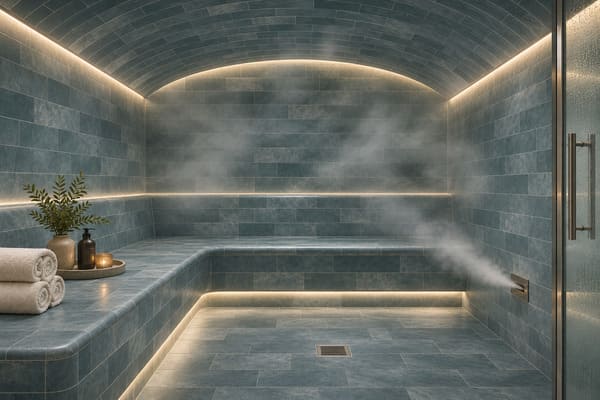
If the ceiling is flat or poorly designed, condensed water may drip directly onto guests.
A sloped, curved or appropriately pitched ceiling helps direct condensation away from seating areas.
Benches should also be designed to prevent water from collecting on their surfaces.
The floor needs suitable drainage, while horizontal ledges and recessed areas should not create standing-water problems.
Harvia's steam room construction recommendations provide manufacturer-specific guidance on ceiling geometry, benches and materials.
Important: Ceiling angles, waterproofing details and material specifications should follow the selected construction system and local building requirements. Do not apply one manufacturer's measurements to every project.
3. Water Supply, Drainage and Equipment Maintenance
Water management is one of the most easily overlooked parts of a commercial steam room project.
The generator needs a suitable water supply, and the installation must provide an appropriate way to discharge water during maintenance or automatic blowdown cycles.
Water Quality Matters
Mineral content and water hardness vary between locations.
Depending on the generator, excessive mineral deposits may accumulate inside the equipment and affect heating elements, probes, valves and other components.
Before purchasing, buyers should ask the supplier:
- What water-quality limits apply to the selected generator?
- Is filtration or water softening recommended?
- Does the unit include automatic flushing or blowdown?
- How frequently should internal components be inspected?
Do not assume every generator requires the same water-treatment system. Follow the manufacturer's specific water-quality requirements.
Plan Drainage Before Installation
Commercial systems may need automatic blowdown to remove accumulated water and sediment.
The discharge must be connected to an appropriate drainage arrangement.
Depending on local plumbing requirements and discharge temperatures, a dedicated cooling or blowdown tank may be necessary.
The generator should also be installed in an accessible technical area so that maintenance does not require dismantling the steam room.
For facilities with frequent daily operation, maintenance access and drainage planning should be included in the original project drawings.
4. Additional Features for a Better Commercial Steam Experience
Once the basic system is specified, buyers can consider optional features that improve the guest experience.
| Optional Feature | Project Value |
|---|---|
| Aroma Dosing System | Adds controlled fragrance to the steam experience |
| LED Lighting | Supports different lighting environments |
| Digital Control | Simplifies temperature and operating management |
| Steam Stop Control | Provides an additional operating control where supported |
| Temperature Alarm | Adds protection against excessive temperature |
| Centralized Scheduling | Helps staff coordinate operation across compatible systems |
For example, MrSteam offers commercial accessories such as AromaFlo fragrance systems, high-temperature alarms, steam controls and moisture-resistant lighting.
These features should be selected according to the venue.
A small boutique spa may prioritize aroma and lighting, while a large fitness club may place greater importance on scheduling, equipment durability and simplified maintenance.
Avoid adding accessories simply because they are available. Each component should serve a defined operational purpose.
5. How Much Does a Commercial Steam Room Cost?
There is no single standard price for a commercial steam room.
A small prefabricated installation and a custom-built hotel steam room with premium finishes can have very different project costs.
For a more useful comparison, separate the quotation into the following categories:
| Cost Category | What It Includes |
|---|---|
| Main Equipment | Steam generator, controls and sensors |
| Accessories | Steam outlets, aroma systems and lighting |
| Room Construction | Wall panels, waterproofing, ceiling and benches |
| Building Services | Electrical work, water supply, drainage and ventilation |
| Installation | Equipment connection and construction labour |
| Commissioning | Testing, adjustments and handover |
| Ongoing Costs | Electricity, water, consumables and maintenance |
What Causes the Biggest Price Differences?
Room size and capacity: Larger rooms generally require greater steam output and may need more extensive construction.
Finishing materials: Ceramic tiles, natural stone, custom benches and specialist surfaces have different material and installation costs.
Operating requirements: A facility expecting long daily operating hours may need a different generator configuration from a smaller spa.
Additional features: Aroma dosing, customized lighting and advanced controls increase the equipment scope.
Project location: Labour, electrical standards, shipping, local approvals and installation conditions vary by country.
When requesting quotations, ask suppliers to separate equipment costs from construction and installation costs.
This makes it easier to compare proposals and identify missing components.
6. What Should Buyers Prepare Before Requesting a Quotation?
A detailed project brief helps suppliers recommend suitable equipment and avoid repeated specification changes.
Before requesting a quotation, prepare the following information:
- Room dimensions: Length, width and height.
- Construction materials: Tile, stone, glass and other finishes.
- Operating requirements: Expected daily hours and user capacity.
- Equipment preferences: Generator capacity, controls and optional accessories.
- Building services: Electrical supply, water connection, drainage and available ventilation.
- Project location: Country, applicable regulations and installation conditions.
- Project drawings: Floor plan, sections and equipment-room location, if available.
Also ask the supplier to confirm the complete equipment list, compatibility, installation requirements, technical documents and maintenance arrangements.
For multiple steam rooms, clarify whether the proposed system uses individual generators or a manufacturer-approved multi-room configuration. Do not assume one generator can serve several independent rooms without explicit technical confirmation.
Frequently Asked Questions
What Is the Difference Between a Commercial and Residential Steam Generator?
Commercial systems are selected according to the room's size, operating hours and expected usage intensity. Some commercial models are designed for extended daily operation and may include additional control and maintenance features.
Does Every Commercial Steam Room Need an Automatic Blowdown System?
Not every system uses the same arrangement. However, commercial generators may require regular blowdown or flushing. Follow the selected manufacturer's maintenance instructions and local drainage requirements.
Can One Steam Generator Serve Multiple Steam Rooms?
Some manufacturers offer approved multi-room configurations, while others require dedicated generators for individual rooms. Confirm the exact system architecture and independent control capabilities before purchasing.
Does a Commercial Steam Room Need Special Waterproofing?
Yes. A steam room requires a construction system designed for sustained heat, humidity and vapour exposure. Ordinary bathroom waterproofing should not automatically be considered suitable.
Can Aroma Systems Be Added to an Existing Steam Room?
Potentially, if the existing generator supports a compatible fragrance dosing accessory. Confirm the approved fragrance products, injection arrangement and control compatibility before installation.
Plan the Complete System Before Ordering
A successful commercial steam room project depends on more than selecting a powerful generator.
The generator, controls, steam delivery, water supply, drainage and room construction must be coordinated as one system.
For hotels, fitness clubs and wellness centres, confirming these requirements before ordering helps reduce equipment mismatches, construction changes and avoidable maintenance problems.
ROC Sauna-Solution supports commercial sauna and steam projects with Harvia and ROC equipment options.
If you are planning a new steam room or upgrading an existing facility, share your room dimensions, construction materials, project location and operating requirements.
We can help review the equipment configuration and discuss suitable options for your project.
Contact ROC Sauna-Solution for your commercial steam room project.
References
-
LATICRETE. Tiled Steam Room and Steam Shower – Technical Design Manual.
-
Harvia. How to Build a Steam Room.