How much electricity does a sauna use in one session? Is a 9 kW heater more expensive to operate than a 6 kW model? And how much electricity might a hotel or fitness club consume when operating several commercial saunas every day?
The answer depends on more than the heater's rated power.
A 9 kW sauna heater does not necessarily consume 9 kWh during every hour of use. Once the sauna reaches its target temperature, the thermostat regulates the heating elements, switching them on and off to maintain the heat.
To estimate electricity consumption accurately, buyers need to understand three things: heater power (kW), actual operating time at full power, and electricity price per kWh.
This article compares 6 kW, 9 kW and 18 kW heaters, explains how to calculate session and monthly electricity costs, and looks at what energy consumption means for commercial sauna facilities.
1. How Much Electricity Does a Sauna Use?
The basic calculation is:
Electricity consumption (kWh) = Power (kW) × Operating time at full power (hours)
For example, a 6 kW heater running continuously at full power for one hour consumes 6 kWh.
However, this is a theoretical calculation, not necessarily the actual consumption of a complete sauna session.
Once the room reaches the selected temperature, the thermostat reduces the heater's average power consumption by switching the heating elements on and off.
Maximum Theoretical Consumption
The following table shows the maximum electricity consumption if each heater operates continuously at full rated power.
| Heater rating | 1 hour | 2 hours |
|---|---|---|
| 6 kW | 6 kWh | 12 kWh |
| 9 kW | 9 kWh | 18 kWh |
| 18 kW | 18 kWh | 36 kWh |
These figures represent full-power operation only.
Actual consumption depends on the time needed to heat the room, insulation, ventilation, target temperature, door openings and thermostat operation.
What Does a Typical Session Consume?
Harvia provides a useful reference based on a well-insulated family sauna:
- A 6 kW heater consumes approximately 4–5 kWh during the first hour and 3–4 kWh during the second hour.
- An 8 kW heater consumes approximately 5–7 kWh during the first hour and 4–6 kWh during the second hour.
This gives estimated totals of 7–9 kWh and 9–13 kWh respectively for a two-hour session.
These are manufacturer examples for family saunas, not guaranteed figures for commercial installations.
For a larger commercial sauna, the best approach is to measure actual consumption over representative operating cycles.
2. Comparing 6 kW, 9 kW and 18 kW Sauna Heaters
Heater power must match the sauna's room volume and operating requirements.
A smaller private sauna may use a 6 kW heater, while medium-sized rooms commonly require higher outputs. Large commercial facilities may need 18 kW or more.
For example, EOS lists its 18 kW 34.G HD commercial heater for sauna rooms of approximately 24–30 m³. The model is designed for intensive commercial operation.
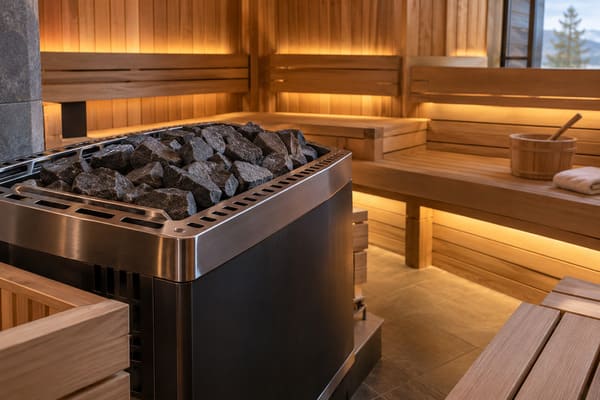
The important distinction is that a larger heater has greater heating capacity, but this does not automatically mean its electricity cost per session will be proportionally higher.
A larger heater may be required to heat a larger room within an acceptable time. Comparing two heaters without considering room volume and usage conditions can therefore be misleading.
Choose the heater for the room first, then estimate its energy consumption.
For more information, see our Sauna Heater Size Guide.
3. What Affects Actual Sauna Electricity Consumption?
Two saunas with identical heater ratings can have different energy consumption.
Four factors are particularly important.
1. Room Insulation and Heat Loss
A well-insulated sauna retains heat more effectively.
Poor insulation, gaps around doors and unsuitable construction materials allow heat to escape, increasing the time the heater needs to maintain the desired temperature.
Frequent door openings also introduce cooler air, creating additional heating demand.
2. Room Size and Glass Surfaces
A larger room generally requires more heating capacity.
Glass doors, windows and other heat-storing or poorly insulated surfaces can also affect the required heater output.
This is why selecting a heater based only on floor area can lead to inaccurate specifications.
3. Target Temperature and Heating Schedule
A higher target temperature generally requires more heating energy.
Heating an empty sauna for longer than necessary also increases consumption.
For hotels and fitness facilities, preheating schedules should reflect actual opening hours and expected usage rather than running continuously without a clear operating need.
4. Sauna Stones and Heater Condition
Sauna stones deteriorate over time and can shift inside the heater, restricting airflow.
Harvia recommends inspecting stones regularly, replacing eroded stones and arranging them correctly to maintain airflow and heating performance.
Equipment condition is therefore part of energy management, not just routine maintenance.
4. How Much Does It Cost to Run a Sauna?
Once electricity consumption is estimated, calculating the operating cost is straightforward.
Electricity cost = Energy consumption (kWh) × Electricity tariff per kWh
For example, if a sauna consumes 8 kWh during one session and the electricity tariff is US$0.20 per kWh:
8 × $0.20 = US$1.60 per session
The following examples show how costs change with electricity consumption.
| Electricity consumption | At $0.15/kWh | At $0.20/kWh | At $0.30/kWh |
|---|---|---|---|
| 6 kWh | $0.90 | $1.20 | $1.80 |
| 9 kWh | $1.35 | $1.80 | $2.70 |
| 12 kWh | $1.80 | $2.40 | $3.60 |
| 18 kWh | $2.70 | $3.60 | $5.40 |
These are illustrative calculations, not fixed sauna running costs. Actual tariffs vary by country, electricity provider and commercial electricity contract.
How Much Electricity Does a Sauna Use Per Month?
Monthly consumption depends on the number of sessions and the energy used per session.
For example, assume a sauna consumes 8 kWh per session and operates twice daily for 30 days.
8 kWh × 2 sessions × 30 days = 480 kWh per month
At an electricity tariff of $0.20/kWh:
480 × $0.20 = $96 per month
This calculation covers the heater only. Lighting, ventilation, controls and other equipment may add to the property's total electricity consumption.
For a commercial facility, actual monthly figures should ideally come from a dedicated electricity meter or energy monitoring system.
5. What Does This Mean for Commercial Saunas?
For hotels, gyms and wellness centres, electricity consumption becomes more significant when several rooms operate throughout the day.
Consider an illustrative commercial installation using an 18 kW heater.
Assume an energy meter records 75 minutes of equivalent full-power heating-element operation during one session.
18 kW × 1.25 hours = 22.5 kWh per session
If the sauna operates twice daily for 26 days:
22.5 × 2 × 26 = 1,170 kWh per month
At $0.20/kWh, the estimated monthly heater electricity cost is:
1,170 × $0.20 = $234
The 75-minute full-power equivalent is an illustrative measurement assumption, not a standard consumption figure for every 18 kW sauna.
This example demonstrates why commercial buyers should evaluate actual operating conditions rather than simply multiplying the heater's rated power by the facility's total opening hours.
What If a Hotel Has Multiple Saunas?
The same calculation can be applied to each room.
For example:
| Sauna room | Monthly consumption |
|---|---|
| Room A – 9 kW | 450 kWh |
| Room B – 9 kW | 450 kWh |
| Room C – 18 kW | 1,170 kWh |
| Total | 2,070 kWh |
Illustrative figures for comparing room-level energy use, not measured operating data.
At $0.20/kWh, the combined heater electricity cost would be $414 per month.
This gives hotel operators a more useful basis for evaluating operating expenses and comparing different room schedules.
It also highlights why a single electricity estimate cannot represent every commercial sauna project.
6. Do Infrared Saunas Use Less Electricity?
Infrared saunas are often marketed as more energy-efficient alternatives to traditional electric saunas.
They use infrared heating elements to warm the occupants and surrounding surfaces rather than relying on a conventional sauna heater and stones to heat the room in the same way.
Many infrared cabins have lower rated electrical loads than traditional electric saunas.
However, comparing their electricity consumption requires more than comparing the wattage on the product labels.
Consider:
- Cabin size and number of infrared panels.
- Heating time before use.
- Session duration.
- Temperature settings.
- Insulation and heat loss.
- Whether the comparison includes additional electrical equipment.
An infrared cabin with a lower rated power may consume less electricity during a comparable operating period, but the result depends on the complete installation and usage pattern.
For commercial buyers, the decision should also consider the intended customer experience, capacity, daily usage and maintenance requirements.
Our Commercial Infrared Sauna vs. Traditional Sauna comparison explores the differences between these two systems.
7. How Can Commercial Operators Reduce Sauna Energy Costs?
Reducing electricity consumption does not necessarily mean choosing a smaller heater or lowering the temperature.
The objective is to avoid unnecessary energy use while maintaining the intended sauna experience.
Four practical measures can help.
1. Match the heater to the room.
An appropriately sized heater can reach the target temperature within the intended heating period. Avoid selecting equipment based on power rating alone.
2. Improve insulation and door sealing.
Reduce unnecessary heat loss through suitable insulation, properly sealed doors and appropriate construction materials.
3. Schedule heating around actual demand.
For hotels and gyms, preheating should be coordinated with bookings and opening hours. Avoid leaving unused rooms heating unnecessarily.
4. Monitor actual electricity consumption.
A dedicated meter or compatible energy monitoring system can help identify unusually high consumption and compare operating patterns between rooms.
For commercial projects, these measures are particularly useful when several sauna rooms share the same facility.
Frequently Asked Questions
How Much Electricity Does a 6 kW Sauna Use?
At full rated power, a 6 kW heater consumes 6 kWh per hour. Actual session consumption is usually lower because the thermostat regulates the heating elements after the room reaches its target temperature.
Is a 9 kW Sauna More Expensive to Run Than a 6 kW Sauna?
Not necessarily in every application. A 9 kW heater has a higher maximum power draw, but the actual cost depends on room size, heating time and operating conditions.
How Much Electricity Does a Sauna Use Per Month?
Monthly consumption depends on energy used per session, daily sessions and operating days. For example, 8 kWh per session, twice daily, over 30 days equals 480 kWh.
Do Infrared Saunas Use a Lot of Electricity?
Many infrared cabins have relatively low rated power, but actual consumption depends on cabin size, panel output, heating time and session duration.
What Is the Best Way to Measure Commercial Sauna Electricity Consumption?
Use an appropriately installed energy meter to measure the heater's actual electricity consumption over representative operating cycles. Where possible, measure auxiliary equipment separately.
Choose the Right Sauna Equipment for Your Project
Sauna electricity consumption is influenced by more than heater power. Room construction, operating schedules, equipment selection and daily usage all affect the final electricity bill.
For commercial buyers, the priority is to select a heater that matches the room and expected operating requirements, then evaluate its actual energy consumption under realistic conditions.
ROC Sauna-Solution works with hotel developers, fitness facilities, wellness centres and commercial sauna buyers on sauna equipment sourcing and project configurations.
If you are planning a new sauna installation or upgrading an existing facility, share your room dimensions, expected usage, destination country and preferred heater specifications.
We can help assess suitable equipment options and prepare a configuration for your project.
References
-
Harvia. The Cost of Heating a Sauna Is Less Than You Think. Manufacturer information on heater energy consumption, thermostat operation and energy-saving practices.
-
Harvia. Sauna Heater Selection and Room Volume. Manufacturer product and installation information.