Pick the wrong sauna heater and you pay twice. Too small, it burns out early. Too big, it gives your client a dry, harsh room they hate.
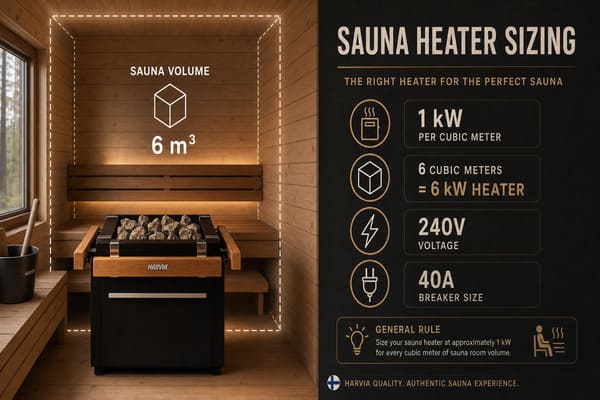
To size a sauna heater, use the rule of 1 kW per 1 m³ of room volume (or about 1 kW per 35 ft³). Then add "computational volume" for glass, stone, and outdoor exposure. Then choose the heater whose published room-volume range contains the result.
One wrong number on a quote can cost a dealer the client. This guide gives you a method you can use today. It covers the base formula, the hidden adjustments, and the rules for commercial jobs that most guides skip.
How Do You Calculate Sauna Heater Power From Room Size?
Guessing the power leads to slow heat and bad steam. Your client blames you, not the room. Start with a simple number instead.
Measure length × width × height to get the volume in m³. Match about 1 kW to each 1 m³. For a 6 m³ home sauna, you need a 6 kW heater on a 240V, 40A circuit.
The Quick Reference Table
Here is a base chart for well-insulated indoor rooms.
| Room Volume | Typical Use | Suggested Power | Circuit (North America) |
|---|---|---|---|
| ≤ 3 m³ | 1-2 person cabin | 3.0 kW | 240V / 20A |
| 3–6 m³ | Home standard | 4.5–6.0 kW | 240V / 30–40A |
| 6–9 m³ | Family sauna | 6.0–8.0 kW | 240V / 40–50A |
| 8–14 m³ | Large / light commercial | 9.0 kW | 240V / 60A |
| 10–18 m³ | Spa / club | 10.5 kW+ | Three-phase |
One rule matters most: the room's computational volume must sit inside the heater's published range. Between two models, prefer the one whose range sits comfortably around your room, and never pick a heater whose minimum room volume is larger than the room. This single habit stops most warranty claims before they start.
Room Size and Headcount Chart
Use a size chart to match volume with power. This one adds typical room dimensions and headcount for 220V/380V markets.
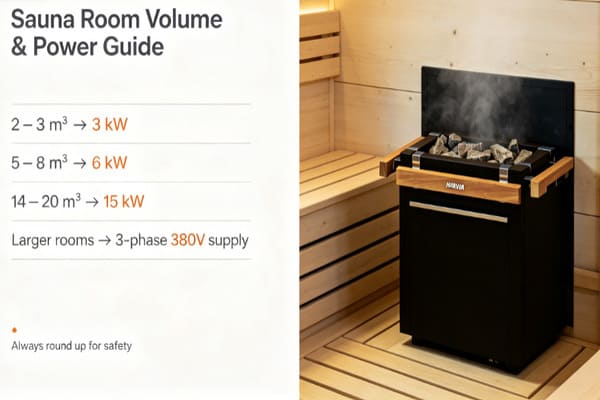
| Room Volume | Power | Room Size | People | Power Supply |
|---|---|---|---|---|
| 2–3 m³ | 3 kW | 1.2×1.2×2.0m | 1 | 220V single |
| 3–4.5 m³ | 4.5 kW | 1.5×1.5×2.0m | 1–2 | 220V single |
| 5–8 m³ | 6 kW | 1.8×1.8×2.1m | 2–3 | 220V/380V |
| 7–12 m³ | 8–9 kW | 2.0×2.0×2.1m | 3–4 | 380V three |
| 10–15 m³ | 10.5–12 kW | 2.5×2.4×2.2m | 4–6 | 380V three |
| 14–20 m³ | 15 kW | 3.0×2.5×2.3m | 6–8 | 380V three |
| 18–30 m³ | 18–24 kW | Commercial | 8+ | 380V three |
Brands mark volume in different ways. Check the maker's manual before you buy. Many units over 6 kW need a three-phase supply; check each model's published voltage options and confirm your wiring first.
Why Do Glass and Stone Ruin Your Calculation?
You measured the room right, yet it still runs cold. The problem is heat loss. Glass and stone drink your power away.
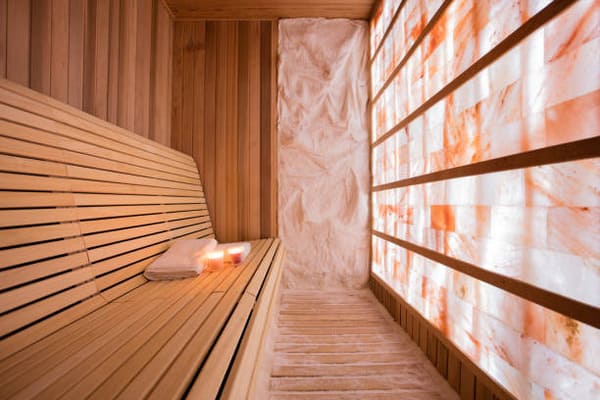
Glass, stone, and concrete pull heat out of the room. Add "computational volume" for each: about 1.2 m³ per m² of glass or bare stone/concrete wall (the Harvia rule of thumb).
A Real Example
Take a 2m × 2m × 2m room. That is 8 m³. Now add a 4 m² double-glass wall. The glass adds 4 × 0.75 = 3 m³. Your computational volume is therefore 11 m³. Check that volume against the chosen heater’s approved room-size range. The Harvia sauna calculator can help you account for the room’s construction.
This is where 90% of sizing errors happen. People trust the physical box and ignore the material. If you sell modern saunas with full glass doors, print a "suggested heater" line right on the product page. Do not let the end client size down on their own. Log walls and thick timber act the same way, since they store and lose heat. Treat them as extra volume too.
Adjust for Real Conditions
The formula assumes good insulation. If not, add "computational volume":
| Condition | Adjustment |
|---|---|
| Glass door / glass wall | Add about 1.2 m³ per 1 m² glass |
| Bare brick / stone / tile | Add 1–1.2 m³ per 1 m² |
| Ceiling over 2.3m | Move up one power level |
| Single-layer wood, no insulation | Multiply total volume × 1.5 |
What Common Mistakes Should You Avoid?
Buyers repeat the same errors. These errors waste money and ruin the sauna feel. I want you to skip them all.
The top mistakes: judging by floor area not volume, buying too small to "save power," going too big, and forgetting sauna stone weight. Glass heat loss and power supply limits are covered in the sections above and below.

The Errors Explained
Only floor area, not volume. Ceiling height matters a lot. A 2.0m and 2.4m ceiling differ by 20% in volume. Keep height near 1.9–2.1m.
Buying too small to save power. A weak heater runs full blast for a long time. It uses more power, not less. The stones never heat through.
Going too big. Too much power spikes heat and trips the thermostat. You feel dry heat, not deep heat. Stones cannot store enough warmth.
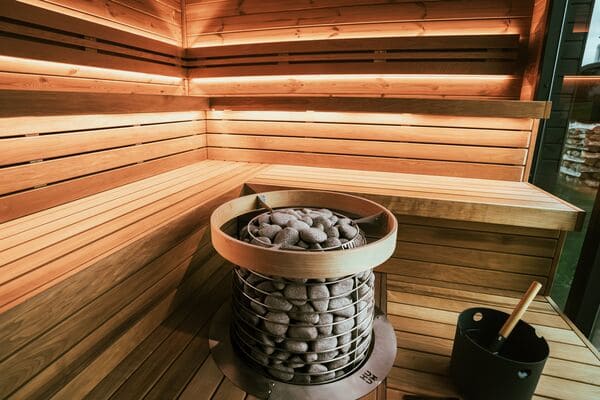
Forgetting stone weight. Match stones to power. Stone load varies by model, from about 20 kg in compact wall heaters to 80 kg in a Harvia Cilindro PC70, so load what the manual specifies.
What Do B2B Buyers Miss About Voltage and Commercial Use?
A home heater in a gym looks like a smart saving. It is a trap. The element burns out in months and the warranty gets denied.
Home heaters have a forced cool-down limit for safety. Commercial heaters run all day with tougher elements and longer warranties. Never install a home unit in a hotel or gym.
Voltage, Phase, and Runtime
The kW number is universal. However, the power supply varies. Europe uses 230V single-phase or 400V three-phase. North America uses 240V split-phase. Any heater above 4.5 kW needs a licensed electrician and a dedicated circuit. Units above 9 kW often need three-phase power. For North America, always print the breaker and wire size on the page, since that is the most asked question.
For commercial jobs, ask the client three things first. Start with daily operating hours. Next, check peak occupancy. Finally, ask how often guests open the door. High traffic and frequent door use both drain heat fast. In those cases, choose a heater whose published range has headroom above the room volume, rather than one at its limit. This protects the client and protects your reputation.
Conclusion
Size by computational volume, not just the box. Add for glass, stone, ceiling height, and outdoor exposure. Match the heater to real use. When in doubt, check that the room sits inside the heater's published range.