A traditional sauna and a steam room are familiar features in hotels and wellness centres. But what if a spa operator wants to offer something different without rebuilding the entire facility?
The question is becoming more relevant as luxury hotels expand their thermal wellness offerings.
In October 2026, Waldorf Astoria Kuala Lumpur introduced a 2,275-square-metre wellness sanctuary across two floors. Its facilities include mineral salt saunas, herbal steam rooms, vitality pools, an Oriental Hammam and multisensory showers, according to Hilton's official announcement.
For hotel and spa developers, the interesting question is not how many facilities a luxury property can offer. It is how these different experiences are designed, equipped and maintained.
Can an existing sauna become a salt sauna? Can a standard steam room be upgraded with herbal aromas? And when does an upgrade require a completely different room?
This guide compares the technologies, equipment requirements, renovation options and purchasing costs involved in adding a salt sauna or herbal steam room to a commercial spa.
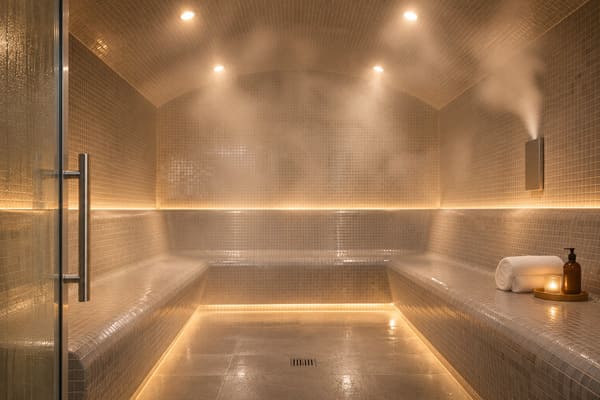
1. Salt Sauna vs. Herbal Steam Room: What Actually Changes?
Before requesting equipment quotations, it is important to clarify the experience being offered.
The terms salt sauna, salt therapy sauna and herbal steam room are sometimes used loosely, even though they can involve substantially different equipment.
Traditional Sauna vs. Salt Sauna
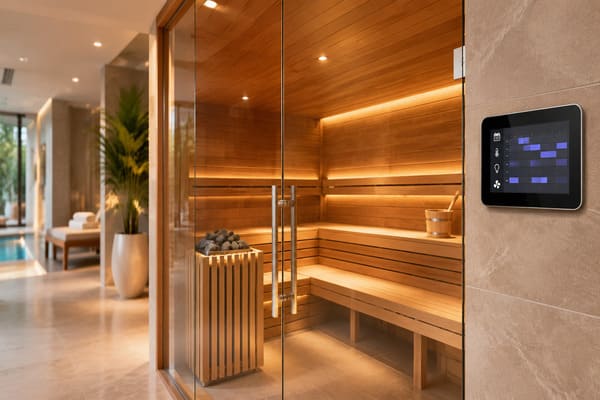
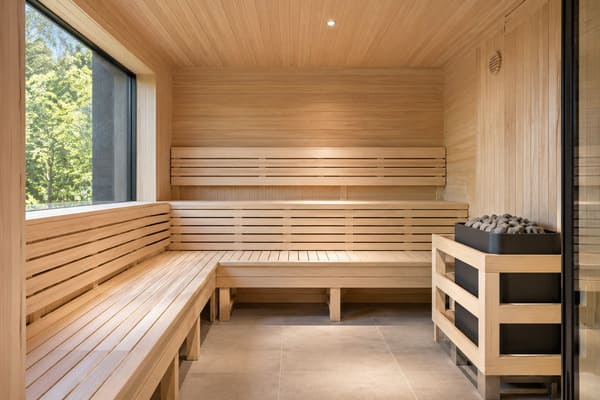
A traditional Finnish-style sauna uses a heater and sauna stones to create a high-temperature environment. Water may be poured over suitable stones to produce short bursts of steam.
A salt sauna can mean two different things:
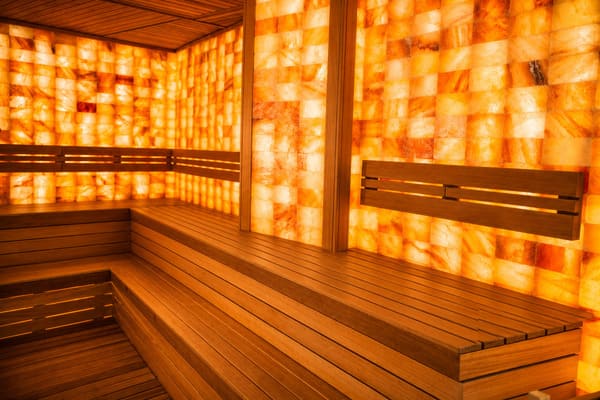
Salt-wall sauna: A conventional sauna incorporating mineral salt bricks, salt panels or decorative salt features.
Active salt-aerosol sauna: A sauna incorporating a manufacturer-approved system that generates and disperses fine dry salt particles.
These are not equivalent.
Salt walls primarily add a distinctive visual environment. They do not automatically provide the controlled airborne salt aerosol used in active halotherapy.
Active salt-aerosol systems require additional equipment and a compatible operating environment.
Traditional Steam Room vs. Herbal Steam Room
A traditional steam room uses a steam generator to supply warm, humid air to an enclosed space.
A herbal steam room introduces an additional sensory element, commonly through a controlled fragrance or botanical aroma system.
Depending on the selected technology, this may involve:
- A compatible fragrance dosing pump.
- Steam-system-approved aroma concentrates.
- A dedicated botanical infusion system designed for steam use.
- Controls for fragrance intensity and operating periods.
These methods are not interchangeable. A steam room that uses eucalyptus fragrance is not necessarily equipped with a system that extracts aromas directly from fresh herbs.
Quick Comparison
| Facility | Main equipment | Room environment | Key purchasing consideration |
|---|---|---|---|
| Traditional sauna | Sauna heater, stones and controls | High-temperature, relatively dry | Heater capacity and ventilation |
| Salt-wall sauna | Traditional heater plus salt panels | Similar to a conventional sauna | Salt material suitability and installation |
| Active salt-aerosol sauna | Compatible heater and salt aerosol generator | Must meet both manufacturers' requirements | Aerosol delivery, humidity and corrosion |
| Traditional steam room | Steam generator and controls | Warm, highly humid | Waterproofing, drainage and generator sizing |
| Herbal steam room | Steam generator plus compatible aroma system | Warm, highly humid | Fragrance dosing, hygiene and maintenance |
The first purchasing decision is therefore not which product to buy, but which experience the spa actually wants to provide.
This matters especially when reviewing projects such as Waldorf Astoria Kuala Lumpur. Hilton identifies mineral salt saunas among its facilities but does not publicly specify whether those rooms use decorative salt walls, active salt-aerosol equipment or a combination of both.
2. Can You Convert an Existing Sauna into a Salt Sauna?
For a commercial spa that already operates a traditional sauna, there are two main upgrade approaches.
They differ considerably in cost, equipment requirements and installation complexity.
Option A: Add Salt Walls or Decorative Salt Panels
This is the more straightforward concept.
The existing sauna heater and control system may remain in place, while selected wall areas receive suitable mineral salt panels or bricks.
The result is a visually distinctive sauna that can be marketed as a salt-themed thermal experience.
However, adding salt material is not simply an interior decoration decision.
Before installation, the contractor should assess several factors.
Heat compatibility
Salt panels, mounting systems, adhesives and any backlighting must be suitable for the sauna's expected operating temperature.
Ordinary decorative wall products should not be assumed suitable for sauna conditions.
Moisture exposure
Even comparatively dry saunas experience humidity fluctuations, condensation and cleaning moisture.
Salt can be affected by moisture, so the construction method needs to account for the material's behaviour over time.
Structural support
Salt bricks add weight. Wall framing and support systems must be capable of carrying the proposed installation.
The contractor should also ensure that panels are securely fixed and accessible for inspection where necessary.
Heater clearances
Salt walls must not interfere with the heater's required safety distances, ventilation arrangements or temperature sensors.
Cleaning and replacement
Ask how damaged salt panels will be replaced and whether the surrounding materials can tolerate the required cleaning procedures.
A decorative salt-wall conversion may be relatively simple compared with a new room, but its feasibility depends on the existing construction.
Option B: Install an Active Salt-Aerosol System
An active halotherapy installation is a different technical project.
Instead of relying on decorative salt surfaces, the system uses a salt aerosol generator, often called a halogenerator, to introduce fine dry salt particles into the room.
This creates additional requirements.
For example, KLAFS describes its Microsalt technology as a system that produces fine dry salt aerosol. Its product range includes configurations for dedicated rooms and a device intended for use in compatible sauna or infrared environments.
However, not every halogenerator is suitable for use inside a heated sauna.
Some salt equipment is designed for lower-temperature, low-humidity treatment rooms.
Other systems may be engineered specifically for heated environments.
Before adding one to an existing sauna, ask the supplier to confirm:
- Operating temperature: Can the device function at the sauna's intended temperature?
- Humidity tolerance: What humidity conditions are permitted?
- Room capacity: What room volume can the system serve effectively?
- Corrosion protection: Which electrical and metal components need protection?
- Installation position: Can the device be installed inside the room, or must it be located outside?
- Maintenance: How are salt residue and equipment components cleaned?
Corrosion is particularly important.
Halotherapy Solutions warns that adding an ordinary halogenerator to an existing sauna can expose electrical components to corrosive salt particles. Its own sauna-specific system is designed around this challenge.
This does not mean every existing sauna is unsuitable for conversion.
It means that compatibility must be demonstrated for the specific heater, room construction and salt system, rather than assumed from the word "halotherapy."
For operators planning a new installation, a dedicated dry salt room may sometimes be more practical than modifying an existing high-temperature sauna.
3. How to Upgrade an Existing Steam Room into a Herbal Steam Room
For a hotel or spa that already has a functioning steam room, adding an aroma experience may be less construction-intensive than installing active salt-aerosol technology.
The important condition is that the existing steam system and enclosure are suitable.
Start by Checking the Existing Steam Generator
The steam generator remains responsible for producing steam.
Adding fragrance does not normally require a higher-output generator merely because the room now offers herbal aromas.
Before deciding whether to keep the existing unit, confirm:
- Steam generator model and rated output.
- Room volume and existing construction.
- Compatibility with a fragrance dosing accessory.
- Available control functions.
- Steam pipe configuration and service access.
- Water quality and maintenance condition.
If the existing generator already provides adequate steam and supports an approved dosing system, replacing the entire generator may be unnecessary.
If it is undersized, approaching the end of its service life or incompatible with the proposed aroma equipment, a larger upgrade may be appropriate.
Add a Compatible Fragrance Dosing System
Many commercial steam systems can use a fragrance pump.
The pump delivers a controlled quantity of compatible fragrance into the steam delivery system.
According to Harvia's steam room construction guidance, the fragrance pipe should connect to the steam pipe using manufacturer-approved components, with the connection positioned near the steam outlet.
A typical compatible package may include:
| Component | Purpose |
|---|---|
| Steam generator | Produces steam for the existing room |
| Fragrance dosing pump | Delivers a controlled quantity of aroma concentrate |
| Fragrance container | Stores the approved concentrate |
| Injection connection | Introduces fragrance into the approved steam-line position |
| Control interface | Manages permitted operating functions and, where supported, dosing |
| Service access | Allows refilling, cleaning and maintenance |
For a hotel wishing to introduce eucalyptus or another botanical-inspired scent, this type of system may provide a practical route.
However, the operator should use only fragrance products approved for the chosen equipment and intended exposure conditions.
Do not pour essential oils, herbal mixtures or loose plant material directly into the steam generator's water tank unless the manufacturer explicitly permits that method.
Improvised additives can create problems with deposits, components and maintenance.
A genuine botanical infusion system, where actual herbs are processed through dedicated equipment, should be specified separately rather than assumed to be part of an ordinary fragrance pump.
Don't Ignore Maintenance and Guest Sensitivities
Adding aroma introduces consumables and operational responsibilities.
Staff will need to monitor concentrate levels, clean or replace appropriate components and follow the manufacturer's dosing instructions.
Aroma intensity also needs careful management in a shared commercial facility. Some guests may be sensitive to particular fragrances.
Providing clear information about the aromas used, and avoiding excessive dosing, can make the experience more practical for a wider range of visitors.
4. When Does the Room Itself Need to Change?
Adding a new sensory experience does not always mean constructing a new room.
However, existing room conditions determine how much can realistically be reused.
This is particularly important when comparing salt-aerosol systems with herbal steam rooms.
Salt-Aerosol Systems Need a Compatible Dry Environment
Dry salt-aerosol equipment is sensitive to environmental conditions.
The supplier should evaluate room humidity, air circulation, temperature and the exposure of electrical components to salt particles.
Depending on the equipment, this can require:
- Humidity management.
- Suitable ventilation and airflow.
- Salt-resistant fixtures and components.
- Accessible equipment positions.
- Cleaning procedures for deposited particles.
- Measures to prevent moisture from entering sensitive equipment.
The exact allowable humidity or temperature must come from the selected device's technical specifications.
Do not apply the limits from one manufacturer's halogenerator to all salt systems.
Herbal Steam Rooms Need Continuous Moisture Protection
A steam room is fundamentally different from a relatively dry sauna.
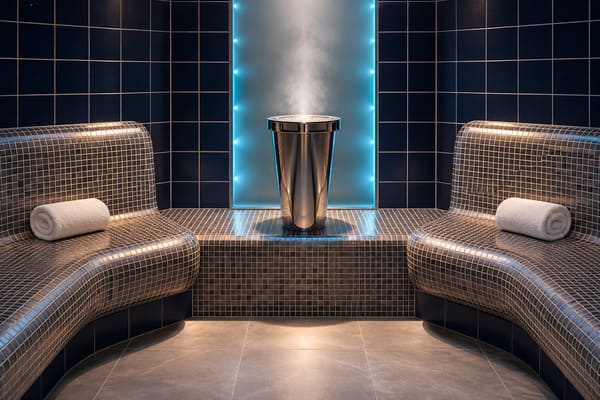
Its walls, ceiling, seating and penetrations must withstand prolonged exposure to warm moisture.
For new commercial steam rooms, Harvia's construction guidance recommends fully waterproofed interiors, suitable non-organic materials, proper drainage and mechanical ventilation.
It also specifies sloped or curved ceilings to manage condensation and describes epoxy-based grout requirements for public steam rooms using its recommended construction approach.
These requirements affect more than appearance.
Poorly designed steam rooms can experience water leakage, persistent condensation and deterioration of unsuitable finishes.
Important areas to examine include:
Floor and drainage: The room must have a suitable drainage arrangement, including appropriate slopes.
Ceiling: Condensed water should be directed away from bathers rather than dripping directly from overhead surfaces.
Walls and seating: Materials must tolerate prolonged moisture exposure and repeated cleaning.
Steam generator location: The generator should be installed in a suitable service location outside the steam room, with the drainage and ventilation required by the manufacturer.
Steam delivery: Pipe routing, insulation and outlet position must comply with the selected system's instructions.
For a genuine existing steam room that has already been designed and commissioned correctly, these structures may not need replacing simply to add fragrance.
For a normal dry sauna, however, introducing continuous steam would generally require a substantially different enclosure.
Can One Room Provide Both Experiences?
It is tempting to ask whether a hotel can install a salt aerosol generator and a steam generator in the same room, then alternate between salt therapy and herbal steam.
This should not be treated as a straightforward equipment combination.
Dry salt-aerosol systems and high-humidity steam rooms have different environmental requirements.
Moisture can affect dry salt particles and equipment, while salt exposure may create additional corrosion and maintenance concerns.
Unless a manufacturer explicitly approves and documents an integrated system for both operating conditions, separate rooms are the more practical starting point for project planning.
For facilities designing a complete thermal area, our Hotel Spa Design Guide explains how to coordinate different rooms, guest circulation and supporting spaces.
5. Which Upgrade Makes the Most Sense for Your Existing Spa?
The right approach depends on what the operator already owns and what it wants to achieve.
Consider three illustrative renovation situations.
Scenario A: A Hotel Has One Traditional Sauna
Goal: Create a more distinctive sauna experience without adding another room.
A salt-wall conversion may be worth evaluating first.
The project could retain the existing heater and controls while adding suitable salt finishes.
However, the supplier must still review the room's structure, temperature conditions, heater clearances and maintenance requirements.
If the hotel wants active airborne salt aerosol rather than decorative salt features, the scope changes.
It must assess a compatible halogenerator system and the effects of salt exposure on the installation.
Purchasing lesson: Confirm whether the hotel wants salt-themed design or active salt aerosol before comparing quotations.
Scenario B: A Commercial Spa Already Has a Steam Room
Goal: Introduce eucalyptus or other herbal-inspired steam experiences.
The first step is to check the existing generator and control system.
If compatible, an approved aroma pump, fragrance container and injection connection may be sufficient to add the new feature.
The main costs could relate to accessories, installation, consumables and servicing rather than replacing the entire room.
If the generator cannot support the proposed accessories, the supplier should assess a replacement package.
Purchasing lesson: Check compatibility before ordering another steam generator.
Scenario C: A New Wellness Centre Wants Both Features
Goal: Offer an active salt-aerosol experience and herbal steam as separate services.
A dedicated layout may be preferable.
The salt room or compatible salt sauna can be designed around its equipment and environmental requirements.
The herbal steam room can be designed around waterproof construction, drainage and an appropriately sized steam system.
This creates greater upfront construction scope but allows each room to operate under conditions suited to its technology.
Purchasing lesson: Two purpose-designed rooms may be easier to operate and maintain than forcing incompatible technologies into one enclosure.
6. What Equipment and Costs Should Buyers Include?
One of the most common procurement mistakes is comparing the price of an accessory with the cost of a complete facility upgrade.
A fragrance pump quotation and a new herbal steam room quotation are not equivalent.
Neither are a set of decorative salt panels and an active commercial salt-aerosol installation.
Equipment and Construction Budget
| Budget category | Salt sauna project | Herbal steam room project |
|---|---|---|
| Main equipment | Existing heater or compatible sauna system; halogenerator if required | Existing or new steam generator |
| Added components | Salt panels, mounting materials or aerosol equipment | Aroma pump, approved concentrate and fittings |
| Control system | Heater and aerosol-system controls as applicable | Steam and fragrance controls |
| Room construction | Salt wall supports, surface compatibility and finishes | Waterproofing, ceiling, seating and drainage if required |
| Building services | Ventilation, electrical suitability and environmental controls | Water supply, electrical connection, steam pipe and drainage |
| Installation | Mounting, equipment integration and testing | Pump installation, pipe connection and testing |
| Consumables | Approved salt and replacement parts | Fragrance concentrate and service components |
| Maintenance | Salt residue cleaning and corrosion inspection | Descaling, dosing-system cleaning and hygiene |
This table separates the main work packages, but does not imply that every project needs every item.
Compare Three Levels of Investment
Level 1: Accessory or finish upgrade
Examples include a compatible fragrance pump for an existing steam room or suitable decorative salt panels for an existing sauna.
The original heating equipment may remain in service.
Level 2: Equipment integration upgrade
Examples include adding a compatible salt-aerosol system or replacing an incompatible steam generator to support the planned functions.
Additional controls, installation work and service arrangements may be required.
Level 3: Complete room construction
This includes a new enclosure, mechanical and electrical connections, finishes, controls, installation and commissioning.
It generally involves a wider project scope than a straightforward accessory upgrade.
These are scope categories, not fixed price bands. A difficult retrofit can sometimes cost more than a straightforward new installation.
Don't Forget Operating Costs
The initial purchase is only part of the financial picture.
A commercial facility also needs to consider:
- Electricity consumption during scheduled operating hours.
- Water use and treatment for steam generators.
- Fragrance or salt consumables.
- Cleaning and staff time.
- Equipment servicing and replacement parts.
- Potential downtime if a system becomes unavailable.
For example, a busy commercial steam room with aroma dosing may require regular concentrate refills and generator maintenance.
An active salt-aerosol installation may need scheduled cleaning and inspection of components exposed to salt particles.
These are different operating expenses and should appear separately in the budget.
For broader commercial sauna budgeting, see our Commercial Sauna Cost Guide.
7. What to Confirm Before Requesting a Supplier Quotation
A supplier can provide a more useful proposal when it understands the existing room and the intended upgrade.
Instead of asking only for a "salt sauna price" or "herbal steam room price," prepare a short project brief.
Existing Room Information
- Interior dimensions and ceiling height.
- Existing room type and construction materials.
- Heater or steam generator model and power rating.
- Electrical supply, including voltage and phase.
- Existing water supply and drainage arrangements.
- Ventilation and moisture conditions.
- Available technical and maintenance space.
Intended New Experience
For a salt sauna, specify whether the requirement is:
- Decorative mineral salt walls.
- Active dry salt aerosol.
- A complete salt sauna with both features.
For a herbal steam room, clarify whether the requirement is:
- A compatible fragrance dosing system.
- A dedicated botanical infusion system.
- A completely new steam room.
Commercial Operating Requirements
The supplier should also understand:
- Expected number of guests.
- Daily operating hours.
- Private, booked or shared use.
- Cleaning and maintenance arrangements.
- Destination country and applicable local requirements.
- Whether the project involves renovation or new construction.
What Should the Quotation Include?
Request a breakdown separating equipment from construction and installation.
At minimum, ask the supplier to confirm:
| Quotation item | Required information |
|---|---|
| Equipment | Exact models, quantities and rated capacities |
| Compatibility | Written confirmation for existing equipment and room conditions |
| Accessories | Included controls, pumps, sensors, fittings and consumables |
| Installation | Scope of supplier work versus local contractor work |
| Technical documents | Manuals, installation requirements and relevant certifications |
| Commissioning | Testing requirements and responsibility for final approval |
| Maintenance | Cleaning instructions, servicing needs and replacement parts |
| Delivery | Packaging, shipping terms and expected supply schedule |
For active salt-aerosol systems, request documented operating-temperature and humidity limits, permitted installation arrangements and corrosion-related guidance.
For herbal steam systems, request the approved dosing configuration, fragrance specifications and steam-generator compatibility.
These details make it easier to identify missing items and compare suppliers on an equivalent basis.
Frequently Asked Questions
Can I Turn a Regular Sauna into a Salt Sauna?
Potentially, yes.
Adding suitable decorative salt panels may be possible after reviewing the room structure, temperature and heater clearances.
Adding active salt aerosol requires further assessment of the selected halogenerator, its operating conditions and its compatibility with the sauna.
The two upgrades should not be treated as the same project.
Do Himalayan Salt Walls Provide the Same Experience as a Halogenerator?
No.
Salt walls can create a distinctive visual environment, but they do not automatically generate the controlled airborne salt particles produced by an active halogenerator.
Buyers should clarify what technology is actually included when a supplier advertises a salt sauna.
Can I Add an Aroma System Without Replacing My Steam Generator?
In some cases, yes.
If the existing steam generator supports an approved fragrance pump and is suitable for the room's operating requirements, additional aroma equipment may be sufficient.
Confirm the exact model and accessory compatibility before purchasing.
Can I Put Essential Oils Directly into a Steam Generator?
Not unless the manufacturer's instructions explicitly permit it.
Commercial fragrance systems commonly use approved dosing equipment and compatible concentrates.
Adding unapproved substances directly to the generator can create equipment and maintenance problems.
Is an Herbal Steam Room More Expensive Than a Traditional Steam Room?
Not necessarily.
For an existing compatible steam room, the main additional purchases may be aroma equipment, installation components and consumables.
For a completely new herbal steam room, the project must also budget for the steam generator, enclosure, waterproofing, drainage and other construction requirements.
Can One Room Function as Both a Salt-Aerosol Sauna and a Herbal Steam Room?
Do not assume it can.
The environmental requirements of dry salt aerosol and high-humidity steam are different.
A combined installation should only be considered where the equipment manufacturers and qualified project designers have approved the specific system and operating conditions.
Does Salt Therapy Have Proven Medical Benefits?
Salt therapy is promoted for various wellness purposes, but many medical claims still lack strong supporting evidence.
Cleveland Clinic's review notes the limitations of existing research and cautions against treating salt therapy as a replacement for medical care.
Commercial operators should distinguish the sensory experience from unsupported treatment claims.
Conclusion: Expand Your Spa Experience Without Buying the Wrong Equipment
Adding a salt sauna or herbal steam room can help a commercial spa diversify its thermal wellness offering.
However, the most cost-effective upgrade is not automatically the one with the fewest new components.
A decorative salt-wall sauna, an active salt-aerosol system and a herbal steam room use different technologies.
Their room requirements, installation methods and maintenance needs are also different.
For existing facilities, start with what can safely be retained. For new projects, design the room around the intended technology rather than selecting accessories first.
ROC Sauna-Solution works with hotel developers, commercial spa operators and project contractors on sauna and steam equipment sourcing.
We can help review existing heater or steam generator specifications, discuss compatible Harvia and ROC equipment options, and identify the information needed for a complete project quotation.
If you are planning to upgrade an existing sauna or steam room, share your room dimensions, equipment details, drawings and intended new functions.
Contact ROC Sauna-Solution to discuss your commercial sauna or steam room project.
References
-
Hilton. Waldorf Astoria Kuala Lumpur Introduces an Integrated Urban Wellness Sanctuary. October 4, 2026. Official project information covering the hotel's mineral salt saunas, herbal steam rooms and other wellness facilities.
-
Harvia. How to Build a Steam Room. Technical guidance on steam generators, fragrance pumps, water quality, room construction, waterproofing and ventilation.
-
Cleveland Clinic. Could Salt Therapy Improve Your Health?. April 21, 2025. Review of salt therapy types and the limitations of available medical evidence.