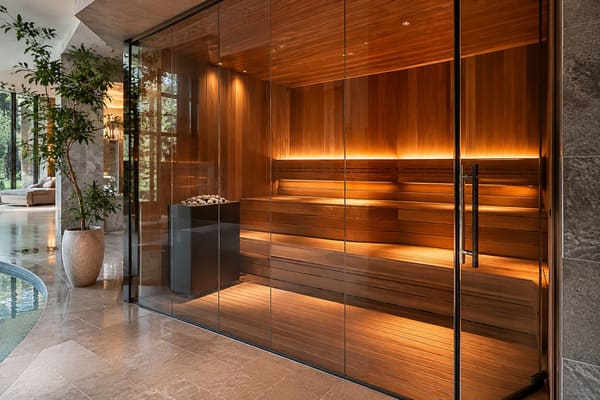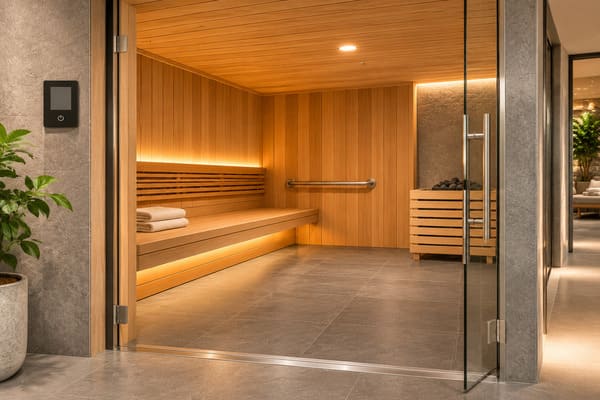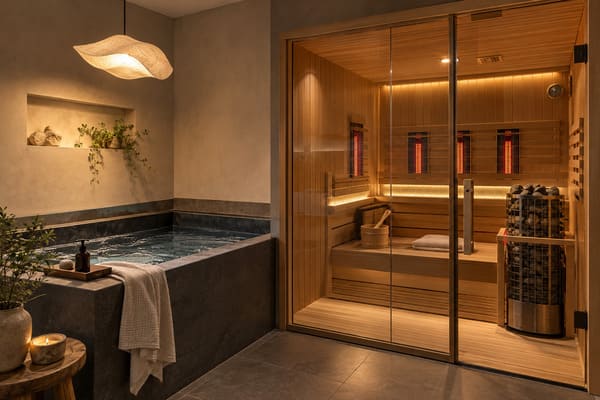
Commercial sauna commissioning is the final check between installation and opening to guests. The room may look finished, yet the team still needs to confirm that the heater, controls and ventilation work together.
For hotels, spas and gyms, this step also establishes who operates the sauna, who handles faults and which records the owner receives.
A useful commissioning checklist covers equipment checks, a documented trial run, staff training and the handover pack. Use it alongside the exact product manuals, approved project design and locally required inspections. Qualified installers should carry out electrical and safety tests.
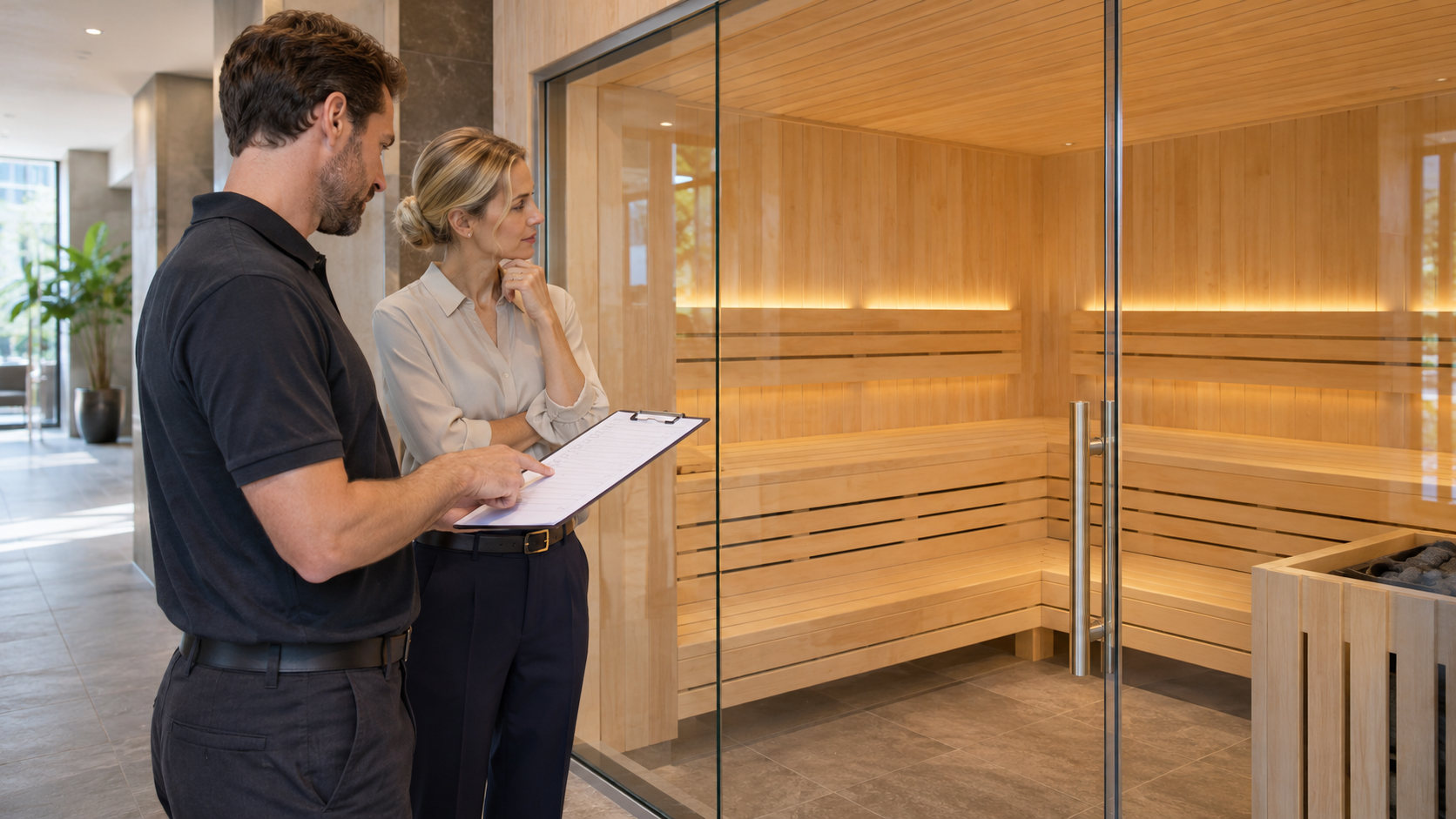
Agree on the Commercial Sauna Commissioning Scope
First, separate the checks that happen at the factory from those that happen on site.
A pre-shipment inspection checks the goods before dispatch. Site commissioning checks the equipment after installation, with the building's actual power supply, ventilation and controls.
Before booking the trial run, agree on:
- Who leads the inspection and records the results.
- Which installer checks electrical work and safety functions.
- Which hotel or spa representative accepts the handover.
- What counts as a pass, and who closes any outstanding issues.
Also confirm the operating brief: opening hours, target conditions, guest access and staff responsibilities. For earlier design decisions, use our Commercial Sauna Installation Guide.
Check the Installed Room Before Heating
Next, compare the finished installation with the approved equipment list and drawings. A matching kW rating alone does not prove that the whole system is correct.
Use this commercial sauna commissioning checklist as a starting record:
| Check | What the team should verify | Record to keep |
|---|---|---|
| Equipment | Heater, controller, power unit and sensors match the agreed models | Model list and serial-number photos |
| Electrical installation | Supply and protective arrangements match the selected equipment and local requirements | Installer's test results and required certificates |
| Heater and stones | Clearances, guard, stone type, quantity and loading follow the heater manual | Inspection notes and photos |
| Sensors and ventilation | Sensor position and airflow match the approved design and product instructions | Location photos and ventilation checks |
| Room finish | Benches, door, lighting and maintenance access are complete | Room inspection checklist |
| Controls and safety | Operating limits and applicable safety functions work as specified | Installer's functional test record |
| Handover | Manuals, training, service contacts and outstanding items are documented | Signed handover record |
Sensor placement deserves particular attention. Harvia explains that supply air can cool a nearby sensor and distort its temperature reading. Therefore, the installer must check the model-specific position, rather than copy another sauna's layout.¹
Likewise, stones must suit the heater. Harvia notes that tightly packed or broken stones can restrict airflow. Confirm the specified loading before the first run.²
Record the First Trial Run
Once the installer has completed the pre-start checks, follow the manufacturer's first-heating procedure.
Harvia advises good ventilation during initial heating because manufacturing residues can cause odours.³ Schedule this work before guest use. If the team finds unexpected faults or persistent abnormal smells, stop and investigate before proceeding.
For the trial, record:
- Date, heater model and starting room temperature.
- Controller setpoint and ventilation operating mode.
- Time taken to reach the agreed operating condition.
- Temperature readings, including where each reading was taken.
- Any fault messages and the corrective action.
For example, a hotel can record the warm-up time from a cold start and use it to plan the morning schedule. However, one successful run does not prove performance under peak guest traffic. Agree on further checks where the operating brief requires them.
Avoid using a universal “ready in 30 minutes” rule. Room construction, glazing, ventilation and equipment all affect the result.
Test Staff Controls and Remote Functions
Next, demonstrate the controls that staff will actually use: start, stop, timer, temperature limits and any approved scheduling functions.
If remote start forms part of the project, confirm its safety arrangement for the exact heater and control system. Harvia distinguishes between home-use door switches and safety devices intended for public saunas.⁴ A working phone app alone is not an acceptance test.
Ask the installer to demonstrate the specified safety checks using the manufacturer's procedure. Never bypass a sensor or protective device to obtain a passing result.
Our hotel sauna control guide explains how guest access and staff control differ across hotel settings.
Complete the Sauna Handover Pack
After the trial run, collect the information the operating team will need next week, not just on opening day.
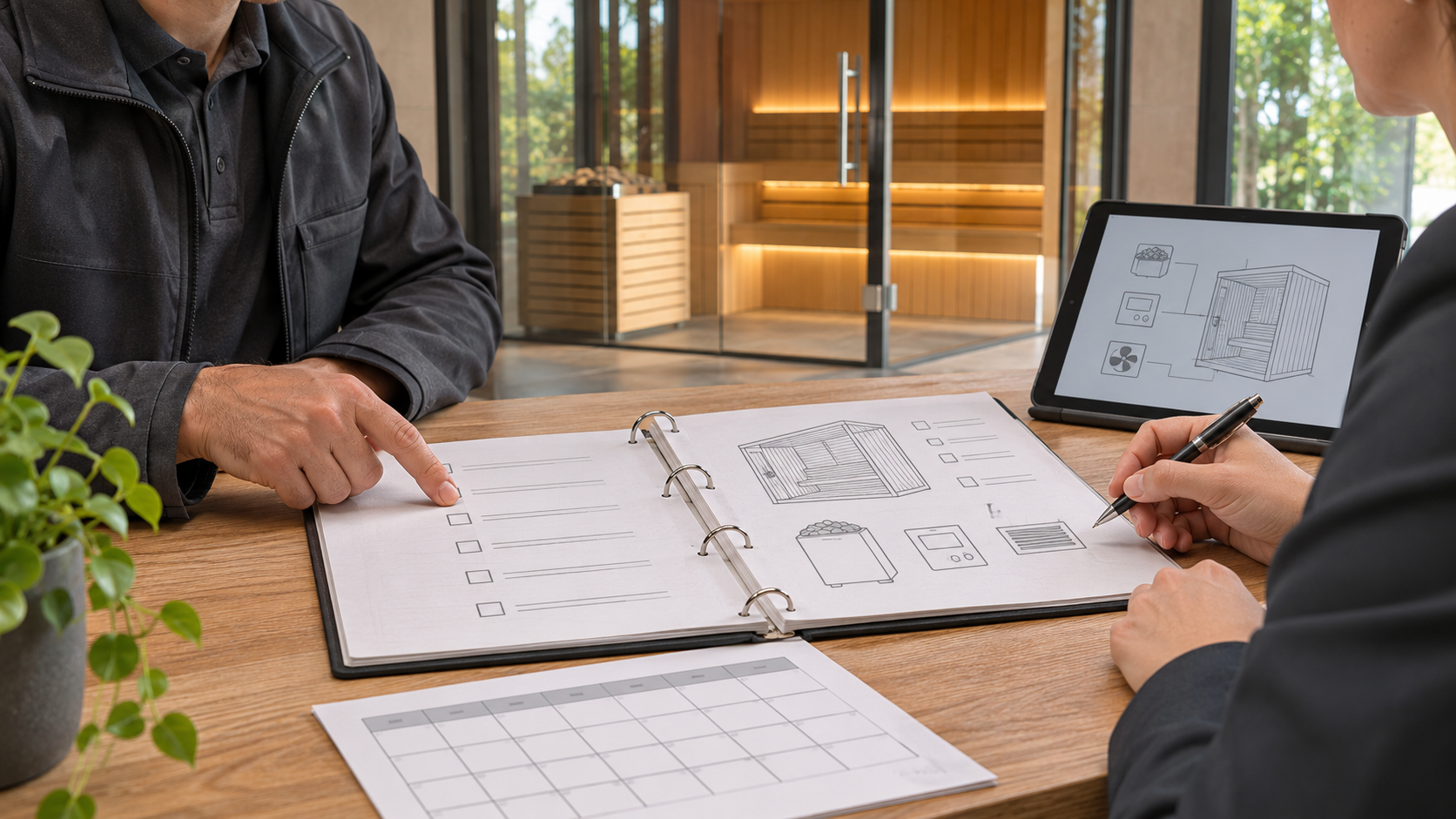
Illustrative concept of equipment records and maintenance documents prepared for handover.
A practical handover pack should contain:
- Final equipment schedule, model numbers and serial numbers.
- Relevant installation, operation and maintenance manuals.
- Electrical records and other required inspection documents.
- Commissioning results and confirmed control settings.
- Warranty terms, service contacts and spare-parts references.
- Staff training record and an initial maintenance schedule.
Also record any remaining defects. Give each item an owner, deadline and closure check. Safety-related faults must be resolved before guest use; cosmetic items should follow the agreed acceptance process.
Finally, train the staff who will open and close the room. They should know how to report a fault, stop operation and contact the responsible service provider. Link the handover pack to your commercial sauna maintenance plan.
Frequently Asked Questions
Is commissioning the same as pre-shipment inspection?
No. Pre-shipment inspection checks the goods before dispatch. Commercial sauna commissioning checks the installed system and prepares the operator to use it. Both stages serve a different purpose.
Who should sign the sauna handover record?
Agree this in the project contract. Typically, the relevant installers document their checks, while the owner's representative records acceptance and outstanding items. Required local inspections remain separate obligations.
What if the sauna heats up but shows a fault?
Reaching the target temperature does not cancel a fault. Record the message, stop the affected operation and ask the responsible installer to investigate. Repeat the relevant checks after correction.
Should we repeat the checks after replacing a heater?
Review the affected system whenever equipment changes. A replacement heater, controller or sensor may need different settings or installation details. Confirm compatibility and follow the new equipment's instructions.
Planning a Commercial Sauna Project?
Include commercial sauna commissioning and handover requirements in your purchasing brief. This helps the supplier and local installer agree on documents, responsibilities and acceptance checks before delivery.
ROC Sauna-Solution can help you discuss heater and control options, equipment scope and the product documentation needed for your project.
Send us your room drawings and equipment requirements. Include the destination country, power supply, daily operating hours and planned opening date so we can discuss a suitable supply package.
References
-
Harvia, Temperature sensor installation. Model-specific positioning and the effect of supply airflow.
-
Harvia, The easy guide to looking after your sauna stones. Stone selection, loading and airflow.
-
Harvia, The heater produces smells. Ventilation during first heating.
-
Harvia, Safety devices for electric heaters. Remote-use safety devices and application differences; check the selected product's instructions.