A hotel installs a sauna in its spa. Then it decides to add another sauna inside a premium guest suite.
Can both rooms use the same heater, controls and maintenance plan?
Not necessarily.
The First Cortina, a five-star hotel scheduled to open in Italy's Dolomites on December 4, 2026, provides an interesting example.
The 76-room property is introducing a REVĪVŌ spa with shared wellness facilities, while its Wellness Suite Terrace View includes a private sauna and steam bath.
The hotel has not disclosed the exact sauna heater models or electrical specifications. But its planned facilities raise a valuable question for hotel developers:
Why should shared hotel spa equipment and private suite equipment be specified differently?
The answer begins with how guests use the space.
1. One Hotel, Two Different Sauna Experiences
The First Cortina is positioning wellness as an important part of its Alpine hospitality experience.
According to the hotel's official wellness information, REVĪVŌ Spa will offer thermal facilities including a traditional hammam, alongside treatments and advanced wellness experiences.
An October 26 report by Sports Management also confirms a sauna, six treatment rooms and an indoor-outdoor swimming pool.
But the hotel is not concentrating every wellness experience in the main spa.
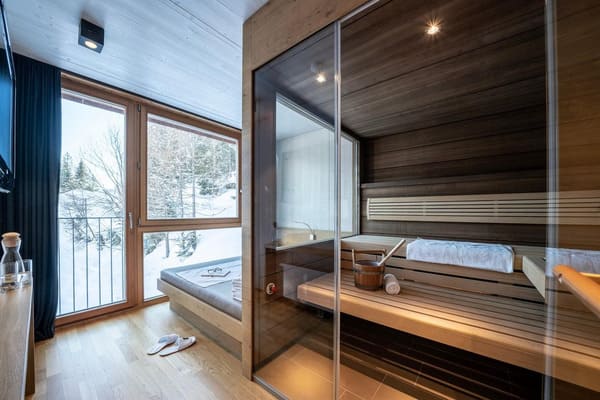
Its Wellness Suite Terrace View is approximately 44 m² and includes a private in-room sauna and steam bath.
These facilities may appear similar on a hotel equipment schedule, but they serve different purposes.
| Project consideration | Shared hotel spa sauna | Private suite sauna |
|---|---|---|
| Primary use | Multiple guests during spa opening hours | Individual suite guests |
| Usage pattern | Potentially frequent or concentrated use | Intermittent, guest-controlled use |
| Main priority | Capacity, durability and operating management | Compact layout, privacy and ease of use |
| Controls | Staff supervision and scheduled operation | Suitable guest controls and safety limits |
| Maintenance impact | Closure may affect a shared facility | A fault may affect the suite's advertised amenities |
This distinction should influence purchasing decisions from the beginning.
A shared spa sauna must be planned around its expected guest flow and operating schedule. A private suite sauna needs to work within a much smaller accommodation setting.
The lesson is not that one installation needs better equipment. Both need equipment suited to their specific use.
2. Why One Heater Specification May Not Fit Both Rooms
Consider the shared spa first.
If the sauna operates for extended periods and accommodates changing groups of guests, buyers must confirm that the heater is suitable for the intended commercial workload.
The selected model should match the room's adjusted volume, required safety clearances and operating hours.
Now consider the private suite.
The priority may be a smaller heater that fits the available space, with controls guests can operate easily and safely. However, the actual sauna dimensions—not the suite's total 44 m²—must determine heater sizing.
Room Volume Matters More Than Guest Count
A glass-fronted sauna may have a different heating requirement from a similarly sized, well-insulated timber room.
According to Harvia's official heater-sizing guidance, each square metre of glass, stone or similar uninsulated surface adds approximately 1.2 m³ to the calculated heating volume.
For example, imagine a sauna with an internal volume of 8 m³ and 2 m² of qualifying glass surface.
Its illustrative adjusted volume would be:
8 + (2 × 1.2) = 10.4 m³
The buyer should compare this value with the manufacturer's rated room-volume range rather than selecting a heater based only on the number of guests.
This is a hypothetical sizing example, not a measurement of The First Cortina.
Commercial Use Also Changes the Equipment Decision
For frequent-use rooms, maintenance access becomes particularly important.
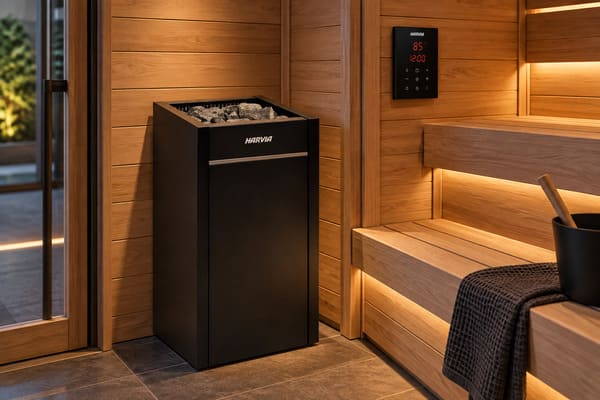
For example, the Harvia Virta heater range offers professional-use options with separate controls.
Harvia's official Virta HL70 specifications describe a front maintenance hatch and heating elements separated from the stones, allowing technicians to access the heating-element module more easily.
These are practical features worth evaluating for commercial operation, although the exact heater must still match the room and project requirements.
For private accommodation, compact dimensions and guest-friendly controls may carry more weight.
The best heater is not automatically the largest or most expensive. It is the one that meets the room's operating and maintenance requirements.
3. What Changes During the Winter Season?
The First Cortina is preparing to welcome guests during the Alpine winter season.
That makes operating reliability an important consideration for its wellness facilities.
However, cold outdoor weather does not automatically mean every indoor sauna needs a more powerful heater.
The correct heater output still depends on the sauna's internal volume, insulation, glazing, ventilation and construction.
What may change is the hotel's operating pattern.
After a day of skiing, guests may prefer to visit the spa during similar afternoon or evening periods. That possibility should be considered when estimating peak demand and planning operating schedules.
For the shared sauna, buyers should discuss:
- Expected daily operating hours and peak usage
- Preheating and temperature-control requirements
- Heating recovery under the intended usage pattern
- Routine stone and heating-element maintenance
- Availability of replacement parts during busy periods
Maintenance planning deserves attention before the first winter season begins.
Harvia's professional heater maintenance guidance explains that repeated heating cycles gradually deteriorate sauna stones. It recommends inspecting and rearranging them at least annually, and more frequently under heavy use.
For a private suite, the operational challenge is different.
A fault may not interrupt the entire spa, but it can affect a room sold with private wellness facilities.
Therefore, the purchasing team should confirm how equipment can be inspected and serviced without unnecessarily disrupting accommodation.
This is where initial price and long-term value begin to diverge.
A lower-priced heater may be suitable, but only if it meets the intended operating requirements and has appropriate warranty, servicing and parts support.
4. What Should Hotel Buyers Include in the Equipment Specification?
Once the shared and private sauna requirements are clear, the next step is preparing separate equipment specifications.
Buying two heaters with similar power ratings does not mean the complete installed systems will be equivalent.
A commercial sauna installation may also require a compatible controller, power unit, sensors, sauna stones and safety components.
Our Commercial Sauna Control Units Guide explains why heater output, voltage and control compatibility should be checked together.
The same principle applies to steam facilities.
The First Cortina's shared hammam and private suite steam bath should not automatically receive identical generator specifications.
Steam equipment must be selected according to enclosure volume, construction, ventilation and intended use.
For comparable projects, buyers can explore our Harvia HGX steam generator range, which includes different outputs for appropriately sized steam enclosures.
These products are examples of options available through Sauna-Solution—not confirmed equipment installed at The First Cortina.
What Belongs in the Quotation?
| Item | What the buyer should confirm |
|---|---|
| Sauna heater | Exact model, power and rated room volume |
| Controller | Compatible panel, sensors and required power unit |
| Sauna stones | Approved type, size and quantity |
| Steam generator | Capacity, compatible controls and service requirements |
| Electrical supply | Voltage, phase and installation responsibility |
| Maintenance | Service access, spare parts and warranty scope |
For hotels, it is often useful to request separate quotations for the shared spa and private-suite installations.
This makes it easier to compare the equipment scope, installation requirements and expected operating costs.
Why Quality Matters More Than the Cheapest Quotation
Imagine two suppliers offering similar sauna heaters.
One provides a lower equipment price. The other includes clearly specified controls, technical documentation and reliable access to replacement parts.
The second quotation may initially appear more expensive, but it could represent a more complete and maintainable system.
That does not automatically make it the better choice. Both proposals must be compared against the same requirements.
For commercial hotels, quality means equipment that is correctly specified, reliably supported and practical to maintain—not simply equipment with a premium price tag.
This is particularly important when several sauna and steam systems must operate within one property.
What Other Hotels Can Learn from The First Cortina
The First Cortina demonstrates why hotel spa equipment should be selected according to the services each space is expected to provide.
Its shared spa and private suite wellness facilities belong to the same hotel, but they create different requirements for capacity, controls, guest access and maintenance.
For other hotel developers and spa procurement teams, three lessons stand out:
1. Separate shared and private equipment briefs. Similar-looking sauna rooms may have very different operating requirements.
2. Plan for actual usage, not assumptions. Winter demand, peak guest flow and room-specific use should inform the equipment specification.
3. Compare the complete system and its lifetime support. Heater price matters, but so do compatibility, maintenance access, documentation and replacement parts.
The practical goal is to create facilities that guests can enjoy consistently and operators can maintain without unnecessary complications.
Conclusion
The First Cortina offers an interesting example of how luxury hotels can combine shared spa experiences with private in-suite wellness facilities.
The purchasing lesson is straightforward: one hotel does not necessarily need one standardized sauna solution for every space.
A better approach is to define how each facility will be used, then select the heater, controls, steam equipment and supporting components accordingly.
When comparing suppliers, long-term reliability and serviceability deserve as much attention as initial price.
Planning a Hotel Sauna or Spa Project?
At Sauna-Solution, we supply Harvia sauna equipment, our own ROC heater range, steam generators, control systems and related accessories for commercial and hospitality projects, subject to model availability and destination requirements.
Whether you are developing a shared hotel spa or adding private saunas to premium suites, share your project drawings, room dimensions, electrical supply and expected operating schedule with our team.
We can help evaluate suitable equipment options and prepare a clearly defined project supply proposal.
Contact Sauna-Solution for a Project Consultation
Frequently Asked Questions
1. Can a hotel use the same sauna heater model in its spa and private suites?
Possibly, but only if the exact model is suitable for both installations. Room volume, glazing, operating hours, required clearances and controls must be checked separately. A model suitable for occasional private use should not automatically be specified for extended shared commercial operation.
They may require different control arrangements. A private suite needs an appropriate, easy-to-use guest interface and suitable safety limits, while a shared spa may require staff supervision, scheduling and centralized operating controls. Final compatibility and permitted functions depend on the exact equipment and local requirements.
3. What should hotel buyers compare beyond sauna heater prices?
Compare the complete equipment package, including the heater, compatible controller, sensors, stones, electrical requirements and installation scope. Also confirm warranty terms, maintenance access, spare-part availability and local servicing responsibilities. These factors influence the long-term cost and reliability of the facility.
Sources
- The Pavilions Hotels & Resorts — The First Cortina
- The Pavilions Hotels & Resorts — Wellness at The First Cortina
- Sports Management — The First Cortina to Open with REVĪVŌ Spa in the Dolomites
- Hospitality Net — The Pavilions Hotels & Resorts Expands with The First Cortina
- Harvia — How to Select the Correct Heater Power
- Harvia — Virta HL70 Electric Sauna Heater
- Harvia — Stacking Sauna Stones into a Professional Electric Heater